Adam Minter: Drag racing is leaving Formula 1 and NASCAR in the dust
Published in Auto Racing
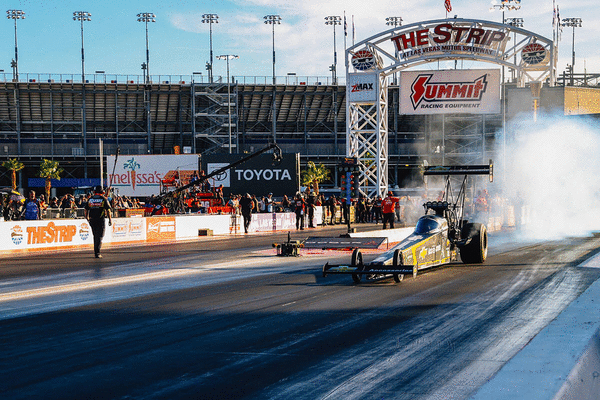
On a late summer Saturday in Brainerd, Minn., rookie driver Maddi Gordon waited at the starting line in a roaring lime green Top Fuel dragster, one of the most extreme machines in motorsports.
When she hit the throttle and launched, the engine sounded like a pile driver wired to a jet engine. I was perhaps 20 feet from the car, and the blast lifted the baseball cap off my head. Before I could retrieve it, she’d clocked 336.99 mph, covered 1,000 feet in 3.695 seconds, and posted a quicker time than former national champion Shawn Langdon.
Later, in the pits, fans crowded around Gordon for autographs and pictures. That she is a 22-year-old woman — and, after Brainerd, one of two women ranked in the top five in Top Fuel(1) — barely warrants comment at the track. In Formula 1, NASCAR, IndyCar or most other major motorsports, it would be headlining news. That shows how far drag racing has outpaced the others on inclusivity, offering a model for sports that still treat women competing at the highest level as a novelty.
Women are still a minority in drag racing, but they have been driving, winning and setting records for decades in the National Hot Rod Association — the country’s premier drag racing organization.
“I was the 100th woman to ever win a national event in NHRA history,” Gordon later reminded me, recalling her 2024 victory in Top Alcohol Funny Car (a slower, generally less costly class than professional Top Fuel racing). Women have won more than 200 NHRA professional events. In 2019, Brittany Force covered 1,000 feet in 3.623 seconds — still the quickest Top Fuel run in NHRA history by a man or a woman.
So, what is drag racing doing differently?
For starters, it gives girls years to learn, compete and prove themselves before the cost of racing becomes a prohibitive barrier.
A daughter who grows up in a family garage can learn to wrench and race long before she needs corporate sponsors. NHRA’s Junior Drag Racing League allows children as young as five to compete in half-scale dragsters, which start around $5,000 used (not including safety gear, maintenance, travel and other expenses).
Costs rise from there, as does the pressure to find sponsors, but the million-dollar barrier comes much later in a driver’s development than in other motorsports.
Racing teams typically like to stay mum about operational costs, but insiders have given the public a glimpse of the money required to compete.
At the Top Alcohol Dragster level, a common step toward Top Fuel’s professional ranks, Rich McPhillips Sr.’s operation is a useful example. Last year, McPhillips told the NHRA it cost $2,000-$2,200 a run, considering fuel, flights, wages and tires. At six or seven runs per event, a 16-event season costs around $200,000-$250,000.
By comparison, last year NASCAR driver Kaden Honeycutt said some teams were asking $3 million for a full season in the Craftsman Truck Series, where many aspiring drivers compete before reaching NASCAR’s top division. And former Formula 1 driver David Coulthard recently estimated it costs nearly £8 million (around $11 million) to reach F1 from elite karting.
Gordon is a case study in why relative affordability and family matter. She was born into a racing family, driving by age 8, and working as a mechanic on her dad’s race car at 15. She moved through drag racing’s junior ranks and into Top Alcohol Funny Car, the class she had dreamed of driving as a kid.
The next step up was harder. Top Fuel costs millions. “We don’t have the money,” she told me with a shrug.
Enter Ron Capps. He’s a championship-winning driver and the owner of Ron Capps Motorsports, Inc. Like most race team owners, Capps is always in search of sponsors to fund the millions required to purchase, maintain and race the world’s fastest cars.
Capps told me that young drivers often “have to bring a check, a pretty big check” from family or sponsors to secure a “ride” or car. “There’s a lot of kids or people that will never get a shot because they don’t bring money.”
Gordon was barely 20 when Capps began considering her for Top Fuel. He’d seen her work on her dad’s cars and watched her compete. By the time he had to contemplate investing millions in her, he didn't need to take Gordon's ability on faith.
He was so confident in her that he offered her the ride before he’d secured sponsors to fund the car, Capps told me.
The jump to Top Fuel is demanding, but Gordon adjusted quickly. She won her first Top Fuel national event in only her 10th start and made the final in Brainerd. Along the way, she’s generated long autograph lines, knockout merchandise sales and a growing social media following that’s attractive to sponsors.
Gordon benefits from something else, too: the decades of women who preceded her. Their success means team owners no longer have to imagine whether a woman can compete at the highest level.
Shirley Muldowney became the first woman to receive a Top Fuel license in 1973, though she later recalled, “the NHRA fought me every inch of the way.” She answered by winning three world championships.
Eventually, women became established enough to shape the sport itself. NHRA adopted a replacement-driver policy in 2024, so racers undergoing fertility treatment or who are pregnant can use substitutes.(2)
It's a reminder that decades of opportunity can shape a sport’s culture. As I looked into the grandstands in Brainerd, motorsports fans offered the proof. Maddi Gordon T-shirts were common sights, and especially popular among children and teens. These fans didn’t wonder why a woman was behind the wheel. They just wanted to see whether Gordon would win.
———
(1) This is drag racing's fastest class.
(2) Leah Pruett, who helped push for the change, returned after becoming a mother and ranked third in Top Fuel after Brainerd.
———
This column reflects the personal views of the author and does not necessarily reflect the opinion of the editorial board or Bloomberg LP and its owners.
Adam Minter is a Bloomberg Opinion columnist covering the business of sports. He is the author, most recently, of “Secondhand: Travels in the New Global Garage Sale."
©2026 Bloomberg L.P. Visit bloomberg.com/opinion. Distributed by Tribune Content Agency, LLC.






Comments