'Worn out, slick' but the Homestead track has a place in NASCAR driver's hearts
Published in Auto Racing
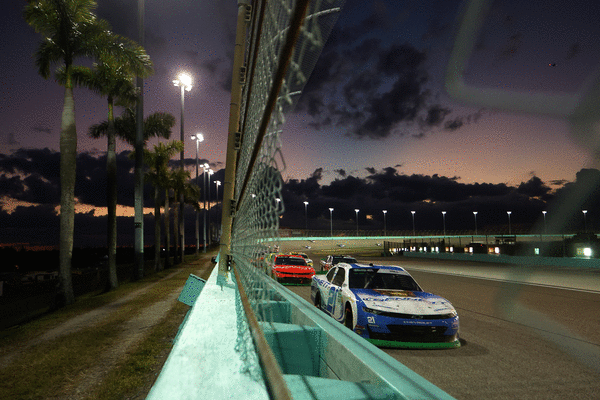
HOMESTEAD, Fla. — The 1.5-mile oval now painted in Miami-esque pastels will start degrading your tires immediately, and play slick surface games with you despite many places to run your car. And, if you’re looking for a little more speedy action, you can violate the personal space of the green wall. There, you can find happiness ... or sadness.
All of the above will get mentioned when drivers of each NASCAR series tell you why they love Homestead-Miami Speedway.
“I think if you talked to any driver, it’s up there with one of their favorites,” NASCAR Cup Series driver Ryan Blaney said. “It’s so unique. It’s ‘How can you run the wall efficiently? And, if you can’t, how do you kind of maneuver off of it to try to find grip?’ There’s just so little grip around that place, and you’re always on edge.”
O’Reilly Auto Parts Series driver Sheldon Creed describe what he likes about Homestead: “Everything. Everything about it. Location. How worn out and slick it is. You can run all over it. Probably running the fence is my favorite part. Just how technical and extremely difficult it us. For whatever reason, that makes it more fun.”
The acknowledged master of running the fence at Homestead is defending Cup Series champion Kyle Larson, owner of a titanic 67-point lead going into Sunday’s season finale. Larson’s logic is that’s where the track’s best grip is, so that’s the place to run. But, for a late yellow in the then-Xfinity, now-O’Reilly series race, Larson would’ve pulled a March 2025 Homestead hat trick, sweeping all three series’ races that weekend.
“Trucks generally aren’t run on the fence, but Larson ripped it last year and showed us it’s actually really fast,” said Kaden Honeycutt, who won the 2026 Craftsman Truck Series race and season championship Friday night.
Layne Riggs, second in trucks this season and another Homestead fan, explains why he and his peers don’t sidle up to the wall as often as drivers in NASCAR’s other two series.
“The composite body versus the steel body and the shape of our bodies has a big effect on how that works,” said Riggs, second in the trucks’ season standings. “I think that we get more of a reward for running the wall, but when you do touch it, if you just kiss the wall, your day is done. Where the Cup and the O’Reilly series, they can literally bounce off the wall and keep going, no issues.”
Lower lanes can run to victory lane, too. For one thing, the margin for error increases as the distance from the wall decreases and there’s enough extended precision required just to get through a race. Also, as Blaney notes, if everybody’s running the wall, you’re not going to do much overtaking by staying up there.
Throughout Homestead races, you can watch each driver figure out which areas of the track work best for his car, knowledge that can change with track temperature and daylight. The track can be the slickest thing this side of Miami Ice Arena. Throw in tire degradation, which, one driver snickered “starts on pit road” at Homestead.
“I feel like Turns 1 and 2, even with 40 laps on tires, you can run from the bottom all the way up to the wall fairly equally,” Blaney said. “Turns 3 and 4, you can probably run three lanes down off the wall. The bottom in 3 and 4 late in a run is really, really slick. But, on a restart, you can use it.
“It becomes a really wide racetrack. Even though it’s famous for running the wall, you can use a lot of different lanes.”
After listing the many changes at the facility — a shiny, bigger main gate, spiffier suites, increased fan participation and food options, Romero Britto murals — track president Guillermo Santa Cruz said, “but, the fact is that at Homestead-Miami Speedway, the track is the star, and we didn’t touch that.”
©2026 Miami Herald. Visit miamiherald.com. Distributed by Tribune Content Agency, LLC.






Comments