Minnesota attorney general charges 7 with Medicaid fraud totaling $700,000
Published in News & Features
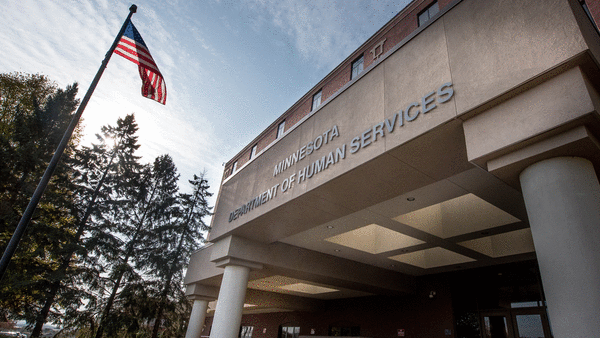
ST. PAUL, Minn. — Minnesota Attorney General Keith Ellison’s office announced criminal fraud charges against seven Medicaid providers on Tuesday, including a former Roseville schools employee who allegedly billed for personal care services for two years while living in Kansas.
The state fraud charges come from investigations by the attorney general’s Medicaid Fraud Control Unit, with alleged losses topping $700,000. Providers are accused of charging for services they never provided or were unqualified to give.
Five of the seven charged provided little or no service to clients, while one provided services but had no license. Another provided some services but overbilled. The Department of Human Services had already cut off payment to the five providers it directly handled, in some cases years ago, officials said.
DHS said it referred two of the cases to the attorney general in 2024, and agency inspector general James Clark said more cases could come as work continues with law enforcement.
“My office continues to use its administrative power to shut off money to fraudulent Medicaid providers as soon as we uncover credible allegations of fraud,” Clark said. “We’ll continue to provide law enforcement with billing and ownership information, investigative files and other relevant documentation. And as I’ve said before, I fully expect we’ll see more charges in the future.”
Fraud defendants in the new round of state charges come from across the state, with alleged schemes taking place in the Twin Cities metro area and in cities along the North Dakota border. Cases were referred to the attorney general by a mix of DHS, law enforcement, the insurance company UCare and a private tip.
In a Ramsey County fraud case, Tremayne Lemar Jackson, 46, faces seven felony theft charges after allegedly defrauding Minnesota Medicaid of more than $125,000. Over the course of a few years, he claimed to provide more than 6,000 hours of personal care assistant services, the Attorney General’s Office Alleges in court documents.
Jackson, who worked as a behavior specialist in Roseville Area Schools from 2020 to 2023, claimed personal care assistant hours that conflicted with his schedule at school, according to charges. He’s accused of continuing to claim care hours for two years after moving to Kansas to coach college basketball.
Court documents did not list an attorney for Jackson.
A Blaine man, 41-year-old Shawki Elsaid, is charged in Anoka County with fraud and identity theft crimes after allegedly filing more than 1,655 fraudulent claims for personal care services he never provided — including when he was out of the country. Total alleged losses topped $182,000.
In addition to filing false claims, Elsaid is accused of using others’ identities to collect payments, according to charges. The attorney general’s office said it learned of the case from the Crystal Police Department. As of Tuesday, there was an active warrant for his arrest.
Federal prosecutors are handling Medicaid fraud cases where alleged losses are in the hundreds of millions. Minnesota’s Medicaid fraud unit has gotten more than 340 people convicted of fraud since 2019 and recovered around $90 million, according to Ellison’s office.
High-profile fraud cases involving hundreds of millions of federal dollars stolen from state agencies have drawn national attention to Minnesota over the last year.
Minnesota fraud has been described as “industrial scale” by former Assistant U.S. Attorney Joe Thompson, who speculated total losses in Medicaid programs alone could top $9 billion since 2018 — a figure Gov. Tim Walz and state officials have disputed. So far, prosecutors have proven hundreds of millions of dollars in fraud.
A spokesperson for Ellison said the office hopes a new law expanding its ability to fight fraud — which passed the Minnesota Legislature with overwhelming bipartisan support in 2026 at the attorney general’s urging — will give the state more power to pursue fraud cases on its own. Lawmakers also approved funding for more staffing at the Medicaid fraud unit.
Significant fraud in Medicaid programs, particularly 13 considered “high risk,” continues to trouble the Department of Human Services, which is currently working on “corrective action” after Trump administration threats to cut off billions in funding.
_____
©2026 MediaNews Group, Inc. Visit at twincities.com. Distributed by Tribune Content Agency, LLC.




Comments