Hard-right candidate backed by Trump wins Colombia's deeply polarized election
Published in News & Features
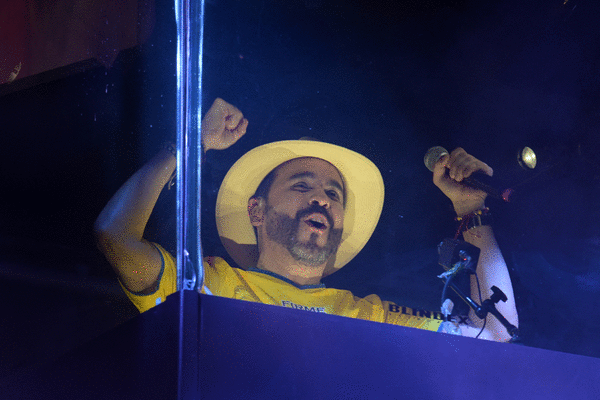
Abelardo de la Espriella, a far-right populist backed by Donald Trump, will be Colombia’s next president after narrowly defeating leftist Iván Cepeda in a runoff election on Sunday.
The criminal defense lawyer who cast himself as a political “outsider” promised to take an “iron fist” to crime during elections in which security was a major concern for ordinary Colombians.
With nearly 100% of the pre-count votes tallied, de la Espriella garnered over 12.9 million votes, or 49.65%, edging out Cepeda by just under 250,000 votes, or less than 1% — underscoring one of the most polarized elections in the country’s recent history.
De la Espriella’s win swings Colombia back to the right after four years of Gustavo Petro, a former leftist guerrilla who often clashed with Trump over migration and drug eradication. Cepeda was the successor to Petro’s Historic Pact party.
Describing himself as “right-wing, pure and hard,” de la Espriella has been likened to El Salvador’s Nayib Bukele and Javier Milei in Argentina. Days before the election Trump wrote on Truth Social that if “Abelardo wins, [he] will have the total support and strength of the United States behind him.”
A naturalized U.S. citizen who lived in Miami and Florence, Italy, before launching his political career, de la Espriella was often combative against his opponents, promising to “disembowel” the left, saying it was a “plague” to be “eradicated.”
Now, de la Espriella must govern a country where nearly half of the electorate voted against him.
Patricia Muñoz Yi, a political scientist from the Javeriana University in Bogotá, told the Miami Herald that de la Espriella has to figure out how “to generate trust in the government and construct governability after a polarizing campaign.”
At a celebration rally for de la Espriella in Barranquilla on Colombia’s Caribbean coast, Julian Castillo told the Herald that he thinks the president-elect is up for the task.
“The president will represent us all as Colombians regardless of our differences.”
A referendum on Petro’s ‘Total Peace’
In contrast to Petro’s Total Peace strategy, which sought to negotiate with Colombia’s numerous armed groups to get them to lay down their weapons, de la Espriella has taken a hard-nosed approach to crime, saying “peace is not negotiated, it is imposed.”
According to Fundación Ideas Para la Paz (FIP), a think tank, active fighters in Colombia’s armed conflict have more than doubled since Petro took office, from 13,000 in 2022 to nearly 27,000 in 2025.
Some analysts see de la Espriella’s win as a referendum on Petro’s security strategy.
“De la Espriella’s support is clearly a protest vote against Petro’s government. The electoral map shows he won heavily in conflict-affected areas, suggesting that voters are punishing the ‘Total Peace’ policy for failing to deliver on security,” Gabriel Clavijo, a political scientist and expert in international relations, told the Herald.
De la Espriella, who was criticized during the campaign for his ties to right-wing paramilitary groups, has proposed some controversial security strategies of his own, including constructing seven “mega-prisons,” imposing mass trials for criminals, and dissolving Colombia’s transitional justice system, the JEP.
Days ago, he said that upon taking office he would sign a series of executive orders to tackle security, health and education.
“De la Espriella’s rise as an outsider is concerning,” said Clavijo. “He often shows a lack of understanding of democracy and constitutional checks and balances, which could threaten the country’s legal and constitutional norms.”
Following the results of the pre-count, de la Espriella and his Vice President-elect José Manuel Restrepo thanked Colombians for their backing and said the “miracle homeland will become a reality.”
Petro took to X to say that he would await the scrutinized results of the elections. “No one can be proclaimed president. It is the vote count that determines who the president is. I obey the judges.”
For his part, Cepeda said that he will “recognize tonight’s preliminary count as unofficial and non-binding.” But, he also reported that his “team of observers is moving to challenge 33,000 polling stations across the country.”
De la Espriella is set to take office on Aug. 7.
©2026 Miami Herald. Visit at miamiherald.com. Distributed by Tribune Content Agency, LLC.






Comments