Teachers at Minneapolis' Annunciation' school look back on a year marked by loss, grief and glimpses of joy
Published in News & Features
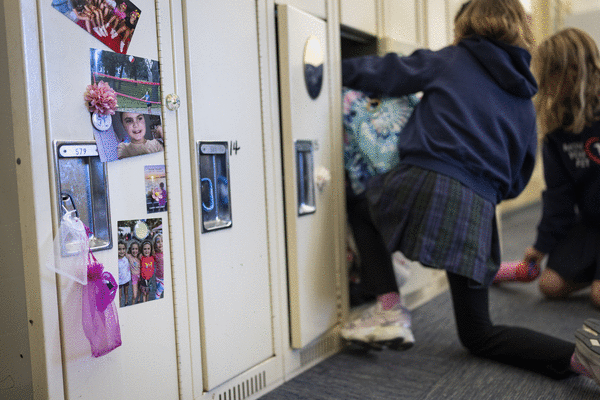
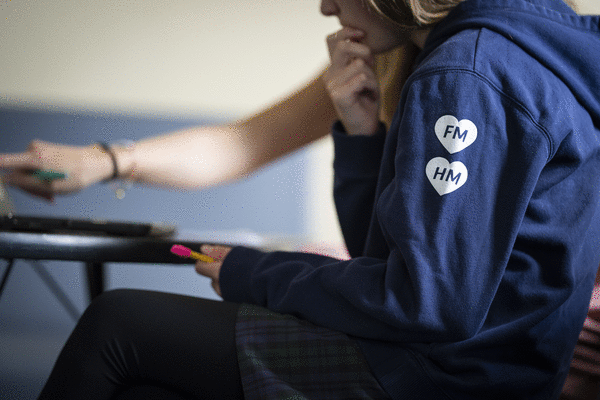
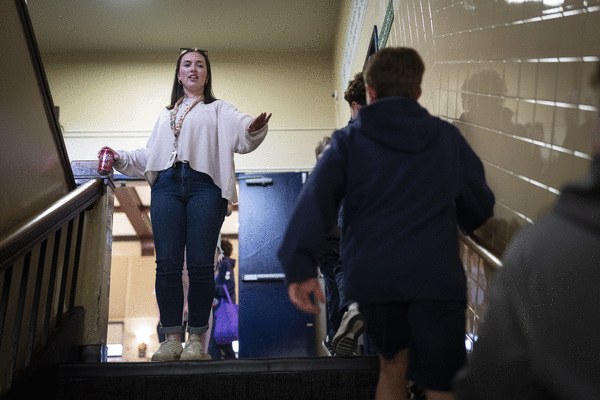
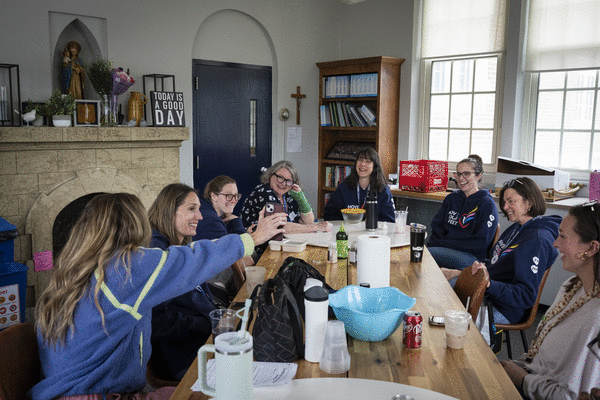
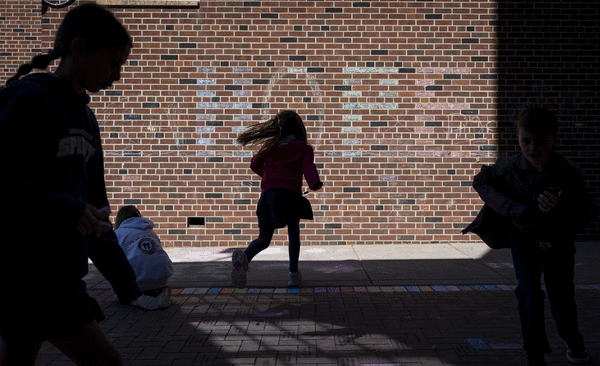
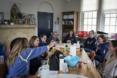
MINNEAPOLIS — Mikayla Pellegrene teaches on the top floor of Annunciation Catholic School in southwest Minneapolis. Her fifth-grade classroom is filled with natural light, comfy chairs and the heavy presence of one empty desk. All school year, her kids have held onto reminders of Harper Moyski, the friend they lost.
Teachers here have spent the nine months since August’s mass shooting trying to create normalcy in a school year that’s been anything but normal. That has meant embracing memories of Harper, the 10-year-old spitfire who loved volleyball and wanted to be a veterinarian, and Fletcher Merkel, the 8-year-old with the flashbulb smile who loved fishing and Captain Underpants and the Green Bay Packers.
The television cameras left. The students returned. Deaths were mourned, physical recoveries celebrated. A political battle over gun control overtook the public’s attention on steering children through trauma.
And every day these teachers came back for a more difficult battle: navigating raw and unpredictable grief, both the children’s and their own.
One recent morning not long before the final day of school, Pellegrene unlocked her classroom at 7:23 a.m. She checked the caterpillars in a net hanging in the back. She’d been gone a few days for a bachelorette party and worried the caterpillars had pupated into chrysalises. Even the loss of one caterpillar could, she feared, send students spiraling.
All seven were alive: still caterpillars, not yet cocooned. Students planned to release them as butterflies before school’s end, a sign of new life.
Toward the back stood Harper’s desk. On the first day of school, Harper had beautifully painted her name on the desk’s corner, in pink, yellow and blue, as if three-dimensional. After her murder, friends adorned her desk with painted seashells (“Love 4 Harper”) and charms of turtles, her favorite animal. Pellegrene had put a small wicker bowl on the desk, where students placed private notes to Harper. The bowl was filled. So was a larger basket beneath the desk.
“It’s just become so much of the daily routine,” Pellegrene said. “Other grades come in here and are fixated with her desk. For us, it’s a comfort. Because we’re around it all day.”
Since the Aug. 27 mass shooting, Annunciation has faced grief head on.
Seemingly the entire school attends therapy. Outside counselors are a stalwart presence. Kids look both ways when they leave a classroom and walk into the hall. Teachers maneuver around emotional land mines all day. They say students mostly hold things together at school then fall apart at home: nightmares, tantrums, bed-wetting.
At 7:45 a.m., the first bell rang. Soon, Pellegrene’s 21 students, five who’d been injured in the shooting, were at their desks.
“We get to sit wherever we want!” one girl squealed.
For the school year’s final stretch, Pellegrene allowed students to arrange their own seating. They’d do it at the end of this school day. But fifth-grade girls were already fretting.
“Can we have Harper’s desk by us?” one asked.
Pellegrene demurred, noting uncertain faces at the suggestion of moving Harper’s desk. Each grade has processed trauma and grief at its own pace. For this class, it’s complicated: They all witnessed a shooting. They all lost a beloved classmate. And they’re fifth-graders, teetering between childhood innocence and the beginning of worldly understanding.
Noting to herself the entire class must agree on Harper’s desk, Pellegrene pivoted and brought out 21 boxes, each with a ceramic planter shaped like a turtle, and palettes of paint.
“Try really hard not to get this paint on your clothes!” Pellegrene said.
“Can we put Harper’s initials on it?” one girl asked.
From a few floors down came sirens. Twenty-one heads perked up. One girl walked to a window and poked her head over the bookshelf. “Just a fire truck,” she said. Twenty-one chests exhaled.
“It’s become so much my normal, you don’t even notice,” Pellegrene said later. “The hardest part when we were first back was making things normal. What? No. This is not normal. But it becomes easier. We’re so in it every day."
Not long ago, teachers wondered if anything ever would be normal again. Normal became showing up, day after day after day, and tackling whatever drama would come: The drama of fifth-grade crushes, or the drama of a first-grader unable to attend prayer services because of the graphic memories of the first student Mass of the school year.
In Pellegrene’s classroom, students cleaned paint off desks with Clorox wipes. It was time for math. Pellegrene started talking about pyramids and prisms and calculating an object’s volume, and it felt like any other fifth-grade class.
‘We can do this’
In the 20 days between the shooting and returning to school, classmates met at parks on a near-daily basis: kids playing, parents sobbing.
Becca Heer, a fourth-grade teacher who herself attended Annunciation, went to one fifth-grade meetup a mile from school. She knew these fifth-graders deeply, having taught them the year before.
“MISS HEER!” some kids screamed.
At first, Heer panicked at the urgent yells. Then she realized: The girls had found a freshly hatched snapping turtle, and held it in one girl’s Croc.
“We named it Harper, because turtles are her favorite animal,” one girl told Heer. “Harper is here with us at the park!”
Heer choked back tears. Together, they released the turtle into Diamond Lake.
“And then they went on playing. They were so happy to be together. They were kids,” Heer said later. “I think about that moment a lot. The pure joy they can still experience, even after losing their friend. That’s what I am striving for. That was the moment where I was like, ‘We can do this.’”
‘Light in dark times’
It may sound cliche to refer to Annunciation as a family brought together through tragedy. But consider: Eleven Annunciation educators have children attending the school. Seven went to school here themselves. Heer teaches in the same classroom where she attended fourth grade; her mother taught here as well.
“We raise each other’s kids,” said first-grade teacher Beth Sable. “You know when you send your kids here they are going to be loved.”
The story of Annunciation is a story of duality. In the 250-plus days since the worst thing imaginable unfolded in front of 300 children, trauma and grief seep out daily.
Sometimes it’s subtle, like with Pellegrene’s hall passes. One reads, “BREAK: I need a break, I need to talk to an adult.” The other reads, “RESET: I’m using a strategy to reset myself, I will return to class on my own.”
Sometimes it feels more extreme. Like in Sara Slack’s first-grade classroom, where the youngest of the injured students sometimes must leave class for doctor’s appointments to determine how much shrapnel remains in his body.
“One of my students said to her parents, ‘Every time I go to prayer service, all I see is Fletcher’s face,’” Slack said. “And not Fletcher’s beautiful, cute face. The way she was stuck in the pew while the gunfire was going, the only thing she could look at was Fletcher. Dead.” Slack paused. “She’s 7.”
There have been days when teachers must go home midday, overcome by emotion.
Yet there’s another side to the horror. There’s a classroom of fifth-graders, thrilled to see their teacher again after she was gone for a few days at a bachelorette party. There’s Principal Matt DeBoer, greeting kids with a boombox every morning. There’s Dan the Security Man, happily climbing out a window to grab another recess ball off the roof.
There’s a community that hates the nightmare it has lived through but is thankful to have lived through it together.
They’ve learned that after a nightmare can still come true joy.
“Three days after the shooting, I found out I was pregnant,” said kindergarten teacher Mary Kate Marosi. “Those two events are so closely tied in my brain. I really struggled to let myself feel happy about it.”
“And I was like, oh my gosh, a baby!” said Laura Eiden, her kindergarten colleague. “The best news ever!”
“There can be light in dark times,” Marosi said. “There can be joy where there is also grief.”
Running out of adrenaline
Annunciation teachers have questioned all year whether they’d make it to the end of this school year.
Their answer always came back to: How could they not?
“I have friends who said, ‘You should take a leave of absence,’” Eiden said. “But why? What would that do? Being in the classroom brings me a ton of joy.”
Eiden has three of her own kids at Annunciation. All school year, outsiders have asked an innocuous, loaded question: How’s it going?
“If you look from the outside — oh, they’re going to school! They’re playing basketball! They’re doing life, and they’re doing it well," Eiden said. “But then they come home. A plate dropped the other day. My daughter burst into tears. Went down to the ground and started crying. My son has a really serious fear of strangers and everybody having a gun. He won’t go outside by himself.”
Teachers have coped in their own ways.
They’ve navigated the forgetfulness that comes with trauma brain. They’ve embraced structure, predictability, certainty. They’ve amended curricula: Maybe kids shouldn’t read “Bridge to Terabithia” with the climactic scene of a child’s death. Maybe “Ratatouille,” where rats get shot at in an opening scene, wasn’t the right pick for a rainy day.
Sable knows it’s a fine line when first-graders talk too much about trauma or grief, so she encourages laughter. A recent first-grader’s joke: “Have you seen the movie ‘Constipation’? Don’t worry, it hasn’t come out yet.”
Slack lured back her first-graders with a classroom pet: Lucy George Rabbit, a baby bunny who grew into a big adult rabbit before their eyes.
Some teachers get home and fall asleep by 7 p.m., emotionally spent. Others have focused on self-care: yoga, exercise, even flying to Las Vegas for a New Kids on the Block concert.
They’ve felt physically sick during school breaks as they worried about their students.
They’ve yearned for this school year to end.
They’ve worried about this protective bubble going away in summer.
“Adrenaline got people through,” Eiden said. “This happening on the third day of school is crazy. We had a whole school year to go. Now, I look at colleagues’ faces, we’re running out of adrenaline. We are exhausted.”
Heer wondered how she’d handle Fletcher’s grade when they enter fourth grade next year. She may get two lamps to represent Fletcher and put them in the two fourth-grade classrooms, the lamps following those classes through every grade.
These classes are all trauma-bonded. Each class has created its own coping mechanisms. Thinking about the future subtly tugs at Heer’s gut. How will next school year play out — new teachers, new combinations of students, new chapters of grief and of life?
‘Are we allowed to talk about this?’
The Annunciation community refers to the day of the shooting as, simply, 8/27. Just like Americans’ shorthand for the horrific terror attacks a generation ago became, simply, 9/11.
8/27 marks where their lives fractured: There is the before, and there is the after.
When the gunfire stopped, after triaging students in the church and taking attendance in the gym and learning one of her students was among the murdered, Pellegrene walked back to her classroom to retrieve her things. Harper’s desk was the first one she saw: her water bottle, her name tag, stuff she’d been working on only hours before. Pellegrene couldn’t even cry. She was numb.
On Day 20 after the shooting, their first day back, Pellegrene sat her students in a circle. She told them they would honor Harper and Fletcher daily. “‘She is still your friend — friendship can last forever, really. I don’t want you to ever be afraid of talking about her in here,’” she recalled telling them. “They looked at me when I said her name the first time: ‘Are we allowed to talk about this?’”
On Day 68, Harper’s birthday, the class gave Harper’s parents a gift: an album with photos and letters they wrote about Harper.
On Day 113, a student fainted during the evening Christmas program. Adults rushed to help. Kids’ minds flashed back to the shooting. Some fled the stage in tears. The little girl playing Mary lay on the floor sobbing. The show went on. It was, many teachers said, the lowest moment since the shooting. “My own daughter was basically in the fetal position,” Eiden said. “I scooped her up like a baby and ran out of this place. I said to myself, ‘You can’t do this anymore.’ But then you go to bed, and you wake up the next morning, and you do it again.”
On Day 165, the community gathered for its annual Dancing with the Annunciation Stars fundraiser. Everyone there knew what teachers had been living through; no one had to ask if they were OK. A switch flipped that night, like they finally felt permitted to feel joy.
On Day 251 — after math and reading and Spanish and lunch and recess and Bible charades — it was finally time for Pellegrene’s class to arrange seating for the final stretch of the school year.
“Here are the rules,” the teacher said. “I don’t care what shape it takes. It doesn’t have to be in pods. But you’re including every single person that wants to be included. OK — ready, set, go!”
The end of this school year was hard. Big feelings came out. Kids didn’t seem ready to let go of all this year’s horror and joy. Pellegrene didn’t know how to put a bow on it all. A week before school ended, they’d release butterflies together.
Students began scrambling desks. One girl asked about moving to the far back of the room, near Harper’s desk. Pellegrene said that was too far from the teacher.
So the group of girls moved their desks smack up to the line that was the farthest Pellegrene permitted. When their teacher turned away, the girls pushed their desks two extra inches closer to Harper’s desk. They wanted to stay as near to their friend as they could.
_____
©2026 The Minnesota Star Tribune. Visit at startribune.com. Distributed by Tribune Content Agency, LLC.






Comments