Maximum high tide records broken on Southern California coast as king tides peak
Published in Weather News
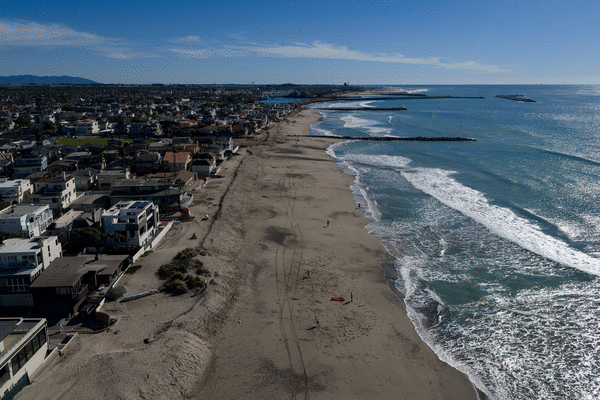
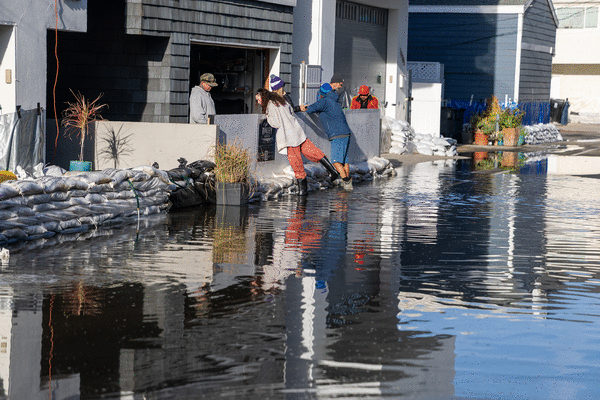

LOS ANGELES — King tides peaked for the week in Southern California on Wednesday, setting new maximum high-tide records.
All-time maximum high tide records were broken in La Jolla and Santa Barbara and tied in San Pedro, preliminary data show, breaking records last set on Oct. 27, when flooding was reported up and down the Southern California coastline.
The tide came in La Jolla at 8.11 feet above the average low tide, breaking the record of 7.98 feet, said meteorologist Chandler Price of the weather service’s San Diego office.
Santa Barbara’s highest tide was recorded at 8.1 feet so far, breaking the old record of 8.04 feet, meteorologist Ryan Kittell of the weather service’s Oxnard office said. In San Pedro, the tide hit 8.19 feet, tying the record last broken on Oct. 27.
High tides caused some flooding in Sunset Beach. But preparations — including walls of sandbags and pumping — appeared to help prevent more damage.
The forecast
Wide swaths of Southern California will be at a greater risk on Wednesday because of the arrival of strong waves. Peak surf heights — the height of waves when they break on shore — of up to 22 feet are possible along the Central Coast on Wednesday, up to 15 feet in Ventura County and up to 10 feet in Orange and San Diego counties.
In Santa Barbara County, an evacuation warning due to potential coastal flooding was issued for parts of the Montecito, Summerland and Carpinteria coastal areas.
In Santa Cruz County, Santa Cruz and Capitola closed their beaches and wharves on Tuesday night due to the significant waves and hazardous surf. An evacuation warning was issued in the Capitola Village area, a scenic spot popular with tourists, and for the Aptos coastline, affecting homes along Beach Drive and the Seacliff State Beach Visitors Center.
The weather service says “extreme” coastal flooding impacts are expected for Orange and San Diego counties, as well as the San Francisco Bay and Humboldt Bay areas, Wednesday, and “major” impacts are forecast for Ventura County, the Central Coast, and the Monterey Bay area.
“Moderate” impacts were expected in L.A. County and Santa Barbara County’s south coast, the latest forecast says.
Impacts
In Santa Monica, the predicted peak maximum sea level — which will occur Wednesday at 8:37 a.m. — was 8.1 feet to 8.3 feet above the baseline (the average daily lowest water level observed between 1983 and 2001). A reasonable worst-case scenario is a peak of up to 8.5 feet, according to the weather service. That would match the all-time record for maximum sea level set during the powerful 1982-83 El Niño. That winter, the Santa Monica Pier was severely damaged during an El Niño-fueled storm that brought large surf to the coast.
Tuesday’s peak sea level in Santa Monica was 8.02 feet.
The highest-ever maximum sea level recorded for Port San Luis in San Luis Obispo County is 7.65 feet, set on Jan. 18, 1973. The predicted maximum sea level Wednesday is 7.8 to 8.1 feet, but a reasonable worst-case scenario puts the maximum sea level there at up to 8.3 feet at 9:14 a.m. Wednesday, according to the weather service.
The areas of greatest concern in the coming days are beaches facing swells from the west, such as in Santa Monica, along the Palos Verdes Peninsula, Manhattan Beach and Redondo Beach, and parts of Malibu and Long Beach, including Naples. The weather service says the Long Beach Peninsula, as a south-facing beach, is likely to see less intense swells compared to west-facing beaches — a welcome change from pounding waves this summer — but could still experience some problems.
In Ventura County, the coastline from Faria Beach to Silver Strand Beach, including the inside of the harbors and the Ventura Pier, are at greatest risk for damage. On the Central Coast, waves are expected to hit hardest along Morro Bay, Pismo Beach, Oceano Dunes, the Cayucos Pier, the Avila Beach Pier and the Pismo Beach Pier.
Variables
L.A. County will probably avoid some of the worse effects that are likely farther north since the strongest swells — of up to 11 feet — are expected to arrive well after high tide Wednesday morning. (By contrast, high tides and very high surf are expected to hit at around the same time on the Central Coast.)
And in general, maximum sea levels on Tuesday were on the lower end of what was forecast, the weather service in Oxnard said. That’s likely due to higher pressure over the region that, essentially, squishes the water down and may contribute to slightly lower sea levels.
Still, meteorologists warned that areas that flooded in late October from high sea levels could again face problems, especially in low-lying areas of the South Bay.
“Life-threatening waves and rip currents are likely to continue into at least Thanksgiving Day,” Robbie Munroe, meteorologist for the weather service’s Oxnard office, said Tuesday. “Other impacts could lead to dock damage and seawater flooding over low-lying areas, including inside of harbors.”
Commuters may suffer delays with low-lying roads flooded by extreme tides and large surf, Munroe said.
Northern California
Cindy Palmer, a meteorologist with the weather service office in Monterey, said high surf would probably result in another November record in San Francisco for maximum sea level on Wednesday and possibly Thursday. Swells ranging from 10 to 30 feet are expected to arrive on the coast beginning on Wednesday, pushing water levels to possibly historic heights.
“We have not just the astronomical and El Niño components [Wednesday], but the residual storm that’s pushing through and the swell,” Palmer said. “Any water going into the bay is going to have a hard time getting out of the bay because of the swell.”
Some floodwaters covered Marin County roads on Tuesday, and crews were preparing for worse impacts Wednesday.
San Francisco is expected to see peak high tide Wednesday at 10:49 a.m. The maximum sea level is forecast to be 8.5 feet above the baseline on Wednesday; on Tuesday, the observed peak tide was 8.23 feet.
©2026 Los Angeles Times. Visit at latimes.com. Distributed by Tribune Content Agency, LLC.






Comments