Should wolves lose endangered species status? Trump administration says in court, 'yes'
Published in Science & Technology News
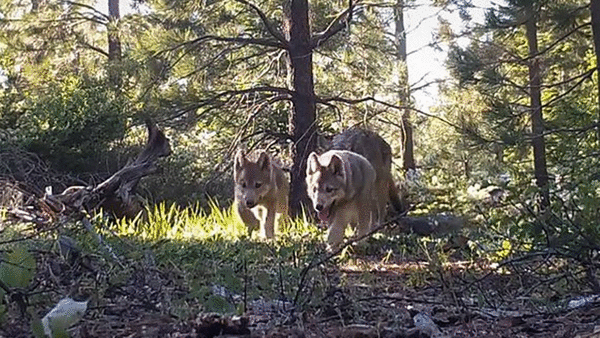
SACRAMENTO, Calif. — Gray wolves throughout the U.S. should no longer be considered endangered, lawyers for the Trump administration told a federal appeals court on Tuesday, as oral arguments began in three cases that could significantly weaken protections for the predator canines.
The cases before the 9th Circuit Court of Appeals grew out of a series of lawsuits against the federal government by environmental groups who said efforts to remove endangered species protections for the animals were improperly considered and therefore illegal.
Lower courts agreed with the environmentalists in the two cases that involve gray wolves, but on Tuesday Emily Polachek, an attorney with the environmental and natural resources division of the Justice Department, told the panel of three judges meeting in Missoula, Montana, that the apex predators had successfully recovered.
“More than a half-century after they were first listed under the Endangered Species Act, gray wolves are no longer in danger of extinction,” Polachek said. “They should stand as a triumph of the ESA.”
Protected since 1967
Wolves in much of the continental U.S. have been protected under federal environmental laws since 1967, after their numbers dropped to just over 1,000 animals amid widespread eradication programs. The predators were locally extinct in California and the West, surviving mostly in rural Minnesota with another 40 animals in Michigan.
Today, about 6,000 gray wolves live in the 48 contiguous states, far more than 60 years ago but a fraction of the estimated 250,000-500,000 that roamed the continent before European settlement. About 75 gray wolves are in California, according to state estimates.
But wolves, which generally prey on deer, elk and smaller animals, have always been drawn to human settlements, and their recovery has meant a return of the behaviors that led people to try to exterminate them in the first place: preying on cattle and sheep, and terrifying ranchers and other rural residents.
In 2011, former President Barack Obama signed a law removing wolves in the Northern Rocky Mountains from the endangered species list, a change that removed federal prohibitions on killing or harassing them in that region. In 2020, during his first term, President Donald Trump attempted to de-list gray wolves in the rest of the country, a move that was challenged in one of the lawsuits before the court on Tuesday.
On Sept. 4, Trump tried again, issuing an executive order directing the Secretary of the Interior to consider de-listing gray wolves.
The 2020 de-listing order, along with an effort to restore protections to gray wolves in the Northern Rockies and a third case involving the recovery of Mexican wolves in Arizona and New Mexico, were the subjects of cases before the 9th Circuit on Tuesday.
‘Not some lone wolves to be written off’
In their oral arguments, Polachek and other government lawyers argued that because wolves had recovered in Minnesota and the Northern Rockies, it wasn’t necessary to consider their fate in other areas, including the West Coast.
Wolves in California and the coastal parts of Oregon and Washington are merely dispersers from the larger population in the Rockies, and therefore do not require protection, Polachek said. If these animals lose their status as endangered species, it would not harm their cousins in the Northern Rockies — defined as Montana, Idaho, Wyoming, and parts of Utah, Oregon and Washington, she said. It is therefore unnecessary to designate the West Coast animals as endangered, Polachek said.
But attorneys for the group Defenders of Wildlife said the government was distorting the environmental law’s definition of a species by focusing only on the populations in Minnesota and the Northern Rockies. When gray wolves were listed as endangered, they were meant to be protected as a species whose range had stretched from coast to coast — not just in one or two areas of the country, said Kristen Boyles, an attorney with the environmental law group Earthjustice.
It was simply untrue, she said, to say that protections were only meant to extend to those populations. “These are emerging populations that need the protections of the Endangered Species Act, not some lone wolves to be written off,” Boyles said.
The protections of the Endangered Species Act allowed wolves to slowly begin to return to states like California and Colorado, she said. Removing those protections could lead to harm for the comparatively small populations of wolves in those states. And if the Obama-era removal of protections for the Rocky Mountain wolves is allowed to stand, that could also have a ripple effect on the West Coast or Colorado wolves, because fewer animals might leave to form new packs in those geographical areas, she said.
The environmentalists’ argument appeared to draw skepticism from Judge Richard Tallman, who questioned them pointedly about how large the range should be for wolves in the modern world.
“Is it your position, then, that the species cannot be delisted until the wolves reoccupy their entire historical range?” ask Tallman, who was appointed by former President Bill Clinton.
“No, absolutely not, Your Honor,” replied Boyles. “We do not think that there need to be wolves in downtown Des Moines, or even in all the states where they originally were.”
But, she said, it is the government’s responsibility to develop some kind of nationwide recovery plan for wolves, rather than simply considering the two parts of the country where recovery has been stronger.
Arguments about Mexican wolf
Tallman also pressed Boyles and other environmental lawyers on the court’s role in second-guessing the agency’s expertise and decision-making. The Supreme Court, he pointed out, had in 2024 admonished judges “that we should not be substituting our judgment for that of the agency, even if we agree with your argument.”
Boyles responded that the groups were contesting the decisions based on the law, and not asking the panel to substitute its own views about wolves for those of the federal government.
In addition to the two cases about gray wolves, the judges also heard arguments in a lawsuit by environmentalists in Arizona and New Mexico about a 2022 recovery plan for the Mexican wolf, a smaller animal once completely eradicated from its historic range.
A breeding program started in the late 1990s allowed biologists to reintroduce the wolves to New Mexico and Arizona, but it was deemed experimental and non-essential in relation to Endangered Species Act protections. The Grand Canyon Wolf Project, which sued over the recovery plan, says that designation is now outdated and should not have been included in the 2022 roadmap.
The group also questioned the government’s analysis of the wolves’ improved but comparatively small population: in its announcement of the new plan in 2022, the U.S. Fish and Wildlife Service said there were 198 Mexican wolves in Arizona and New Mexico, and 35 in Mexico.
“There are two fundamental questions that the Service needs to ask,” attorney Andrew Hawley told the judges. “Is this going to help recover the species? And what are the fundamental basic protections that need to be in place?”
____
©2026 The Sacramento Bee. Visit at sacbee.com. Distributed by Tribune Content Agency, LLC.






Comments