NASA's Roman Space Telescope, set to probe universe with JPL tech, launches on SpaceX rocket
Published in Science & Technology News
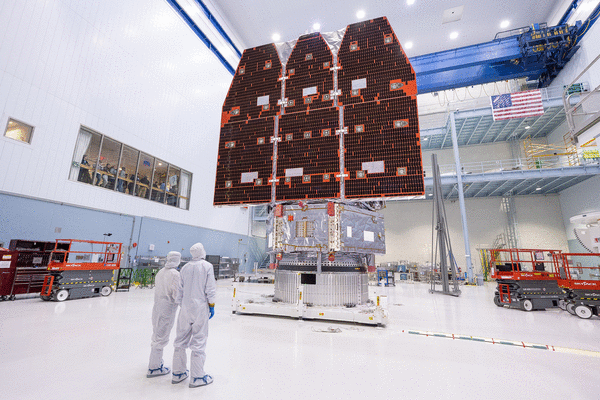
NASA's Nancy Grace Roman Space Telescope — a $4.3-billion sister to the Hubble and James Webb telescopes — launched into space Sunday morning on a SpaceX rocket with space enthusiasts and scientists from around the world looking on.
Once fully operational, the observatory is expected to vastly expand scientists' inventory of planets outside our solar system, increasing it from about 6,300 planets to more than 100,000. Scientists aim to find some of those with a cutting-edge instrument built by NASA's Jet Propulsion Laboratory in La Cañada Flintridge.
"It's a little bit like having a kid go off to college," said Vanessa Bailey, JPL instrument scientist for the planet-hunter, called a coronagraph. "You're used to having it around, being able to go visit it when you want, and now, it's out in the world."
Roman will also complete detailed surveys of the sky to help physicists better understand "dark matter," which pulls the universe together, and "dark energy," which pushes it apart.
Caltech will play a leading role in managing Roman's scientific operations.
A SpaceX Falcon Heavy rocket carrying Roman lifted off from NASA's Kennedy Space Center in Florida at 4:26 a.m. Pacific. As the rocket rumbled along the Space Coast, nerves turned into catharsis for JPL scientists and engineers looking on.
"I had my hands over the rails, white knuckles, as we were counting down — and then just, tears streaming down my face as she went up," said Alina Kiessling, a JPL research scientist who studies dark matter and dark energy.
She watched alongside her husband, JPL Roman project scientist Jason Rhodes, from the space center. Shortly after launch, their nanny at a nearby Airbnb shared a video of their two kids, ages 5 and 1, watching, too.
The rocket successfully deployed the 18,000-pound telescope about 31 minutes after launch. Roman then opened its array of solar panels and sunshades, which power the craft and keep its sensitive instruments cool.
In the middle of a post-launch news conference, NASA Administrator Jared Isaacman's phone began to ring. "The president is excited about Roman," he said.
"I just want to thank everybody and congratulate you. It looked beautiful on television," President Trump (who proposed killing the project multiple times) said on speakerphone. "You are doing a fantastic job."
Roman was initially projected to come in over budget, but a significant course correction helped the telescope launch on budget and ahead of schedule.
While JPLers are already planning their celebrations, Roman coronagraph project manager Feng Zhao said the team won't truly be able to relax "anytime soon."
Over the next three months, Roman will deploy its antenna, adjust its course, and power on its two instruments: JPL's planet hunter and a night-sky surveyor called the Wide Field Instrument.
Roman's final destination is the same cosmic parking lot where the James Webb Space Telescope resides: a million miles from Earth, far past the moon. At this spot, the Earth's and the sun's gravity create a stable point, allowing the spacecraft to better conserve fuel.
Then, it's time for some "very cool science," Zhao said.
Once in operation, the Coronagraph Instrument will attempt to observe planets that are 100 million times dimmer than their host star, a significant improvement over James Webb. To do it, the instrument can maneuver a flexible mirror with near-atomic-scale precision to focus the bright starlight into a pinprick, then block it with a mask so it can observe the dim planet.
Those observations will inform an aspirational future mission — the Habitable Worlds Observatory, which aims to view Earth-like planets more than 1 billion times dimmer than their host stars.
The Wide Field Instrument will focus on observing the night sky with the clarity of Hubble, but cover a vastly greater area than the 36-year-old observatory. With this, scientists hope to better understand dark matter and dark energy, which are invisible but make up 95% of the universe.
Scientists do not yet know whether dark matter is made up of ancient black holes lurking throughout space, undiscovered heavy and slow particles, or unknown lighter and faster particles. The different theories provide different answers for how dark matter should clump. By looking at how dark matter's gravity bends the light of galaxies, Roman will be able to measure this clumping.
As for dark energy, scientists long thought its strength has remained constant throughout the universe's history. However, recent observations suggest it is weakening — potentially jeopardizing Einstein's so far unblemished theory of general relativity and calling into question the leading description for how the universe will die.
Scientists hope Roman's observations, paired with other cutting-edge space and ground-based telescopes, will help settle whether dark energy is constant, or if the recent measurements point to deeper problems in our understanding of the universe.
NASA anticipates the telescope's first images will come in early 2027.
"Doing things like this — launching a telescope into space to uncover the mysteries of the universe — this is the best of humanity. This is what we can aspire to as a species," Rhodes said shortly after launch. "So, I'm on top of the world."
_____
©2026 Los Angeles Times. Visit latimes.com. Distributed by Tribune Content Agency, LLC.






Comments