Antarctic krill fishing is now concentrated in the exact pattern conservation rules were designed to prevent
Published in Science & Technology News
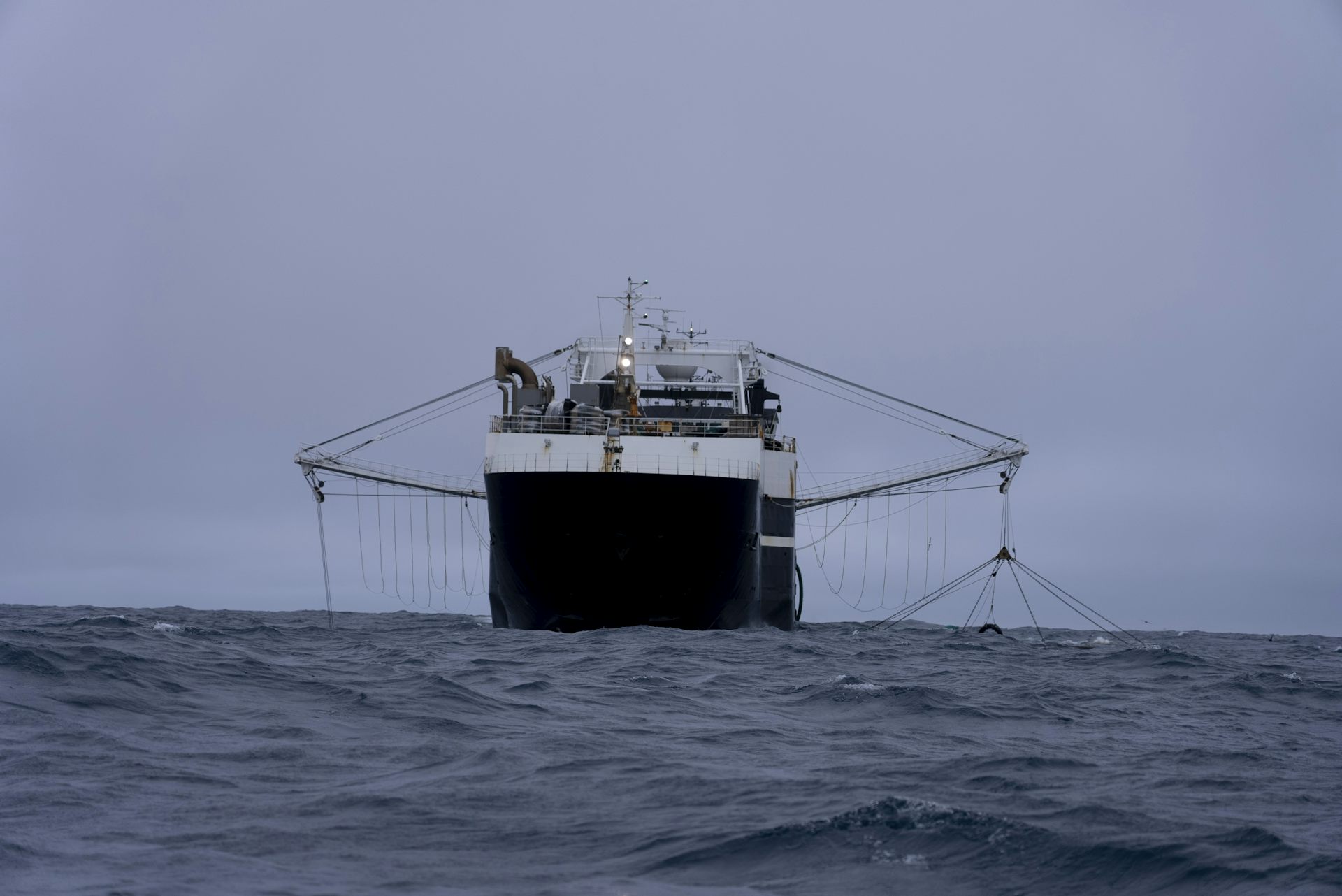
The companies fishing for Antarctic krill have harvested so much so quickly that the season had to close in August 2026, three months before it was scheduled to end. That’s the second consecutive year of an early closing.
The fishing industry has said these developments are evidence that the management system is working as intended: Once the 620,000-ton limit, called a “trigger level,” is reached, fishing must stop. And the evidence indicates that the krill fishing boats do stop when the trigger level is hit.
However, as someone who has been studying Antarctic krill ecology and their role in the Southern Ocean ecosystem for 16 years, what currently concerns me most is how locally concentrated that harvest has become.
Antarctic krill, Euphausia superba, is a principal food source for penguins, seals, whales, seabirds and fish. But krill are not distributed evenly across the Southern Ocean: They gather in dense, patchy groups in particular locations. They are most numerous in the waters off the Antarctic Peninsula stretching into the Scotia Sea.
Breeding penguins and seals depend on high concentrations of krill found relatively close to their colonies because they must repeatedly return to those colonies to feed their young. If they don’t find krill nearby, they can’t go much farther into the ocean to seek alternative prey without risking their young starving on the shore. More than 30 years of observations from the Antarctic Peninsula show why this concentration of krill matters. Models using those observations predict overall penguin performance – factors such as breeding success and foraging trip duration – to decline when fishing removes a high proportion of the krill available locally.
Baleen whales are more mobile, but they depend on exceptionally dense krill patches to make feeding worthwhile and often congregate in the same productive hot spots. There is growing concern around the overlap between the krill fishery and important feeding grounds of the recovering fin whale population.
Perhaps obviously, those locations are also attractive to fishing vessels, because it’s most efficient to catch large amounts of krill in those places. Krill meal is used as feed for aquaculture, pets and ornamental fish, among others. While some nations use krill meal as an additional food source for their people, human use of krill products is primarily through dietary supplements containing oils that are extracted from krill.
An intergovernmental agency called the Commission for the Conservation of Antarctic Marine Living Resources, better known by its acronym CCAMLR, manages the Antarctic krill fishery, among other sea life in the Southern Ocean. It was created in 1982 amid concern that the rapidly expanding krill fishery could remove too much food from penguins, seals, whales and other predators. At present, 26 countries and the European Union are members of the commission.
In 1991 the commission set a precautionary threshold of 620,000 tons on the annual catch of krill across a region known as Area 48, which extends from the Antarctic Peninsula across the Scotia Sea. CCAMLR refers to this threshold as the “trigger level” because reaching it was intended to trigger a management system splitting the region into smaller areas, with their own specific catch limits, before catches could increase further.
The commission recognized that catching even a relatively small amount of krill could damage local ecosystems if it all came from a small area. In 2009, it placed regional caps within the 620,000-ton trigger level, limiting how much could be taken from each of four subareas within the broader Area 48: the Antarctic Peninsula, the South Orkney Islands, South Georgia and the South Sandwich Islands.
While the regional caps were in effect, krill fishing ran the full year without ever hitting the trigger level.
The conservation measure that established the regional caps expired in 2024, and was not renewed or replaced. The trigger level remains in force, but companies are now allowed to fish for krill in whichever krill-rich areas they find most productive.
In each of the two seasons since then, fishing companies have hit the 620,000-ton trigger level months before the end of the season, in part by focusing their efforts on places where they can catch the most krill.
Global Fishing Watch’s vessel tracking shows that in 2026 the krill fishing fleet operated primarily in the Bransfield and Gerlache straits of the Antarctic Peninsula and northwest of the South Orkney Islands, with little to no fishing in the rest of Area 48.
Krill fishing is now happening in precisely the concentrated pattern the regional-cap conservation measure was created to prevent.
The concentration of fishing comes as the overall ecosystem is becoming more vulnerable as a result of climate change. The Antarctic Peninsula and Scotia Sea are among the fastest-warming places on the planet.
Decreased sea ice cover, changing wind patterns and warming ocean temperatures are already altering krill habitat and the Southern Ocean food web. A long-term analysis of the Antarctic krill population in this region found that their densities declined by about 59% between the late 20th century and more recent decades, with the sharpest declines in the northern part of their range.
Because of the rapid changes to the marine environment of the Antarctic Peninsula and the region’s exceptional ecological importance, Argentina and Chile have proposed a marine protected area to conserve important habitats, biodiversity and ecological processes. The proposal, developed through years of scientific planning, would also protect areas important to krill and the predators that depend on them. But eight years after it was formally submitted to CCAMLR, member nations have still not reached the consensus required to adopt it.
The CCAMLR members next meet in October 2026. At that meeting, members need to restore binding spatial limits on krill catches while agreeing on a more sophisticated ecosystem-based management system that distributes fishing at scales relevant to krill and their predators. The proposed marine protected area will also be up for discussion, again. The concerns that led to the committee being created 44 years ago – fears about krill fishing harming krill-dependent Antarctic wildlife – have not diminished over the decades.
This article is republished from The Conversation, a nonprofit, independent news organization bringing you facts and trustworthy analysis to help you make sense of our complex world. It was written by: Kim S. Bernard, Oregon State University
Read more:
Whales are recovering from near extinction, but industrial fishing around Antarctica competes for their sole food source
Waiting for an undersea robot in Antarctica to call home
200 years ago, people discovered Antarctica – and promptly began profiting by slaughtering some of its animals to near extinction
Kim S. Bernard receives funding from the National Science Foundation and National Geographic. She has served as an invited scientific expert for CCAMLR through the Scientific Committee for Antarctic Research.







Comments