Trump administration spares Southwest from harshest water cuts in new Colorado River plan
Published in Science & Technology News
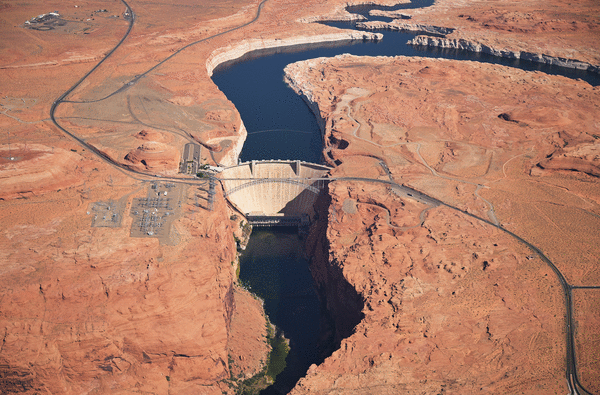
The Trump administration has released its long-awaited 10-year plan for dealing with worsening water shortages along the Colorado River. Instead of ordering the most drastic water cutbacks it could have imposed, the administration chose to take more of a wait-and-see approach.
The plan allows for harsh water cuts if they’re deemed necessary, requiring California, Arizona and Nevada to cut up to 3 million acre-feet per year — up to 40% of the combined allotments.
But as the Los Angeles Times reported last week, state and local officials say for the first two years, the Trump administration is accepting an offer the three states made to reduce what they take from the river by about half that amount — 3.2 million acre-feet between now and the end of 2028. So the Southwest has for now, avoided the harshest possible water cuts.
The Trump administration’s plan, announced Friday, will allow the federal government to reassess every two years.
It aims to strike a compromise between two quarreling groups: the three downstream states of California, Arizona and Nevada, and the upstream states of Colorado, Wyoming, Utah and New Mexico.
The 10-year plan is designed to deal with “unprecedented hydrologic conditions,” said Andrea Travnicek, the Interior Department’s assistant secretary for water and science.
The agency said in its announcement that “drought conditions over the past 25 years,” and the likelihood of continued dry conditions, made it “particularly challenging” to come up with new rules.
The Trump administration’s statement did not mention climate change. But extensive research shows global warming, driven by the use of fossil fuels and other emissions of planet-heating gases, is intensifying the extremely hot and dry conditions.
Under the two-year deal, which has not yet been released, officials say California will cut its use of Colorado River water by about 12% through 2028, Arizona will take about 31% less and Nevada 28% less.
The Interior Department called it a flexible approach “to respond to changing conditions” on the drying river through 2036.
The Colorado, a major water source for seven states and northern Mexico, has shrunk dramatically since 2000, and its largest reservoirs, Lake Mead and Lake Powell, have dropped this year to the lowest combined levels on record.
The federal government was required to set new rules for addressing shortages this year because the old rules are expiring.
Representatives of the seven states have repeatedly deadlocked in negotiations, while the river’s reservoirs have continued to decline.
During the last decade, scientists have found that roughly half the decline in the river’s flow has been caused by higher temperatures, and that for each additional 1.8 degrees the region warms, the river’s average flow is likely to decrease about 9%.
Scientists say climate change is driving the aridification of the Southwest, a long-term shift to drier conditions that will require permanently taking less from the river.
The Colorado provides water for about 35 million people and 5 million acres of farmland from the Rocky Mountains to northern Mexico. It was originally divided among the states under a 1922 agreement.
The Interior Department said the three lower states used 49% of the water from 2020 to 2024, while the upper states used 29%. The agency said 11% evaporated from reservoirs and along the river, and Mexico used the remaining 11%.
The U.S. Bureau of Reclamation is not requiring water cuts for the four upstream states — Colorado, Wyoming, Utah and New Mexico — over the next two years.
The Trump administration is, however, providing funds for water-saving efforts, including $350 million for the lower states and $100 million for the upper states. The money comes from the Biden-era Inflation Reduction Act, and will go to pay cities to leave water in Lake Mead, and farmers and ranchers to leave fields dry.
About three-fourths of the water that’s taken out of the river is for agriculture, producing hay, lettuce, broccoli and other crops.
The Trump administration published its plan in a document called a final environmental impact statement. It will soon release more details in what’s called a record of decision, and in its guidelines for 2027 and 2028.
“This is an important milestone, but it is not the finish line,” said JB Hamby, California’s Colorado River commissioner.
He said California’s use of Colorado River water has already decreased to the lowest level since 1949, and the state is agreeing to further help reduce water use because “the Colorado River no longer reliably produces enough water to support all the uses and expectations built around it.”
Southern California’s cities get nearly one-fourth of their water from the river. Farms in the Imperial Valley depend entirely on the river.
Since 2020, the river flow has averaged 32% less than during the last century, according to federal data.
The country’s two largest reservoirs are now about three-fourths empty.
Near Las Vegas, Lake Mead is 27% full. Lake Powell, on the Utah-Arizona border, is at just 23% of capacity. If it drops an additional 32 feet, water won’t reach its intakes to generate hydroelectric power.
This year, the upper portion of the river’s watershed in the Rocky Mountains had the least snow on record.
In a July study, scientists estimated that global warming made this year’s severe snow drought along the upper Colorado River 14 times more likely than before the Industrial Revolution.
The researchers said in their study, published in the journal PNAS, that this kind of severe snow drought will continue to happen more frequently as levels of greenhouse gases rise, and that reducing emissions “would reduce this risk and should be pursued ambitiously.”
©2026 Los Angeles Times. Visit at latimes.com. Distributed by Tribune Content Agency, LLC.






Comments