Silicon Valley donors poured $194 million into California politics. Now comes the wealth tax fight
Published in Science & Technology News
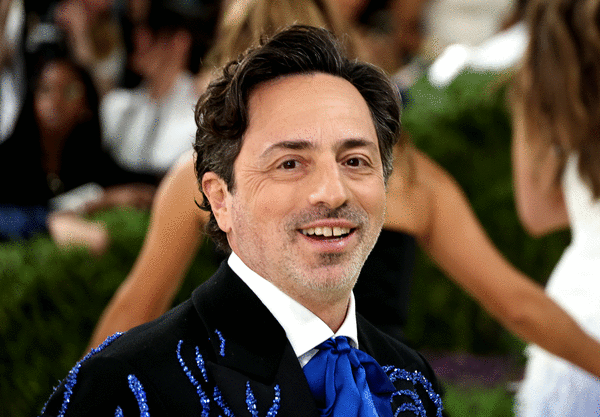
For more than 15 years, Google co-founder Sergey Brin didn’t spend a cent in California elections, but earlier this year, when it seemed likely a union-backed wealth tax would make its way onto the November ballot, he reopened his wallet.
The $85 million that he’s contributed so far this year eclipses his past political spending in the state. The sum is nearly 57 times what he donated between 2004 and 2010, according to campaign finance data from the California Secretary of State’s Office. All but $3.1 million of those contributions have gone to Building a Better California, a recently formed group that has already spent heavily to undercut the proposed tax, a one-time 5% levy on the state’s roughly 200 billionaires.
Brin’s surge in spending is part of a broader shift as Silicon Valley titans reconsider their role in California politics. The 2025-26 election cycle has brought a new wave of tech money, with leaders including Coinbase CEO Brian Armstrong, Reddit CEO Steve Huffman and Snap CEO Evan Spiegel making their first political contributions in California to candidates running this year.
A Bay Area News Group analysis of campaign finance data found that 34 Silicon Valley executives and investors, along with 14 of their spouses, poured $194 million into state elections over the past year and a half. Eighty-two percent of the donors contributed more this cycle than they had in the prior 24 years combined. Brin’s donations alone represented 42% of the total.
The five biggest donors this cycle spent nearly five-and-a-half times as much as they had in past elections. Only one, venture capitalist John Doerr, had previously spent more. The other top donors included Ripple crypto executive Chris Larsen and his wife Lyna Thi Lam, venture capitalist Michael Moritz and his wife Harriet Heyman and Netflix co-founder Reed Hastings and his wife philanthropist Patty Quillin.
The analysis included Silicon Valley donors who gave at least $500,000 to candidates and political committees in California state elections.
Why tech leaders are spending now
Several forces are driving the spending, with the wealth-tax campaign among the most significant.
Richard Hasen, a political science professor at UCLA, said it is part of a broader trend of the ultrawealthy getting involved in politics nationwide. In California, several other factors are also at play.
“Many of our richest people are in the tech or tech adjacent world, whether that’s crypto or AI,” he said. “There are issues that are currently before California legislators and voters where there is a lot on the line for these people.”
The wealth tax, Hasen said, has also played a major role as it’s in many billionaires’ interest to use some of their money to defeat an initiative “that would potentially take much more money away from them than they might spend on the campaign.”
Y Combinator CEO Garry Tan, who has spent hundreds of thousands of dollars in San Francisco politics in recent years, said in a statement that “tech leaders realized they couldn’t stay on the sidelines any more.”
“Concerns about public safety, housing, and the business climate made it clear that policy decisions are directly affecting innovation and California’s future,” he said.
Tan launched Garry’s List in February with the goal of boosting centrist ideas and candidates across California. The organization is among several new political groups, including Building a Better California, backed by tech leaders. Their emergence suggests the industry is building political infrastructure intended to endure beyond the midterms.
The data indicates that the cohort is not acting as a monolith: Its members contributed to nearly 180 different committees and candidates.
Some donors, including Hastings and Quillin, spread their money around, contributing to the campaigns of more than 90% of the state legislature. Huffman, by contrast, devoted more than $1 million exclusively to backing San Jose Mayor Matt Mahan’s campaign for governor.
Spokespeople for first-time California political donors Armstrong, Huffman and Spiegel did not respond to requests for comment.
Mixed results at the ballot box
Silicon Valley’s latest political investments produced mixed results in the June primary: Its most visible candidate campaigns failed, while a slate of legislative candidates advanced.
The effort to propel Mahan into the governorship came up short as the mayor placed well outside the top two to advance to November. Political experts cited a variety of reasons for Mahan’s inability to take off, including his late entry into the race, messaging issues and internal campaign disagreements over strategy. The California Back to Basics committee supporting the mayor’s run raised more than $27 million, with an average contribution of nearly $381,000.
Entrepreneur Ethan Agarwal, whose tech backers hoped to unseat Silicon Valley Rep. Ro Khanna over his support of the wealth tax, also failed to advance, with the Democrat finishing a distant fourth behind the incumbent and two Republicans. Agarwal raised roughly $723,000 and also loaned himself nearly $1 million, while Khanna barely had to dip into his nearly $17 million war chest, according to Federal Election Commission filings.
While the high-profile campaigns failed, Grow California, a group funded by Larsen and investor Tim Draper, found success in down-ballot races. Candidates it backed in eight legislative contests advanced to the November election. Larsen has also given $7.5 million to groups opposing the wealth tax, campaign finance filings show.
Larsen and his wife were the second-biggest spenders of the election cycle, shelling out $25 million.
Grow California says it aims to expand opportunity for Californians by focusing on kitchen-table issues such as housing and affordability. The group supports tying public investments to measurable results, a governing principle embraced by moderates in recent election cycles. Larsen has been vocal about concerns that unions hold too much sway over the state legislature.
Shaudi Fulp, a political strategist advising Grow California, said the group uses data to identify the issues voters care about in each district, then finds candidates who can advance those priorities.
Of the eight races in which Grow California spent heavily, only one, Assembly District 36 in Southern California, had an incumbent: Republican Assemblymember Jeff Gonzalez. The group spent more than $800,000 in the primary backing one of his Democratic challengers, Imperial Councilmember Ida Obeso-Martinez.
In Assembly District 12, which represents parts of Marin and Sonoma counties, Grow California spent roughly $300,000 supporting Democratic Marin County Supervisor Eric Lucan. His campaign focused on cost-of-living issues and climate resilience, a cause Larsen has supported through private investments. Lucan advanced to November and will face Rohnert Park Councilmember Jackie Elward, whom the group spent nearly $750,000 trying to defeat.
Elward, the progressive Democrat in the race, told the Press Democrat in May that Larsen and Draper ran attack ads about her because “they think they can flip this traditionally progressive seat.” One ad blamed her for increasing utility rates, but the councilwoman said it was taken out of context because the rate increases were tied to major infrastructure projects.
In Silicon Valley, Grow California spent more than $1 million to boost Democratic Union City Councilmember Scott Sakakihara’s bid to succeed state Sen. Aisha Wahab. Sakakihara, a former Palantir executive, also received outside financial backing from Uber and Meta. He will face Republican Linda Price in November. Two of his leading Democratic opponents, West Valley-Mission Community College District Trustee Anne Kepner and San Jose City Councilmember David Cohen, received numerous endorsements from labor unions. The crowded field split the Democratic vote, producing a Democrat-Republican runoff in a heavily Democratic district.
Cooper Teboe, a Democratic campaign strategist and Silicon Valley donor adviser to politicians including Rep. Sam Liccardo and Khanna, likened the contrast between Grow California’s approach and the effort behind Mahan to a “tale of two cities.”
“They’re not trying to place their people into races, they’re not going around recruiting,” Teboe said of Grow California, “They’re finding candidates who are already in the community, on the school board or a district supervisor — people who have real roots and real worldviews and happen to agree with them on a few things and then bolstering them.”
By contrast, Teboe said, the unsuccessful groups tried to put their “perfect candidate” in the race.
Tan, the Y Combinator CEO who has been a vocal supporter of both Mahan and Agarwal, disagreed with the strategist’s assertion, saying the candidates’ tech backers had “no role in selecting them.”
“The tech community encouraged both Agarwal and Mahan to run for office, but encouragement is not ‘picking’ or ‘selecting’ candidates,” he said in a statement. “To say so isn’t factual. Mahan has a strong, successful political career all on his own. Agarwal also sought the congressional seat on his own.”
Fulp, the Grow California strategist, said that with a new governor taking the helm next year and a younger legislature, California is at a “precipice.”
“I think it’s been incredibly informative and also inspirational to see a number of people who have not been civically engaged come to the table and really understand that this is a worthwhile cause to invest in, ensuring that California stays competitive and a beacon of innovation,” she said. “That’s going to require long-term multi-cycle participation versus sort of being one issue participants.”
Labor pushes back
Labor leaders view the surge in political spending by wealthy tech executives far less optimistically.
Lorena Gonzalez Fletcher, the president of the California Federation of Labor Unions, said many tech leaders have “tasted a little bit of what it’s like to dominate politics at the federal level” and now have their sights set on California.
The political push comes as the artificial intelligence investment boom intensifies concerns about mass job displacement, a central issue for organized labor. Gov. Gavin Newsom recently signed an executive order directing the state to explore policies addressing those concerns. California also released a first-in-the-nation tracker to monitor AI-related job losses.
“Every billionaire exists because of state infrastructure, because of workers, because of other people that have helped them accumulate wealth, and they don’t want to pay their fair share,” Gonzalez Fletcher said. “They don’t care if what they do affects the rest of California.”
She said the labor movement will “continue to fight and stand up for and speak out for working people” while “billionaires will continue to speak for themselves.” The Labor Federation spent more than $500,000 in the primary opposing Mahan’s candidacy, a sum dwarfed by the spending from the mayor’s tech backers.
Brin, who recently moved to Nevada, did not respond to a Bay Area News Group request for comment. But he addressed his increased political spending and opposition to the proposed billionaire tax in what the New York Times described in an April 27 article as a “rare statement”: “I fled socialism with my family in 1979 and know the devastating, oppressive society it created in the Soviet Union. I don’t want California to end up in the same place.”
A costly November fight
Silicon Valley’s new level of involvement in California politics is likely only beginning as tech leaders gear up for an expensive November fight. The proposed wealth tax has roiled the state, and Building a Better California, whose major donors include Brin, Stripe CEO Patrick Collison, Moritz and Doerr, has already amassed a war chest and spent heavily to boost Propositions 41 and 42. Proposition 41 would apply the state’s spending limit to revenue from new taxes and require audits of programs the money funds, while Proposition 42 would prohibit new taxes on personal property. Either could nullify the wealth tax if it passes with more votes.
Hasen, the political science professor at UCLA, said that while tech billionaires funding candidates can sometimes backfire in liberal California, a deluge of spending against a ballot measure often yields success — enough doubt in voters’ minds can “have a pretty big effect.”
Teboe, the Silicon Valley donor adviser, said this election cycle has fundamentally changed California politics as the campaign moves from the primary into the November election. The wealth tax, he said, has drawn new battle lines among donors and could accelerate California’s move toward a more populist moment. The debate could also affect Newsom, who opposes the state proposal but has called for a national wealth tax as he weighs a presidential run, Teboe said.
The debate, he said, has exposed “the fractures between the haves and have nots”: “Having so much you can put billions of dollars into politics versus not having enough to put food on the table.”
©2026 MediaNews Group, Inc. Visit at mercurynews.com. Distributed by Tribune Content Agency, LLC.






Comments