Andy Mukherjee: Stablecoin is the wrong weapon in US-China fight
Published in Science & Technology News
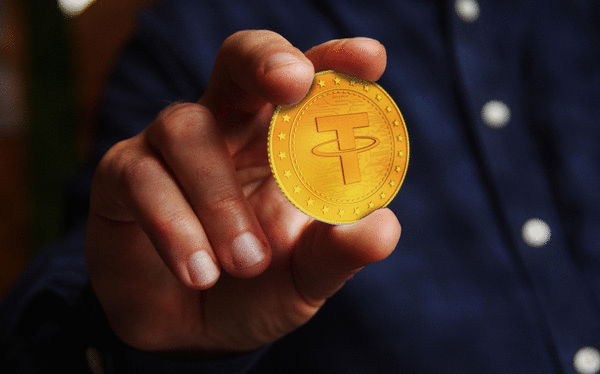
At a gathering of central bankers last month in Basel, Harvard University economist Gita Gopinath presented some unsettling data about stablecoins. Up to three-quarters of Tether’s USDT and Circle Internet Group Inc.’s USDC — the world’s most popular 1:1 dollar clones — are held in wallets where the users control the cryptographic keys.
When money changes hands, it moves from one such self-custody wallet to another in about half of all transactions. Transfers are visible on the blockchain, but the identities of senders and receivers are not. This offers cash-like anonymity. “Stablecoins are now the predominant form of identified illicit activity,” Gopinath said.
The research findings are “frightening,” former Bank of France Governor Francois Villeroy de Galhau said in a panel discussion. For decades, authorities have fought to make money less anonymous by getting rid of high-value paper cash, cracking down on offshore banking secrecy, and tracking bank transfers. However, in crypto, the tide is reversing. Anonymous stablecoin holdings are bypassing U.S.-regulated intermediaries like Coinbase and Kraken. When they do hit centralized exchanges, they’re mostly in jurisdictions outside the reach of the Genius Act, the U.S. stablecoin regulation passed a year ago.
That’s a problem for both Washington and Beijing. The Trump administration views privately issued digital dollar as a potent weapon in its political competition with China. Widespread usage is expected to strengthen U.S. hegemony in international affairs. At the same time, however, the new instrument may erode America’s ability to tax economic activity at home — and its policing power abroad. If the funds don’t even touch regulated U.S. exchanges, who’s going to run checks against money laundering and sanctions evasion?
In theory, China should welcome this unanticipated diminution of Washington’s authority. In reality, Beijing will also be a loser because dollar tokens will undermine its own control over capital flows. While it’s hard to pinpoint the geographical location of privately held crypto keys, many of them are almost certainly in China.
Marco Reuter, a digital-money specialist at the International Monetary Fund, has employed machine learning and artificial intelligence to unmask the real locations of trades in stablecoins. For 2024, he estimated $153 billion in gross stablecoin flows involving China, 5.5 times more than commonly believed. Most of the flows route through non-U.S. exchanges whose websites are blocked on the mainland. Many ordinary Chinese citizens are using virtual private networks to swap their yuan for digital greenbacks.
No wonder then that Beijing is laying its own parallel tracks. If, for instance, Standard Chartered Plc customers want e-CNY, the official digital currency, in Hong Kong, Singapore, or London, the bank can access it for them 24/7 via CBETS,(1)a recently upgraded Chinese platform that connects directly with foreign bank systems. Along with mBridge — a shared blockchain network for central banks — Beijing is offering its trade partners a way to settle commodity deals instantly while avoiding the SWIFT messaging system.
Yet, importantly, the e-CNY is not a stablecoin. It’s a tokenized version of a Chinese commercial bank deposit, changing hands in a controlled, regulated environment. The anonymity and lawlessness of crypto don’t enter the picture. Beijing wants to hit at Washington’s supervision of global payments; it has no interest in smashing the guardrails.
Hong Kong is serving as the sandbox for this state-led vision. The Chinese special administrative region ignored the techno-anarchist dream of letting everyone be their own bank. Instead, it handed its first stablecoin licenses to HSBC Holdings Plc and a consortium led by Standard Chartered. The two banks have been issuing paper money in the financial center for more than 160 years. Hong Kong’s goal is to push stablecoins in everyday use, and employ the underlying blockchain technology to speed up institutional and agentic AI payments. However, the issuers must still run their usual checks on customers, while regulated exchanges are required to verify both senders and receivers.
It’s an experiment to assess genuine retail demand. As Bank of Korea Governor Shin Hyun Song has pointed out, citing research by Kansas City Federal Reserve, only 0.7% of stablecoin holdings are used specifically for payments. Most dollar tokens are sitting inside self-custody wallets, effectively serving as an off-market store of value in U.S. dollars. “It is a very particular type of anonymity that the users are after,” he said in Basel.
With $2.5 trillion of dollar cash in circulation, a $300 billion-plus hoard of tokens held away from the prying eyes of fiscal and monetary authorities may be an acceptable risk to pursue technological innovation. However, as the market in digital greenbacks grows, Washington and Beijing will fight over the future of money — just as they are over control of AI. But neither will want to dilute the power of the state for the sake of their geopolitical rivalry.
©2026 Bloomberg L.P. Visit bloomberg.com/opinion. Distributed by Tribune Content Agency, LLC.





Comments