NASA's moon plans take hit with Blue Origin explosion
Published in Science & Technology News
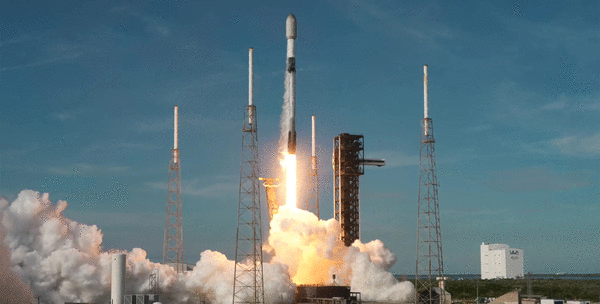
Blue Origin is a central player in NASA’s moon project, but those plans took a big hit Thursday night when one of Jeff Bezos’ rockets catastrophically exploded into a giant mushroom cloud on its Cape Canaveral launch pad.
It’s unknown how long it could take to get the pad up and running again — and the space agency’s timetable for its next Artemis mission, which Blue Origin had hoped to be a part of, is just a year or so away. The mishap could leave the space agency with no alternative than rival SpaceX, a forced choice it has sought to avoid.
The New Glenn rocket was locked down on the pad for a static fire test of its first stage, in which its engines would be lit to make sure they ran properly ahead of an actual launch.
But things went sideways quickly, with the launch pad at Cape Canaveral Space Force Station’s Launch Complex 36 erupting in a fireball. The explosion destroyed the rocket and the transporter erector tower that was holding the rocket in place, and also knocked over one of the two lightning towers at the site.
The recent history of such fiery setbacks is not a positive one for Blue Origin. Its rival SpaceX suffered an on-pad explosion that damaged Canaveral’s Space Launch Complex 40 in 2016. Elon Musk’s company didn’t launch again from the site for more than 15 months.
While Musk was able to continue rocket launches from both its Kennedy Space Center pad as well as Vandenberg Space Force Base in California, Blue Origin doesn’t have a backup launch site for its New Glenn rocket.
NASA had been counting on Blue Origin for several uncrewed lunar missions using its Blue Moon MK1 lunar lander, including one that had been aiming for a launch this fall.
But maybe a bigger hit to NASA’s plans involves Blue Origin’s development of its larger crewed version of the lander, the Blue Moon MK2. A pathfinder version of that lander was aiming to participate in NASA’s Artemis III mission that has been targeting a mid-2027 launch.
Since the Blue Moon MK2 would also need to launch on a New Glenn rocket, a lengthy pad repair could remove Blue Origin’s lander from the mission.
Both Blue Moon and SpaceX’s Starship had been awarded contracts to be the human landing system for Artemis missions.
NASA’s latest plan had been to fly Artemis III with the Orion spacecraft and a crew of four astronauts, launching atop the Space Launch System rocket from KSC and then orbiting close to Earth. At the same time, one or both of the two landers, launching on their own rockets, would then rendezvous with Orion in low-Earth orbit to test out docking in space.
NASA would then choose one of the two landers to fly as part of Artemis IV, with a targeted launch date in 2028. That would be the mission that would return humans to the lunar surface for the first time since Apollo 17 in 1972.
NASA Administrator Jared Isaacman weighed in on social media soon after the explosion.
“Spaceflight is unforgiving, and developing new heavy-lift launch capability is extraordinarily difficult,” he wrote. “We will work with our partners to support a thorough investigation of this anomaly, assess near-term mission impacts and get back to launching rockets.”
In addition, NASA just last week awarded Blue Origin with two more contracts worth a combined $468 million to use its uncrewed MK1 lander to ferry up a pair of lunar rovers that would be used by Artemis astronauts on future missions. Those flights were targeting launch by 2029. The MK1 lander had already been tapped to launch NASA’s VIPER rover to the moon’s South Pole in late 2027.
While work can continue manufacturing the multiple MK1 and MK2 landers as well as replacement New Glenn rocket parts at its Space Coast facilities, the company will need to figure out what went wrong with the static fire test, make fixes and repair the launch pad to move forward.
“It’s too early to know the root cause but we’re already working to find it,” Blue Origin founder Jeff Bezos said. “Very rough day, but we’ll rebuild whatever needs rebuilding and get back to flying. It’s worth it.”
Bezos had spent more than $1 billion to develop the Canaveral site, taking over the lease in 2015. It was previously used for government launches from 1962-2005, including lunar lander Surveyor 1 in 1967 and some of the Mariner probes.
The site includes the launch pad, but also a vehicle integration building where previously flown first stages are refurbished. Also on site are propellant facilities and an environmental control center.
Blue Origin has also invested nearly $2 million more for the New Glenn and moon lander manufacturing sites, mostly based at its campus on Merritt Island.
To date, the company had completed three first stages for New Glenn. The stage that exploded on the launch pad was new. It was named “No, It’s Necessary,” a reference to the film “Interstellar.”
If NASA is limited to just SpaceX for the Artemis III and IV missions, it will need Elon Musk’s company to continue its test launches from Texas and finalize work on a new Starship launch tower under construction at KSC’s Launch Complex 39-A. SpaceX has stated it wants to fly its first operational mission of Starship from the KSC site before the end of the year.
That timeline could mean its version of Starship outfitted with a docking mechanism that works with the Orion spacecraft would be ready for whenever Artemis III launches.
SpaceX is also building out two launch towers at Canaveral’s Space Launch Complex 37, but those won’t be complete until 2027.
While the explosion puts Blue Origin’s plans on hold, it didn’t slow down the launch pace for other providers, with SpaceX flying a Falcon 9 mission on Friday from Canaveral’s Space Launch Complex 40, just 6 miles north of the Blue Origin pad. And a United Launch Alliance mission of an Atlas V rocket was slated for Friday evening.
“Less than 12 hours after a Blue Origin anomaly event at the Cape, SpaceX just had a successful Falcon 9 launch,” new Kennedy Space Center Director Brian Hughes wrote on X. “Space is hard, but NASA and Space Force will continue working with Blue, SpaceX and all our commercial partners at the Cape to keep our nation leading the world in space. Ad Astra.”
_____
©2026 Orlando Sentinel. Visit at orlandosentinel.com. Distributed by Tribune Content Agency, LLC.






Comments