Blue Origin lines up 1st New Glenn launch since rocket was grounded
Published in Science & Technology News
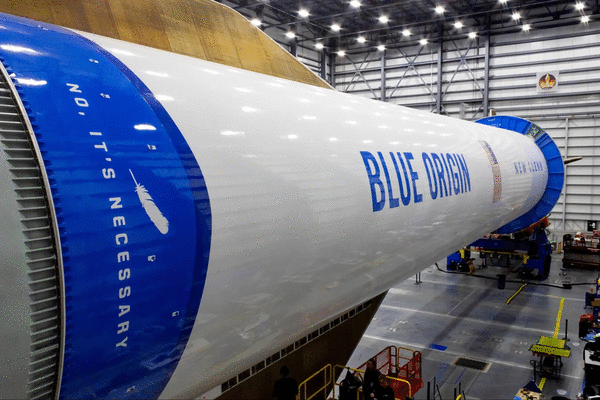
Blue Origin’s time away from the launch pad didn’t last long despite its New Glenn rocket getting grounded by the Federal Aviation Administration in April.
Last week, the FAA cleared New Glenn to return to flight after accepting results and proposed corrective actions to avoid the problem that arose during the NG-3 mission, which saw its upper stage fail to put its payload into orbit.
Now, the FAA has placed the NG-4 mission on its Operations Plan Advisory, with the heavy-lift rocket cleared to launch as early as June 4 during a window that runs from 1:21 p.m. to 3:03 p.m. Eastern time.
The payload will be the first mission to add satellites to the Amazon Leo constellation. Formerly named Project Kuiper, Amazon has more than 100 rockets across four launch providers lined up to get thousands of the satellites to orbit.
It’s the first of 24 missions on New Glenn, which has the largest capacity of all the rockets tapped to carry up Amazon’s satellites. With a nosecone diameter of about 23 feet, it will launch 48 of the satellites.
So far, Amazon has had to rely on United Launch Alliance Atlas V rockets, which can fit at most 29 satellites, SpaceX Falcon 9 rockets, which fit 24, and Arianespace Ariane 6 rockets, which have flown up 32 at a time. Amazon also has dozens of launches on ULA’s new Vulcan rocket under contract, but ULA continues to try and solve an issue with its attached solid rocket boosters before Vulcan flies again.
But with New Glenn’s recent launch woes getting the pass from the FAA, Amazon can now begin reliance on Blue Origin to begin fulfilling its contracts.
New Glenn first launched in January 2025, designed to mimic the rocket reusability of SpaceX’s Falcon 9 with the first stage attempting to be recovered on a vessel stationed downrange in the Atlantic. While the first flight made it to orbit, which had never been done on a commercial rocket’s first flight, the booster “So You’re Telling Me There’s A Chance” did not stick the landing.
The second mission in November 2025, though, was able to see the booster back safely onto the recovery vessel. That booster “Never Tell Me The Odds” was given seven new BE-4 engines and was able to return to flight on April’s NG-3 mission this year, once again sticking the landing.
A third first-stage New Glenn booster named “No, It’s Necessary,” a reference to dialogue from the film “Interstellar”, is the booster lined up for the NG-4 mission.
The company’s investigation into the upper stage issue from the April flight said that one of its two BE-3U engines had suffered a cryogenic leak that froze a hydraulic line. That led to a thrust anomaly during the engine burn of the upper stage, which ultimately meant the payload, the BlueBird 7 satellite for Midland, Texas-based AST SpaceMobile, did not make it to the proper orbit and was destroyed re-entering Earth’s atmosphere.
“There were no public injuries or public property damage,” the FAA stated after closing the investigation. “Blue Origin identified nine corrective actions to prevent reoccurrence of the event. The FAA will verify that Blue Origin implements corrective actions prior to the launch of the next New Glenn mission.”
Blue Origin’s CEO Dave Limp had indicated the company had wanted to try and get at least eight launches up in 2026 before the NG-3 incident.
It has at least one more mission announced which is now targeting fall, according to NASA. That’s when New Glenn will send Blue Origin’s Blue Moon MK1 lunar lander to the moon. The uncrewed lander is headed for the lunar South Pole, carrying with it two pieces of NASA hardware as part of the agency’s Commercial Lunar Payload Services program.
But more importantly to NASA, the mission would pave the way for Blue Origin’s task of building a larger, crewed version of the spacecraft called Blue Moon MK2. A pathfinder version of that, which would be manufactured at the company’s Lunar Plant 1 site in Merritt Island, would need to be flown atop a New Glenn in mid 2027 as part of NASA’s Artemis III mission. That mission seeks to have the Orion spacecraft attempt docking rendezvous maneuvers with one or both of the two human landing systems, Blue Moon and SpaceX’s Starship, on a low-Earth orbit mission.
Depending on the results of that mission, NASA will then choose which of the two landers will be tasked to serve the Artemis IV flight in 2028, which would return humans to the lunar surface for the first time since Apollo 17 in 1972.
Blue Origin is also seeking to get New Glenn certified for national security missions. The company opted to take a four-flight approach to certification, and the completion of NG-4 could line up the rocket to begin getting lucrative task orders under the National Security Space Launch Phase 3 contract alongside ULA and SpaceX.
_____
©2026 Orlando Sentinel. Visit at orlandosentinel.com. Distributed by Tribune Content Agency, LLC.






Comments