New research has this San Diego County desert town at loggerheads on what to do about water
Published in Science & Technology News
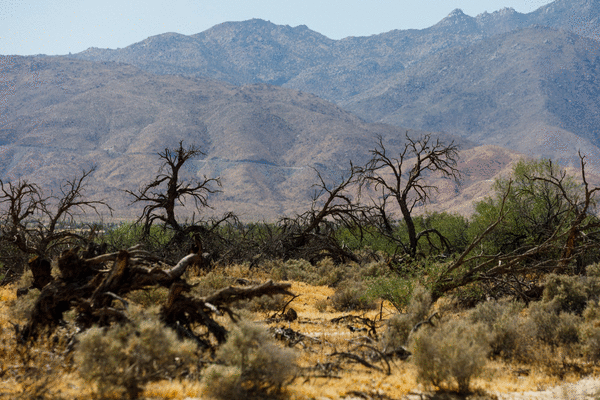
Just off Palm Canyon Drive in Borrego Springs, a dead honey mesquite tree remains rooted in the hot sand. It’s lifeless but not yet useless — not to the creatures that find shade under its branches or the plants that count on its nutrients.
Over the last year, mesquite has been at the heart of a growing water war in Borrego Springs, a tiny but scenic town deep in the San Diego County desert that for years seemed blessed with a rare combination of blazing sun and a font of available groundwater.
A century ago, abundant green mesquite blanketed the landscape. But in the decades since, the forest the trees form has deteriorated — just as the town has pumped too much water out of its underground subbasin to sustain its farms, resorts, golf courses and some 3,000 residents.
Now, controversy has broken out over whether that mesquite forest relies on the same water as the town. Last year, a study led by UC Irvine scientists concluded it does — research that met with hostility from Borrego Springs’ top industries, which control a large swath of its water rights.
Borrego Springs runs entirely on groundwater. But between 1955 and 2020, pumping caused the water table to fall by dozens of feet across the area — including by as much as 126 feet in one area of town.
Under a landmark 2014 state groundwater law, the state determined the town was pumping more water than the system could handle. That ultimately led to a 2021 court settlement in which the town agreed to reduce pumping and stabilize the subbasin.
Whether the mesquite and the ecosystem it supports rely on that at-risk water isn’t just a matter of scientific debate. It has real consequences for how much water the town can use, and it has emerged as a major battle over the future of the town’s water supply, open space and economy.
The board of Borrego Springs’ Watermaster, which regulates the water supply, has spent months debating whether the mesquite needs the groundwater they have jurisdiction over. This week, they’re set to hear from a technical consultant they’ve hired to analyze the findings of the UC Irvine researchers and give them recommendations for how to proceed.
If the Watermaster determines based on the best available science that the mesquite uses groundwater, then under state law they’ll have to reduce the town’s pumping to account for it — forcing other big water users to cut back.
John Peterson, a former county hydrologist who serves on an advisory panel for the Watermaster, said protecting ecosystems like the one the mesquite supports comes down to “more of a moral issue than anything else.”
“People say we want enough water for us to be able to pump out of the system,” Peterson said. “But on the flip side, we live in an ecosystem out here.”
In 2020, in order to stabilize the subbasin, and comply with state mandates, the town’s business interests, landowners and community began coordinating plans to reduce their pumping by 70% by 2040.
So far, the effort has seen real results. Within the first five years, the town slashed pumping by nearly 30%, going from 14,300 acre-feet of water, roughly 4.7 billion gallons, to 10,100 acre-feet last year, about 3.3 billion gallons.
Those who control the town’s water supply consider themselves a leading example of how a community can band together to manage its groundwater. But the new research is challenging that consensus.
Mark Jorgenson, who supports the UC Irvine findings, is one of five Watermaster board members, each representing a group with a stake in the water. He represents town residents; others represent recreational interests, farmers, the county and the Borrego Water District.
“Our forward progress is coming to a screeching halt because we can’t agree on this mesquite issue,” he said.
It’s not yet clear how sharply Borrego Springs would have to slash its water use if the town’s mesquite forest is formally determined by the Watermaster to be dependent on groundwater.
Jim Bennett, a county hydrogeologist who represents the county on the Watermaster board, has called for an outside legal review to help them better understand how state law applies.
Other Watermaster board members who represent the town’s recreation interests and farmers have already emerged as leading critics of the new research. They’ve hired their own technical consultants who dispute the UC Irvine findings.
For industry, there’s a lot at stake. For years Borrego Springs’ golf industry has been buying up much of the town’s water rights. Companies tied to Rams Hill, the town’s largest golf course, have now locked up a third of them, and Rams Hill’s CEO Shannon Smith sits on the Watermaster board representing recreation.
Smith did not respond to requests for comment. But the resort he runs is currently planning a major redevelopment to build another 18-hole course and nearly 1,000 more homes, on top of the roughly 260 already there.
“They’re active in the market,” said Geoff Poole, the general manager of the town’s water district. “They pretty much bought everything that’s become available.”
Mesquite bosque’s decline
Around Borrego Springs, native honey mesquite trees intertwine in thick stands that form what’s known as a bosque, their branches lined with yellow flowers and green bean pods. This bosque can support more than 250 species, from Costa’s hummingbirds to badgers and jackrabbits.
That forest “is actively using groundwater,” concluded a study published last May by a team of researchers from UC Irvine, the Tubb Canyon Desert Conservancy and the San Diego Natural History Museum.
“We urge the Borrego Springs Watermaster and other relevant management and conservation groups to take immediate actions to protect and conserve the mesquite bosque and its reliant biodiversity,” they wrote.
Concern for the mesquite bosque dates back decades, says David Garmon, president of the Tubb Canyon conservancy. Its health started declining back in the 1940s, around the same time Borrego Springs began pumping groundwater — which led many to see the plant’s degradation as a result, he said.
Then the roughly three decades ending in 2015 saw an 84% drop in its vegetation vigor, a metric for a plant’s overall health, said Bennett, the county’s representative on the Watermaster.
Following the 2014 state groundwater law, the county and the town’s water district inked a plan to bring pumping under control, but the plan downplayed the issue of the mesquite. The document described the mesquite bosque as covering just 13 acres — the new study clocks its size at nearly 3,000 — and the plan did not name it as a groundwater-dependent ecosystem.
At the time, Garmon was shocked. “They did it without even an effort of scientific discovery,” he recalls.
Poole acknowledges the limitations of what was in the plan his agency agreed to six years ago, calling it “really more of a literature search and kind of that preliminary, cursory type of analysis.” He says they didn’t have the time or money to investigate the bosque’s water needs, and if they had, they may well have reached the same conclusions as the UC Irvine team.
Travis Huxman, a UC Irvine ecology professor and one of the authors of last year’s study, said the plan missed so much because it relied on flawed mapping and cursory data analysis.
“It was set up to miss groundwater-dependent ecosystems,” said Huxman, who is also the faculty liaison for the Steele/Burnand Anza-Borrego Desert Research Center.
Between analyses of the mesquite, one key question remains unanswered: How deep do its roots go? In Borrego Springs, no one has ever actually confirmed that.
Mesquite roots descend deep into the earth, but just how deep varies widely. Borrego Springs’ 2020 groundwater plan estimated them at about 15 feet, relying mainly on roots measured in Harper’s Well, about 20 miles away. Meanwhile, local well measurements in that plan pegged the water table in the heart of the mesquite bosque as having fallen from 11 feet below ground in 1955 to 55 feet below ground by 2020.
But the UC Irvine researchers found evidence the roots reach at least 40 feet deep, with groundwater depths ranging from 13 to 94 feet — within reach of the mesquite. That led them to conclude “it is probable that there are mesquite still capable of accessing groundwater based on these rooting and groundwater depths.”
Many members of the Watermaster board have questioned those findings, suggesting more research is needed before determining if the mesquite bosque is groundwater-dependent.
“As presented, the analysis offers conceptual insight but does not meet best available science for ecological interpretation,” Bennett wrote to a technical consultant last fall.
Meanwhile, consultants hired by golfing and farming interests in Borrego Springs have offered alternative hypotheses for how the mesquite gets water, such as rain, runoff, moisture in shallow soil and a perched aquifer that forms above the town’s subbasin.
Bennett finds these alternative explanations “plausible” but says their role “remains uncertain.”
Gita Bodner, a conservation ecologist with the Nature Conservancy in Arizona, noted that individual mesquite trees do use rainwater and even store it from past seasons for future use.
“They have these really neat adaptations,” she said. “But they don’t get to that sort of bosque stature unless they have access to some other big pool of water, like groundwater.”
A changing water landscape
Belt-tightening on water usage has already ushered in big shifts for the town’s economy.
Squeezed by the state-mandated reductions and by the demand from local golf courses, many farming businesses like citrus groves and palm tree farms have gone under, leaving fallow fields of trees to punctuate the arid landscape as owners cash out their water rights.
“It just ruined the overall farming industry in Borrego,” said Françoise Rhodes, who heads the town’s Chamber of Commerce.
In its place, another industry has come to define the town’s economy — tourism and recreation, especially golf. But over the decades those businesses have struggled to stay afloat, too.
“Historically, every generation has gone through a bankruptcy in Borrego,” said Jack McGrory, who served as San Diego city manager in the 1990s and now owns La Casa del Zorro Resort & Spa in Borrego Springs in addition to about 1,000 acres of farmland.
But since the 2008 financial crisis, the town’s resorts have bounced back in a major way — especially its biggest, Rams Hill.
In 2013 the property was bankrupt when an investor group led by Terry Considine, a San Diego-born developer and former Colorado state senator, stepped in to buy it. Today, Rams Hill ranks among the country’s top 100 courses, according to Golf Digest.
That success enabled it to complete major renovations last year that involved replacing most of its greens with less water-intensive TifTuf Bermuda grass. In a San Diego Union-Tribune article last year, general manager Harry Turner estimated it would cut water usage by 25%.
Still, over the years, Rams Hill and other business entities linked to Considine have emerged as the largest private owners of water in Borrego Springs, controlling the rights to a third of its water. County property records show their water holdings spread across much of the map of the area, including agricultural land.
Buying and trading rights to the town’s scarce water has become very common, said McGrory, who sold the water rights on about 150 acres of farmland to Rams Hill in recent years.
Jorgenson, the Watermaster’s community representative, expressed frustration over Rams Hill’s acquisition of water rights, especially as the town’s water supply gets more and more limited. “You don’t have to use every drop,” he said.
This expansion of its water supply comes as Rams Hill pursues a major redevelopment. In 2024, it submitted a proposal to the county to add more than 900 new homes, a new 350-room hotel and a new 346-acre golf course expansion, county planning records show.
County planners flagged several major issues, groundwater use among them. Borrego Springs’ water supply may not be able to support the additional groundwater use needed, they warned, and Rams Hill needed to study whether development would impede conservation efforts — a requirement for the project to get state environmental approval.
Last fall, Rams Hill was drafting an environmental impact report for the redevelopment, said county spokesperson Donna Durckel. She said county planners are waiting for it to submit a new application that addresses their concerns.
_____
©2026 The San Diego Union-Tribune. Visit sandiegouniontribune.com. Distributed by Tribune Content Agency, LLC.






Comments