'Chonkers,' the massive sea lion, is drawing crowds at San Francisco pier
Published in Science & Technology News
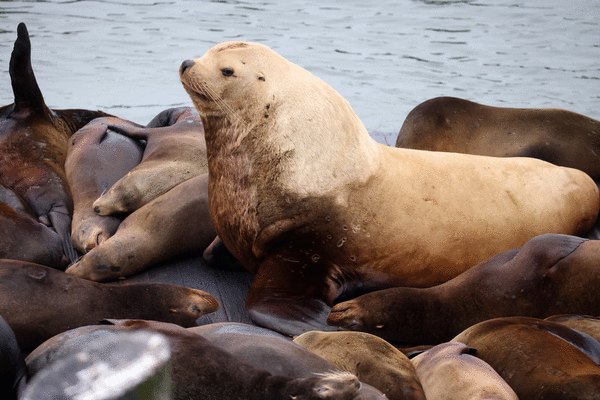
It's a sight to behold — the 1-ton sea lion peeking his head out of the water in San Francisco Bay and triggering a panic as other sea lions hustle to get out of the way.
There's a lot of barking, and suddenly the big fella hops onto the wood platform, sending the other pinnipeds jostling for a new spot in the sun or diving back into the water.
At Pier 39, the sea lion known as "Chonkers" is king, and his sheer size and proximity to a major tourist hub has made him a beloved viral animal obsession, on par with recent celebrities Moo Deng and P-22.
"I saw on the news about Chonkers in Atlanta, Ga., and I came all the way to San Francisco to see him," one visitor told CBS News.
"I'm looking for the big one," another person said. "Looking for Chonkers."
Chonkers is a Steller sea lion, which is a heftier variety of the species compared to his California sea lion counterparts.
According to experts at the Marine Mammal Center, he and the other sea lions arrived in the bay in mid-March, following prey including anchovies and rockfish.
He has attracted interest on online forums like Reddit, where users are posting photos and videos of him sunning and scratching his belly with his flippers next to the other sea lions.
"They figured out that in the bay they're away from their predators like the great white shark and orca whales," Laura Gill, public programs manager at the Marine Mammal Center, explained in a social media post discussing Chonkers and his ilk. "And the docks themselves are a huge draw ... it's kind of the ideal pit stop as they're migrating along the coast."
Male Steller sea lions weigh up to 2,500 pounds and reach 11 feet in length with a lifespan of 20 to 30 years, and females can grow to be 9 feet long and weight 1,000 pounds, according to the Marine Mammal Center website.
Chonkers is from the Eastern population group of Steller sea lions along the U.S. and Canadian coast, according to the center. His presence is particularly special because Steller sea lions haven't been spotted at Pier 39 since 2023, the center said.
"Chonkers the Steller sea lion is back at Pier 39 today!" one Reddit user posted in March. "... lounging at the back. Come and get a glimpse of him before he swims away."
"He'd have 20 Twitter accounts in better times," another Reddit user commented in response to the post.
The marine animal's newfound fame is not unlike that of other creatures that became a cultural phenomenon. In 2024, the pygmy hippo Moo Deng in Thailand captured hearts around the world with her water splashing, knee-biting antics spreading like wildfire on TikTok and other platforms. A decade earlier, photos of P-22, a Southern California mountain lion, caught the public's imagination with his furry face and urban L.A. background.
Sea lions actually earned their "lion" moniker because of the furry mane the Steller species develops, Gill said. Adult male Steller sea lions also don't have a visible sagittal crest (the bump on the top of their heads) that is observed in adult male California sea lions, according to the Marine Mammal Center. California sea lions don't usually exceed more than 850 pounds and 7 feet in length.
Steller sea lions live in coastal waters of the northern Pacific, and around Japan and Central California, according to the center. Breeding occurs in regions spanning from Año Nuevo Island in Central California to the Kuril Islands north of Japan, with the greatest concentration of breeding grounds in the Gulf of Alaska and the Aleutian Islands.
Steller sea lions are separated into Western and Eastern populations and are differentiated by physical and genetic attributes.
Their pups are born in mid-May to mid-July and usually weigh 35 to 50 pounds, according to the center. The mothers stay with them for up to two weeks before heading out to hunt at sea.
Mating occurs about two weeks after the pups are born. Males don't eat during mating season, but when they do they feed on fish, invertebrates and other pinnipeds. Killer whales and white sharks are their primary predators.
_____
©2026 Los Angeles Times. Visit latimes.com. Distributed by Tribune Content Agency, LLC.






Comments