Florida finds an unexpected ally in the fight against pythons: Opossums
Published in Science & Technology News
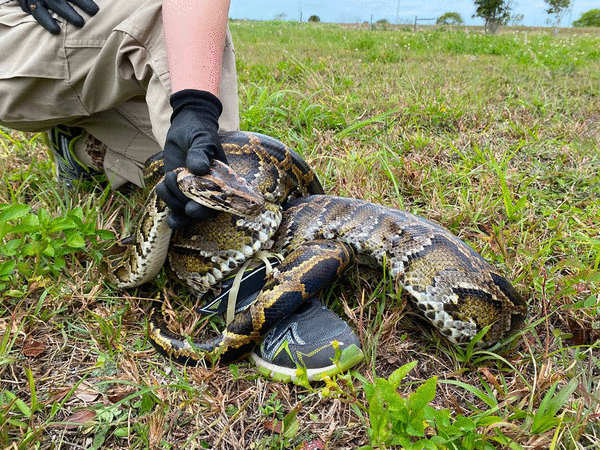
Scientists in Florida have launched a new offensive against the Burmese python invasion, this time using opossums, one of the giant snake’s favorite prey.
The initiative comes from biologists A.J. Sanjar and Michael Cove of the Crocodile Lake National Wildlife Refuge in Key Largo, South Florida.
The researchers attach tracking devices to three-pound opossums, allowing them to track and capture the pythons, an invasive species that devours local wildlife.
Sanjar, Cove, and Jeremy Dixon—the refuge’s manager—told the Sun Sentinel that they have made significant progress in refining this method over the past two years, turning it into an effective tool.
They currently have 32 GPS-collared animals in the field and expect to have at least 40 by summer.
Sanjar has determined that the most opportune time for this work is summer, when pythons begin to accumulate reserves for the breeding season, which occurs in late autumn.
Scientists clarified that they are not using opossums as bait. These marsupial mammals are a common prey for Burmese pythons, something researchers discovered by accident in 2022 while studying the movement and behavior of small mammals.
At that time, researchers attached GPS collars to opossums and raccoons along the southern coast of Florida.
“When a python swallowed one of the tagged animals whole, the collar continued transmitting, allowing researchers to track the snake’s location,” the Sun Sentinel reported.
All the snakes captured using this method measured more than eight feet long, and the largest reached almost 13 feet.
“These are all reproductively viable pythons,” Dixon said.
Using opossums has become one of the most successful techniques for python removal in Key Largo.
Thanks to this method, 18 large pythons have been captured. Many of these snakes—often females—would have laid between 30 and 60 eggs during the spring had they not been intercepted.
Burmese pythons were first detected in Key Largo in 2007. Since then, snake captures have increased, while sightings of opossums, wood rats, and cotton mice have decreased.
©2026 Miami Herald. Visit at miamiherald.com. Distributed by Tribune Content Agency, LLC.






Comments