In race to prep for Artemis III, rocket's core stage on way to Kennedy Space Center
Published in Science & Technology News
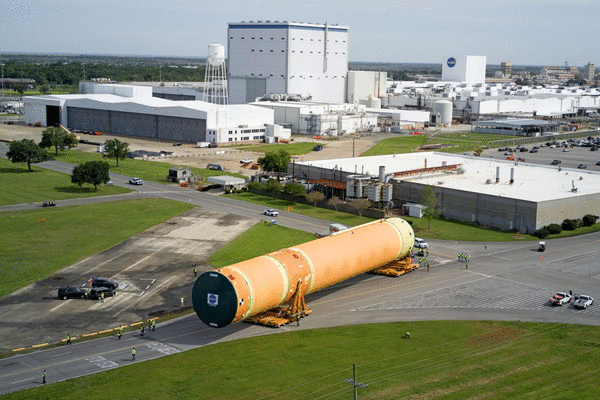
The biggest piece of rocketry needed for the next Artemis mission is headed to Florida.
While the base of the Space Launch System rocket’s core stage has been waiting at Kennedy Space Center’s Vehicle Assembly Building since last summer, the top four-fifths of what will be a 212-foot-tall piece of hardware was loaded onto NASA’s Pegasus barge Monday after shipping out from the Michoud Assembly Facility in New Orleans.
The barge is expected to arrive to KSC on Monday.
Prime contractor Boeing has been putting the finishing touches on the hardware slated to fly on the Artemis III mission as soon as mid 2027. The top section of the core stage includes the liquid hydrogen tank, liquid oxygen tank, intertank and forward skirt.
“Seeing this SLS rocket hardware roll out is a powerful reminder of our progress toward returning humans to the lunar surface,” said Lori Glaze, acting associate administrator, Exploration Systems Development Mission Directorate. “This is the backbone of Artemis III. As it heads to Florida for final integration, we are one step closer to testing the critical capabilities needed to land Americans on the moon, and ultimately, paving the way for our first crewed missions to Mars.”
After the success of Artemis II, which sent four astronauts in the Orion spacecraft on a lunar flyby this month, NASA is opting to keep the next mission closer to Earth. While still crewed, its goal will be to test out docking with one or both of the lunar landers in development by SpaceX and Blue Origin. It won’t be until Artemis IV, targeting early 2028, that NASA aims to return humans to the lunar surface for the first time since Apollo 17 in 1972.
With the entirety of the core stage in hand, NASA will next await the arrival of the four RS-25 engines, converted from the Space Shuttle Program by L3Harris Technologies. They are not set to arrive to KSC until July from Stennis Space Center in Bay St. Louis, Mississippi, where they have been run through the paces on that facility’s test stands. Those will be attached to the core stage’s engine section and then it will be ready for stacking.
Already, the mobile launcher used on Artemis II has made its way back the VAB where it will undergo some repairs after enduring the 8.8 million pounds of thrust produced by the SLS rocket during its launch on April 1.
When fully stacked, the mobile launcher will hold the completed core stage, two solid rocket boosters from Northrop Grumman and whichever upper stage NASA elects to use on Artemis III topped by the next Orion spacecraft.
The Artemis III Orion and its European Service Module, which includes its main propulsion, are also already at KSC. Also nearby in storage at United Launch Alliance’s facilities on Cape Canaveral Space Force Station is the potential upper stage, the interim cryogenic propulsion stage (ICPS).
Based on now-retired Delta rocket hardware, the ICPS was used on both Artemis I and II, flying Orion to a higher altitude so it could perform a trans-lunar injection. NASA may not need it for Artemis III, though, since the Orion for that mission won’t be headed to the moon. NASA may elect to hang onto the third, and last, ICPS for the Artemis IV mission.
NASA has also stated that it will ask ULA to provide versions of its Centaur upper stage, which are used on Atlas and Vulcan rockets, as the successor to the ICPS. That might not be needed until Artemis V depending on NASA’s decision for next year’s mission.
With the SLS rocket, Orion spacecraft and mobile launcher all on track to be ready, all eyes will turn to SpaceX and Blue Origin to get versions of their Starship and Blue Moon landers ready for the mission.
“We’re in a massive test campaign,” said NASA Associate Administrator Amit Kshatriya.
Despite Blue Origin’s New Glenn rocket, which would be the ride for Blue Moon, being grounded by the Federal Aviation Administration this week, the company still plans to fly by the end of summer its uncrewed Blue Moon MK 1 lander to the moon. That will be a smaller version of the MK 2, which would need to be ready for the Artemis III docking mission if Blue Origin wants a chance to be the chosen for that first NASA moon landing.
Meanwhile SpaceX is aiming to fly its third version of the in-development Starship as early as May from its launch site in Texas. Elon Musk’s company looks to begin operational launches from Kennedy Space Center before the end of the year.
Whichever of the two is ready by NASA’s Artemis III timeline will get a shot to line up to be the historic provider on Artemis IV.
“Every day in this program, we’re going to be testing big machines, and we’re just going to keep getting side by side with them to help them make progress,” Kshatriya said.
----------
©2026 Orlando Sentinel. Visit at orlandosentinel.com. Distributed by Tribune Content Agency, LLC.






Comments