Hegseth says climate change is 'crap.' The military is still bracing for it
Published in Science & Technology News
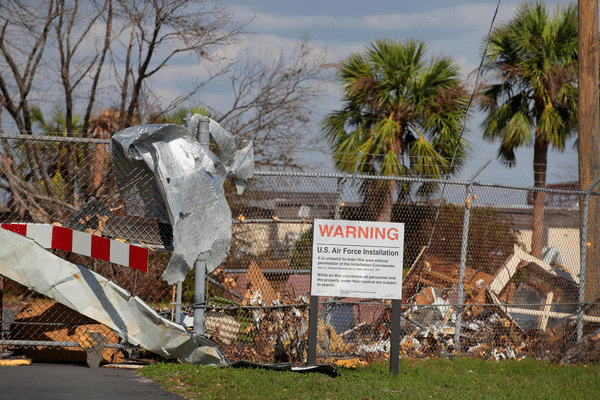
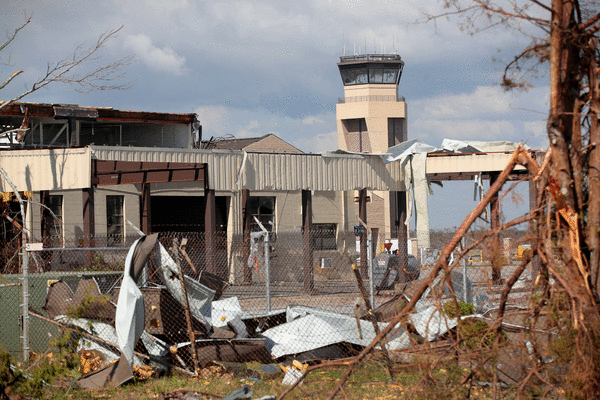
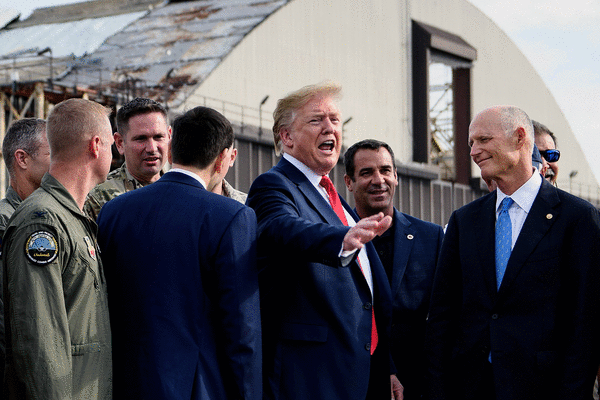


When Hurricane Michael, a Category 5 storm, tore through Florida’s Tyndall Air Force Base in 2018, it battered F-22 stealth fighter jets, destroyed hundreds of buildings and churned up 700,000 cubic yards of debris. The total cost of the damage approached $5 billion.
Now, Tyndall is being rebuilt as a super-resilient “installation of the future.” New buildings sit more than a foot above the ground, to remain dry through 75 years of sea-level rise. Their roofs are designed to withstand winds of up to 165 miles per hour. Manmade oyster reefs will protect coasts by breaking up waves.
The massive project will be 70% complete next year, said the officer leading it, Col. Robert Bartlow, chief of the U.S. Air Force Civil Engineer Center Natural Disaster Recovery Division. “This is a first for the Air Force,” he said, with large-scale, cutting-edge construction taking place “on top of an existing base, while there was a continued flying mission.”
Storms like Michael are becoming more powerful and damaging as the world warms, and many military installations are exposed to them and other climate hazards. Still, Secretary of Defense Pete Hegseth vowed last year that the Pentagon wouldn’t do any “climate change crap” on his watch. Biden-era climate action plans were scrapped, and the 2025 National Security Strategy invoked climate change only to label it a “disastrous” ideology. Hegseth canceled nearly 100 research studies related to global warming and security, which experts say will compound the loss of climate knowledge across the federal government under President Donald Trump.
“Because ‘climate’ is a dirty word, we’re not investing in that predictive capability,” said Sherri Goodman, secretary general of the non-governmental International Military Council on Climate and Security and, from 1993 to 2001, the U.S. deputy undersecretary of defense for environmental security.
But as Tyndall shows, the Defense Department is still engaged on one front of the climate fight: steeling its bases against the effects of a warming atmosphere, such as higher seas, fiercer storms and deadlier fires. A new flood wall is rising at the U.S. Naval Academy in Maryland; a low-lying Air Force runway is being elevated in Virginia; and projects are underway to reduce wildfire risk around various military sites in Hawaii.
Work that was previously described as confronting the climate threat is now touted for ensuring “resilience” and “readiness.” The semantics are a nod to necessity: At stake are hundreds of billions of dollars of assets and the ability to launch missions quickly and smoothly.
“Ultimately, the military is a very pragmatic institution,” said John Conger, a past director of the nonprofit Center for Climate and Security and a senior Defense Department official during the Obama administration. “It wants to maintain mission capability. Whether we’re going to call it ‘climate,’ not ‘climate,’ whatever — if I can’t get to the base because the road is flooded, that’s a problem.”
Representatives of the Defense Department declined to comment.
Global warming impinges on American security and military operations in numerous ways. More climate-driven disasters means more deployments to respond to them. Extreme heat makes it harder for jets to lift off and sickens soldiers during training exercises. Climate change also acts as a “threat multiplier” – a term that Goodman coined – around the world. It can exacerbate drought conditions, which may limit water or food in regions already primed for conflict.
Much of the military’s resilience work began years ago; construction timelines are long. The $900 billion 2026 National Defense Authorization Act, which Trump signed into law in December, includes measures that could be said to come under the umbrella of climate adaptation. The law bolsters the military’s ability to respond to wildfires; raises the cost limit for replacing structures destroyed by disasters; and requires military leaders to identify the biggest risks to water security on bases.
Congress has given the military “decades-long, bipartisan direction” to prepare for climate change, even at times when the term itself was out of political favor, noted Will Rogers, a principal of Converge Strategies and the senior climate advisor to the secretary of the Army from 2022 to January 2025.
If climate preparedness is another term for environmental assessment, “the Army’s been doing this regularly now since World War II,” said Frank Galgano, a geographer at Villanova University who retired from the Army as a lieutenant colonel in 2007.
The approach may not have shifted, but the atmosphere has. Extreme weather and disasters have caused $15 billion of damage to defense facilities over the past decade. In 2023 alone, Typhoon Marwar ravaged two bases on Guam, heavy rains swamped the campus of West Point in New York and a landslide blocked the main road at Camp Pendleton in California.
Close to $400 billion of federal government assets, most of them belonging to the Defense Department, are at high risk of being hit by a major coastal flood or storm in coming years, according to a Bloomberg Law analysis.
The Pentagon explicitly recognized the warming climate as a danger for many years. The 2008 National Defense Strategy flagged climate change as an emerging risk, and two years later it was named a national security threat in the Pentagon’s Quadrennial Defense Review. After that, the Defense Department and the individual armed forces put out a stream of climate and sustainability plans. (Some have now been removed from government websites.)
James Mattis, who served as defense secretary during President Donald Trump’s first term, described climate change as a destabilizing force in 2017. His Biden-era successor Lloyd Austin said in 2021, “We face all kinds of threats in our line of work, but few of them truly deserve to be called existential. The climate crisis does.”
Trump and Hegseth have made a sharp pivot. In a March 2025 memo to military leaders, Hegseth called climate change a “distraction” from fighting wars, ordered that references to it be removed from mission statements and barred any environmental initiatives from being included in the Future Years Defense Program, a strategic plan.
Hegseth also included a caveat big enough to steer an aircraft carrier through. “Nothing in this memorandum,” he wrote, “shall be construed to prevent the department from assessing weather-related impacts on operations, mitigating weather-related risks, conducting environmental assessments, as appropriate, and improving the resilience of military installations.”
Days after Hegseth issued his memo, the Pentagon’s guidance on master planning for bases was updated. (By law, every major military installation must have a master plan.) In the older version from 2022, the word “climate” was used 54 times. It doesn’t appear once in the new version, which still directs planners to identify and mitigate risks from extreme weather.
Bartlow, at Tyndall, sees no contradiction between that project and Hegseth’s guidance.
The overarching goal at Tyndall, he said, is “preserving lethality in a high-end combat capability. When we talk about resilience, it’s focused on preserving that combat capability.” If another Category 5 hurricane hits, “there’ll be some interruptions, but the idea is you’ll be able to recover this installation quickly,” Bartlow said. “You can make that direct link back to readiness.”
Hardening efforts continue elsewhere but are falling short. A February Government Accountability Office report found that the military has failed to track all the costs from disaster damage and hasn’t fully incorporated climate-change projections into facility designs, and that many of its master plans still haven’t been updated to promote greater resilience.
One constraint is funding. “Our installations are funded at about 80% of what they need on a day-to-day basis,” said Rogers, the former Army climate adviser.
The Iran war could apply more pressure. Defense officials “could use their reprogramming authority to pay for contingency operations in Iran” with money meant for fortifying bases, said Rogers. “I would be worried about that, depending on how long this goes.”
Although the Pentagon has maintained a focus on resilience, under Hegseth it has backed off efforts to lower its emissions — the U.S. military is the single biggest climate polluter in the country — and develop green ships and tanks. The armed forces have in recent years explored using hybrid and electric tanks for tactical, not just environmental reasons: They reduce reliance on diesel supply lines, are quieter and are less detectable to heat radar. While the Army is moving ahead with its hybrid M1E3 tank, funding for such initiatives has declined, said Rogers.
Of the studies that Hegseth canceled, some focused on the Indo-Pacific, where China has ambitions, noted Goodman. She said the lost knowledge and reduced funding for climate and weather research – not just in the military but in agencies like the National Oceanic and Atmospheric Administration – could set back defense planning.
She offered a hypothetical example: With AI pushing the envelope in forecasting, an adversary could anticipate and take advantage of a weather event to launch a cyberattack on the U.S. “And if we’re not understanding that,” she said, “then we have become more vulnerable.”
©2026 Bloomberg L.P. Visit bloomberg.com. Distributed by Tribune Content Agency, LLC. ©2026 Bloomberg News. Visit at bloomberg.com. Distributed by Tribune Content Agency, LLC.






Comments