Wildfires killed nearly 20% of the world's giant sequoias. How crews are racing to save the rest
Published in Science & Technology News
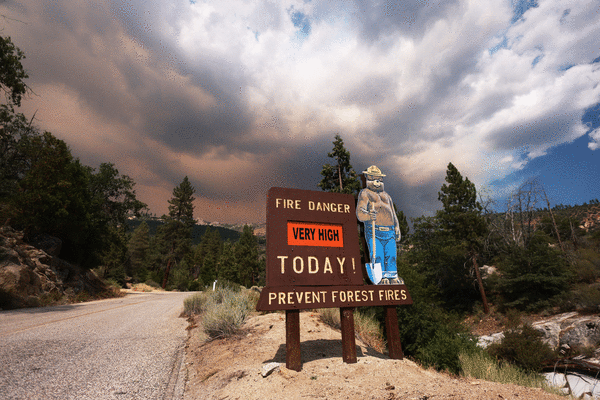
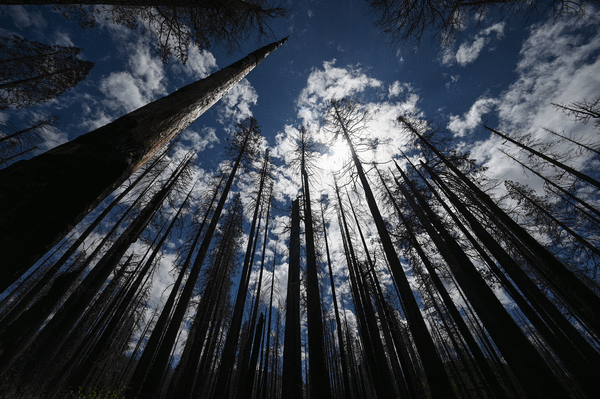
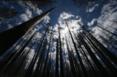
Five years ago, a tragic and depressing environmental story unfolded when thousands of giant sequoia trees, an iconic California species that tower 300 feet high and can live for 3,000 years, were killed during multiple large wildfires that roared across the southern Sierra Nevada.
The fires in 2020 and 2021 at Sequoia National Park, Sequoia National Forest and other areas burned with unprecedented intensity, killing nearly 20% of the world’s giant sequoias, and exposing the growing vulnerability of the most massive trees on the earth.
“It was heartbreaking,” said Kevin Conway, state forests program manager for Cal Fire, the state’s primary firefighting agency. “You can’t help but ask, what could I have done? What should I have done? Could I have prevented this?”
After the fires, stunned scientists, park managers and environmental groups formed a partnership to reduce the chances of similar catastrophic outcomes in the years ahead. Now, with another summer fire season looming, they say they are making encouraging progress.
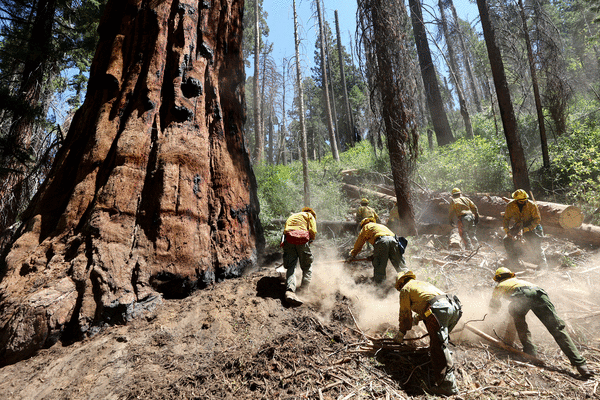
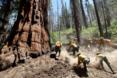
Since their efforts began in 2022, the partnership has thinned the overgrown brush and small trees that provide fuel for fires to burn hotter in 44 of the 94 giant sequoia groves in California.
Crews also have conducted controlled burns and planted more than 682,000 sequoia seedlings in areas that burned severely in wildfires of 2020 and 2021. Altogether, their work has reduced fire danger on 23,251 acres over the past four years, according to a new report issued earlier this month.
“It’s a race against time,” said Steve Mietz, the former superintendent of Redwood National Park who recently became president of Save the Redwoods League, an environmental group based in San Francisco. “It’s not a matter of if, but when we will have more fires. We have the answers. We know what to do. It’s not hopeless.”
The partnership, called the Giant Sequoia Lands Coalition, has eight primary members, which own lands between Tahoe National Forest and Bakersfield where the 94 groves of massive and ancient sequoias are located. They are: Cal Fire, California State Parks, the National Park Service, Tulare County, the Tule River Indian Tribe of California, UC Berkeley, the U.S. Forest Service, and the federal Bureau of Land Management.
Another nine organizations are also included, providing scientific research, funding and support. They are American Forests, the Ancient Forest Society, the Giant Sequoia National Monument Association, Save the Redwoods League, the Sequoia Parks Conservancy, Southern Sierra Conservancy, Stanislaus National Forest, the US Geological Survey, and the Yosemite Conservancy.
A cousin of the coast redwood, which is the world’s tallest tree, giant sequoias are the largest living tree by volume on Earth. Decimated by logging in the 1800s and early 1900s, nearly all of the remaining groves are preserved on public land within Yosemite National Park, Sequoia-Kings Canyon National Park, Calaveras Big Trees State Park and Sequoia National Forest.
The trees evolved with fire, said Kristen Shive, a fuels and forest specialist with the University of California Cooperative Extension Program at UC Berkeley. Giant Sequoia cones have resin that needs fire to melt it to release seeds.
Their spongy, reddish bark can grow to 2 feet thick. It acts like insulation, protecting the tree’s inner living tissue from heat.
Fires from lightning and those set by Indian tribes typically burned through giant sequoia groves every 10 to 20 years before the Gold Rush of the 1850s. But starting about 100 years ago, efforts to fight wildfires began to make them more vulnerable to fire.
When fire crews put out fires, it allowed small trees, brush and dead wood to build up to unnaturally dense levels, Shive noted. Now, when wildfire flames enter the groves, they burn hotter and more intensely than ever before, with the potential to kill the ancient trees entirely.
“Those fires in 2020 and 2021 were a game changer,” she said. “We had thousands of acres of high-severity fire. It was a shocking change and a hard one. We were going out to do surveys and seeing trees that had lived for millennia and had died due mostly to human mismanagement. It was a really hard pill to swallow.”
Another added stress is climate change. Hotter temperatures dry out soils and vegetation, making fire more severe. The drought of 2012-2016 and 2020-2022 killed millions of other trees in the Sierra, providing more fuel for fires.
The solution, Shive and Conway said, is removing many of the overgrown smaller trees that surround the giant sequoias in dense thickets, like white fir, red fir and incense cedar. Large sugar pines and ponderosa pines that died during droughts are also removed with chainsaws.
Much of the debris is piled and burned out of fire season. Some of the larger wood on private land or Cal Fire-owned demonstration forests can be sold to lumber companies to offset the costs of thinning. After thinning, areas can be treated with controlled burns, using techniques native tribes used for centuries, Conway said. Removing the extra material not only causes wildfires to burn less intensely and less hot, but it also allows more sunlight into the forest so giant sequoia seedlings have a chance to grow, he added.
“These forests aren’t in their natural condition,” Conway said. “We are trying to get them back to their natural condition so they are resistant to drought, fire and disease. It is a more open, thinner stand of trees.”
Sometimes the practices are controversial.
In 2022, the Earth Island Institute sued the National Park Service to halt fuel reduction projects planned for Merced Grove in Yosemite. The group claimed that not enough environmental study had been done. A federal district court dismissed the case, and in 2023, the Ninth Circuit U.S. Court of Appeals upheld that decision.
Six wildfires have threatened the Merced Grove in the past 15 years. The work to thin other tree species and perform controlled burns began last year and is expected to continue this year.
It could take another five to 10 years to treat all 94 groves, Conway said. Research has shown that the work has saved giant sequoias. In 2020, the Castle Fire burned into Mountain Home Grove, a giant sequoia grove east of Porterville in Tulare County that Cal Fire had thinned and treated with controlled burns. That fire killed 7% of the giant sequoias there but 18% of the giant sequoias outside it, he said.
The main challenge is funding. Although some money is available from Proposition 4, a climate bond passed by California voters in 2024, more state, federal and private funding is needed to finish the job and maintain the forests, Mietz said.
“Ancient sequoias take thousands of years to reach their majestic beauty,” he said. “They attract people from across the world. They are one of the largest organisms on the planet, a marquee species in the Sierra range. We have the science. We have the know-how. We just need the resources.”
©2026 MediaNews Group, Inc. Visit at mercurynews.com. Distributed by Tribune Content Agency, LLC.






Comments