Damage seen at Blue Origin Space Coast test site; unclear if New Glenn launch could be delayed
Published in Science & Technology News
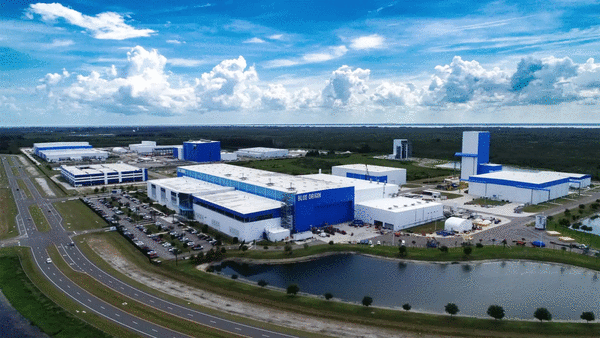
As Blue Origin prepares for the next launch of its New Glenn rocket from Cape Canaveral, the company appears to have experienced unexpected damage at its rocket manufacturing facility in Merritt Island, Florida.
Photos posted to social media show a damaged roof to what is know as the 2CAT facility, a vertical building used for tank cleaning and testing on the rocket’s second stages. It’s a smaller building more toward the rear of the campus than the towering, 224-foot-tall building used to test the first stages, that can be seen for miles around the site.
“An apparent anomaly has occurred at Blue Origins 2CAT testing facility, damaging the roof in the process,” reads a post on X from Brevard-based photographer Jerry Pike.
It’s one the many buildings at the site within Exploration Park adjacent to Kennedy Space Center Visitor’s Complex where Blue Origin manufactures its New Glenn rocket. Jeff Bezos has invested more than $3 billion into the company’s Space Coast facilities, which also manufacture the company’s Blue Moon lunar landers.
The Sentinel reached out to Blue Origin for comment on the damage, but has not heard back.
The facility, though, is one where the company performs pressure testing on the rocket stage.
Any damage that may have been done to the facility or hardware inside it would not directly affect Blue Origin’s rocket already at the company’s launch facilities on Cape Canaveral Space Force Station’s Launch Complex 36.
But rocket companies that suffer damage on test stands sometimes stand down from launches until they understand the reason behind the incidents.
United Launch Alliance, for instance, had been gearing up for the debut flight of its Vulcan rocket in 2023 in Florida when a fireball engulfed an upper stage on a test stand at Marshall Space Flight Center in Huntsville, Alabama. Results of that test led to changes on the upper stage that did eventually fly, but it was among reasons that rocket’s debut was delayed another eight months.
Blue Origin had announced in late March it would aim to launch the NG-3 mission using a previously flown first-stage booster as soon as April 10, but has yet to update its target launch date.
The flight would be the third ever for the heavy-lift rocket after its debut in January 2025 and second mission last November. That flight saw the successful landing and recovery of its first-stage booster, something not achieved on the rocket’s debut. The stage named “Never Tell Me the Odds,” a reference to a Han Solo quote from “The Empire Strikes Back,” was refurbished as is set to fly again on this new mission.
The payload is telecommunication company AST SpaceMobile’s next-generation BlueBird 7 satellite headed to to low-Earth orbit.
Blue Origin CEO Dave Limp posted a video of the booster on April 7 at the rocket prep facilities at Launch Complex 36 getting moved to the Transporter Erector, which will roll the rocket to the launch pad.
“Team Blue inspected every system, completed refurbishment, and certified it for flight,” he said.
Blue Origin is also trying to launch this year its first lunar landing mission, an uncrewed Blue Moon MK 1 lander that just completed successful testing in Houston’s Johnson Space Center’s thermal vacuum chamber.
The lander, which has been named “Endurance,” had been shipped from Florida in January, and will now head back to the Space Coast to prepare for launch, according to an update this week from the company.
“Great work by the team, one step closer to the moon!” Limp posted.
Blue Origin is manufacturing a larger Blue Moon MK2 lander that would be used on future crewed lunar landings as part of NASA’ Artemis program.
The company is in a race with SpaceX to develop a lunar lander for NASA’s planned Artemis IV mission that would return humans to the moon’s surface for the first time since Apollo 17 in 1972.
NASA is aiming to launch the Artemis III mission before that, as soon as mid 2027, which would remain close to Earth, but would have the Orion spacecraft try and dock with one or both of SpaceX and Blue Origin’s landers.
If either of them are ready.
------------
©2026 Orlando Sentinel. Visit at orlandosentinel.com. Distributed by Tribune Content Agency, LLC.






Comments