Amazon CEO Andy Jassy defends spending $200 billion in AI push
Published in Science & Technology News
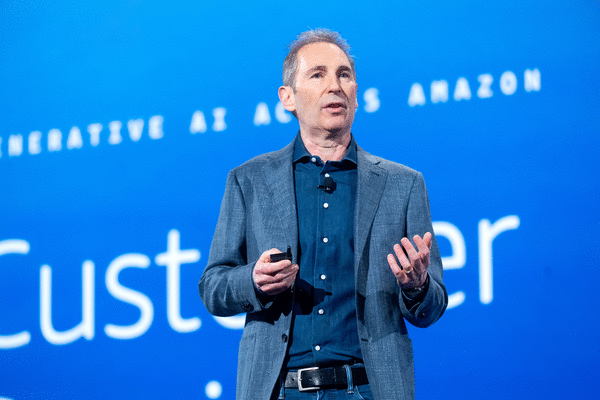
As Wall Street frets about the tech industry's eye-popping artificial intelligence spending spree, Amazon CEO Andy Jassy isn't blinking.
In a letter to shareholders Thursday, the Seattle-based tech giant's chief defended the $200 billion Amazon plans to spend on AI infrastructure this year, saying the company is not going to be conservative in how we play this." That spending, known as capital expenditures, is mostly paying for data centers, servers and advanced computer chips.
As to whether Amazon and the rest of the industry's rise in spending over the past year is creating a bubble, Jassy unequivocally says no.
"I’ve followed the public debate on whether this technology is overhyped, whether we’re in 'a bubble,' and if the margins and (return on invested capital) will be appealing," Jassy wrote. "My strong conviction, at least for Amazon, is that the answers are no, no, and yes."
The AI race at this point may be more comparable to a land rush, as Jassy calls it. With a new market comes the opportunity for tech companies to throw money at the chance to claim market share. And most of the industry is spending big.
Amazon's projected $200 billion in capital expenditures this year is a significant jump from the industry-leading $131.8 billion the company spent in 2025.
Other tech titans like Microsoft and Meta have also ramped up their spending projections recently. Microsoft spent more than $88 billion in its 2025 fiscal year, which ended in June, and is on track to spend far more in 2026. Through the first half of its 2026 fiscal year, Microsoft's capital expenditures totaled $72.4 billion as it increased spending on high-tech computer chips. Meta is expected to spend between $115 billion and $135 billion this year on its AI-related efforts.
As Jassy defended his company's spending, he also acknowledged the strain it's put on Amazon's cash flow. He expects short-term headwinds for free cash flow, which dropped from $38 billion in 2024 to $11 billion in 2025, but likens the trend to what Amazon saw as it built out its cloud computing platform Amazon Web Services. AWS is now the market leader in cloud computing and the company's primary money-spinner. The division brought in $45.6 billion in profit last year.
Amazon is betting that AI will supercharge growth in AWS, and based on customer commitments the company expects to recoup much of its spending between 2027 and 2028.
"We’re not investing approximately $200 billion in capex in 2026 on a hunch," Jassy said.
The company is also bullish on its own chips business.
With the industry, including Amazon, relying on technology from chipmaker Nvidia, companies like Amazon and Microsoft are developing their own chips.
Jassy said the company's Trainium line of chips is seeing increased demand and once scaled up, the business could save Amazon "tens of billions" of capital expenditure dollars per year.
"There’s so much demand for our chips that it’s quite possible we’ll sell racks of them to third parties in the future," Jassy said.
Tech's exorbitant spending has largely been the driver for the industry's layoffs over the past year, though some experts say there may still be some lingering effects from excessive hiring during the pandemic. As capital expenditure costs skyrocketed last year, companies looked to payroll to cut costs.
Amazon laid off 14,000 employees in October, followed by 16,000 more in January. Microsoft let go of about 15,000 employees last summer.
Between the two companies, thousands of Seattle-area tech employees have lost their jobs. Since the Puget Sound region is an enormous engineering hub for out-of-town tech companies, the local industry can't catch a break.
Last week, Oracle and Meta both announced local layoffs that affected hundreds of tech workers. Those followed earlier layoffs from the end of 2025 and the beginning of 2026 at both companies.
After listing Amazon's big bets — AI, chips, faster delivery and grocery among them — Jassy in the letter gestured toward the cuts Amazon made over the past year. Between the October and January waves of layoffs, it was the largest workforce reduction in Amazon's history.
The company has had the mantra of operating like the world's biggest startup, which Jassy said was the primary reason Amazon "worked to flatten our organization the last year, and we're pleased with the improved speed of decision-making and delivery.
Amazon performed well on Wall Street Thursday after Jassy's letter released. The company's stock price was up 5% on the day and is faring better this year compared to other tech companies.
©2026 The Seattle Times. Visit seattletimes.com. Distributed by Tribune Content Agency, LLC.





Comments