Big crowds expected as signs look good for Artemis II launch Wednesday
Published in Science & Technology News



Hundreds of thousands of spectators are expected to descend on the Space Coast this week for a chance to witness something that has not happened since last century.
Humans will be headed to the moon for the first time since the Apollo program in 1972.
The Artemis II mission, a lunar fly-by, could launch from Kennedy Space Center as early as Wednesday at 6:24 p.m. taking NASA astronauts Reid Wiseman, Victor Glover and Christina Koch as well as Canadian Space Agency astronaut Jeremy Hansen on a 10-day flight that could set the record for farthest distance by a human ever traveled from Earth.
“We are getting very, very close and we are ready,” said Lori Glaze, acting associate administrator for NASA’s Exploration Systems Development Mission Directorate, during a mission update Sunday afternoon. “Our flight systems are ready. The ground systems are ready. Our launch and operations teams are ready, and our flight operations team in Houston are also ready. The crew arrived (Friday), and I know that they’re ready. They are more than ready. They can’t wait to get off the ground.”
“Given the magnitude of this launch’s historic significance, it’s hard to estimate a visitation number,” said Meagan Happel with the Space Coast Office of Tourism.
But she noted 2022’s Artemis I mission had between 150,000-200,000 visitors and even more were on hand for the Demo-2 mission of 2020 that returned human spaceflight to the Space Coast after the end of the Space Shuttle Program nearly a decade earlier.
“Multiple hotels have reported being sold out for the launch attempt,” she said. “The popular viewing locations around Titusville, Cape Canaveral and Cocoa Beach are sure to see large crowds. So anyone wanting prime viewing locations should plan on getting there well ahead of time, and having some back-up options just in case their first or second choice is full.”
The Artemis II crew have been in quarantine since March 18, but shifted from Houston to Kennedy Space Center with five days out before the first launch opportunity. They talked with media from KSC’s astronaut quarters on Sunday.
“Things are certainly starting to feel real here at the Cape,” Koch said.
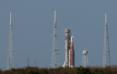
If things go well, they will suit up and head out to KSC’s Launch Pad 39-B on Wednesday afternoon to climb into the Orion spacecraft atop the Space Launch System rocket, which recently was rerolled from the Vehicle Assembly Building after having to retreat from the pad for repairs that took February and March opportunities off the board.
“This team that has really crushed it — the Exploration Ground Systems, the folks that have gotten the vehicle ready and repaired, the things that need fixing — and to watch them really maintain that schedule and to get that rocket into the VAB and back out to the pad,” Glover said.
When they lift off, they will become the first humans to ride the most powerful rocket to ever launch to orbit. The SLS has four RS-25 engines from the Space Shuttle Program paired with two solid rocket boosters that combine to produce 8.8 million pounds of thrust at liftoff.
“When you see this vehicle on the pad, you look at the size of this vehicle, you know it’s going one place. It is going to space, and it is going to go there in a hurry,” Wiseman said.
He added that while he’s commanding the mission, all four of the crew have are loaded up with responsibilities.
“At the end of the day, every ship needs a captain, and I’m ready to make those decisions, but I’m not making them in a vacuum,” he said. “I can just watch my crewmates here. I know their facial expressions. They know mine. We know when we’re tense.”
He said all four remind each other “no fast hands in the cockpit.”
“You do not want to do anything too quick in this vehicle. You need to take your time. You need to process everything. Almost always it pays bigger dividends to move forward than to go backwards,” he said.
The mission won’t fly to the moon right away, but instead spend a day first orbiting Earth. During that orbit they will perform maneuvers to test out manual control of Orion. If all checks out, they will perform a trans-lunar injection burn for the three day trip to the moon.
Koch said the spacesuits are designed to act as individual lifeboats, which could keep them alive for up to 144 hours in the case of something like cabin leak. That allows them multiple options to abort the mission at multiple points during the flight plan.
If the crew launches Wednesday, Orion could fly 252,799 miles away from Earth, which is 4,144 miles farther than the current record holder, the Apollo 13 mission of 1970.
The point of Artemis II is prove Orion can keep astronauts safe, with the spacecraft flying with life-support systems and command and piloting hardware for the first time.
The spacecraft will once again come back hot and fast, with a reentry that could hit near 25,000 degrees Fahrenheit coming in at 5,000 mph before slowing to a parachute-assisted landing in the Pacific Ocean.
“This is a test flight. This is the first time we’re loading humans on board. And I will tell you, the four of us, we are ready to go. The team is ready to go and the vehicle is ready to go, but not for one second do we have an expectation that we are going,” Wiseman said. “We will go when this vehicle tells us it’s ready, when the team is ready to go. So we might go out to the pad, and we might have to try again a few more times, and we are 100% ready for that.”
-----------
©2026 Orlando Sentinel. Visit at orlandosentinel.com. Distributed by Tribune Content Agency, LLC.






Comments