How attractive were Neanderthal men? Study finds sex bias in interbreeding
Published in Science & Technology News
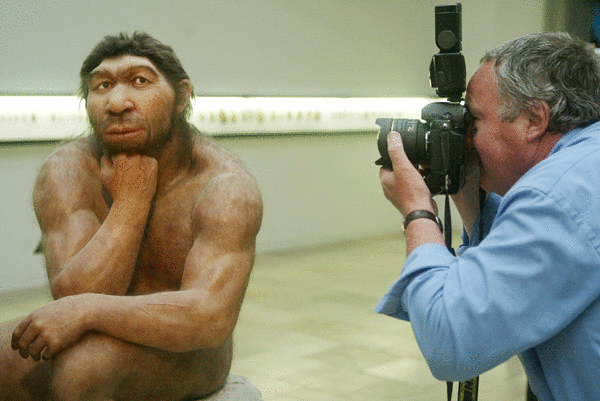
Most people have some amount of Neanderthal DNA from the extinct cousins of modern humans who lived in Europe and Asia until about 40,000 years ago. New research on available Neanderthal genetic material shows a strong bias toward male Neanderthals mating with Homo sapiens women.
It’s unclear why Neanderthals and anatomically modern humans paired off this way, study co-author Sarah Tishkoff told Scientific American. “One can only speculate!”
Researchers found more DNA from Homo sapiens on Neanderthal X chromosomes than expected — even in areas that don’t generally affect survival or reproduction. Very little Neanderthal DNA survives on human X chromosomes compared to other parts of the genome, suggesting a strong imbalance in who mated with whom long before the invention of Tinder.
These findings, published in February in the journal Science, rule out the possibility that Neanderthal DNA on humans’ X chromosome provided some evolutionary disadvantage.
The main limitation of their study stems from the relative lack of available Neanderthal DNA to study, lead author Alexander Platt, a University of Pennsylvania senior research scientist, told Scientific American. Soft tissue rarely survives fossilization, but as anthropologists work to uncover more samples, he said, understanding of interbreeding with modern humans will improve.
The work will improve our understanding of human ancestry, he said.
“We don’t just have to look in our own gene pool to find what happens to Neanderthal alleles when they came into our population,” he told Scientific American. By looking at Neanderthal’s DNA, “you get a much richer picture.”
©2026 The Baltimore Sun. Visit at baltimoresun.com. Distributed by Tribune Content Agency, LLC.



Comments