Top tech companies sign Trump's pledge to provide their own power for AI data centers
Published in Science & Technology News
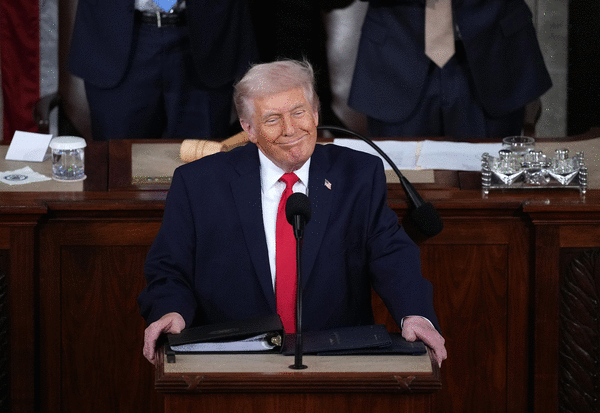
In a ceremony at the White House on Wednesday, executives from seven major tech companies signed a pledge with President Trump to supply their own power for artificial intelligence data centers.
Leaders from Amazon, Google, Meta, Microsoft, xAI, Oracle and OpenAI agreed to the “ratepayer protection pledge” Trump first announced during last week’s State of the Union address. The president said the plan will help shield residents from higher electricity costs in areas where AI data centers are being built.
AI data centers currently consume about 4% to 6% of electricity in the U.S., but that figure is projected to soar to as high as 12% by 2028.
“Under this new agreement, Big Tech companies are committing to fully cover the cost of increased electricity production required for AI data centers,” the president said Wednesday. “Prices in communities will not go up, but in many cases will actually come down, and very substantially.”
Energy affordability is becoming a key issue for voters. While Trump has ordered the acceleration of domestic fossil fuel production including oil, gas and coal, residential electric bills have been climbing — from an average of 15.9 cents per kilowatt-hour in January 2025 to 17.2 cents at the end of December, according to the U.S. Energy Information Administration.
Experts on both sides of the political aisle say the issue could lead to poor outcomes for Republicans in the midterm elections this November. Last year, Democratic candidates won key races in New Jersey and Virginia after campaigning heavily on energy affordability.
The pledge signed Wednesday is voluntary and is not clear about how the companies will source the energy.
The companies agree to build, bring or buy new electricity generation for their data enters. They will also pay for equipment upgrades needed to serve the data centers, which White House officials said will also bring benefits to neighboring communities, along with local investments such as job creation for data center construction and operation.
“We as an administration are using every tool at our disposal to ensure that the U.S. can build and maintain the largest, most powerful and most advanced AI infrastructure anywhere on the planet, and today, we recognize that building the future requires massive amounts of reliable energy,” said Michael Kratsios, director of the White House Office of Science and Technology Policy.
Under the pledge, the companies will negotiate separate rate structures with utilities and state governments, and commit to paying whether they use the electricity or not. In addition, the companies will coordinate with grid operators to make available their backup power during blackouts or times of grid stress.
Many tech firms are already moving in this direction, with Google, Meta, Amazon and others increasingly securing dedicated power for their AI data centers.
The pledge “affirms our long-held commitment to protect energy affordability for American households, accelerate breakthroughs to secure America’s energy future, and deliver energy infrastructure — all of which are critical to maintaining America’s global leadership in this era of innovation,” Ruth Porat, president and chief investment officer at Alphabet and Google, said in a statement.
Matt Garman, chief executive of Amazon Web Services, said “the ratepayer protection pledge marks an important milestone as a national commitment to a stronger grid that supports American families, fuels our economy, and keeps the United States at the forefront of global innovation.” However, he added that more bipartisan collaboration is needed at the state, local and federal levels to unlock private-sector investment to address America’s aging electrical grid, outdated permitting processes and bureaucratic delays.
Experts noted that the agreement does not preclude companies from using fossil fuels to meet growing energy demand. While most of the pledge signers have their own commitments to renewable energy and are investing heavily in wind, solar and battery energy storage, in practice the mix is often a hybrid, with renewables supplemented by power purchase agreements for nuclear or natural gas to ensure round-the-clock reliability.
U.S. Energy Secretary Chris Wright has previously advocated for the use of fossil fuels to help power AI data centers, including natural gas, coal and diesel. Fossil fuel emissions not only drive global warming but also contribute to local air pollution.
Wright on Wednesday criticized Biden-era clean energy policies, which he said were overly burdensome and would have pushed data center companies overseas. He vowed that “we will see declining electricity prices during this administration.”
But current trends are moving in the opposite direction. While the president promised to cut energy costs in half, they have instead risen faster than inflation in many parts of the country, said Costa Samaras, director of the Scott Institute for Energy Innovation at Carnegie Mellon University who previously served as a senior energy official in the Biden administration.
“It’s important to evaluate the administration’s actions, rather than evaluate the administration’s pledges,” Samaras said. He noted that Trump is constraining the construction of clean power even as demand is surging, including canceling funding for federal solar programs and attempting to halt the construction of offshore wind projects nearing completion along the East Coast.
“To ensure that prices don’t continue to spike because of the demand growth in artificial intelligence, we need to add much more clean energy to the grid,” Samaras said. “We need to reinvest in our transmission and distribution infrastructure, and we need to make sure that the companies are bringing new clean energy and infrastructure to the table when they’re coming to communities.”
Trevor Higgins, a senior vice president at the Center for American Progress, a nonpartisan policy institute, criticized the voluntary nature of the pledge as a “vague and largely meaningless effort that fails to offer ratepayers any guaranteed protection from soaring utility rates.”
“Unless all data centers are required to pay their fair share for the costs for their power, companies can opt out or hide the true impacts of their data center development,” Higgins said. “And if the Trump administration continues to block the fastest, cleanest power from being added to the grid, it will force data centers to use dirty, expensive coal and gas plants in communities around the country.”
Recent polling from the nonprofit group Climate Power and the analytics firm Blue Rose Research indicates that Americans are concerned with how data centers are powered. Fifty-three percent of respondents said they would support the construction of data centers fueled by clean energy sources such as wind and solar, compared with only 31% who said they would support those powered by fossil fuels such as coal or natural gas.
©2026 Los Angeles Times. Visit at latimes.com. Distributed by Tribune Content Agency, LLC.





Comments