Trump administration looking at repealing East Coast boat speed rule: 'Brutal blow to right whales'
Published in Science & Technology News
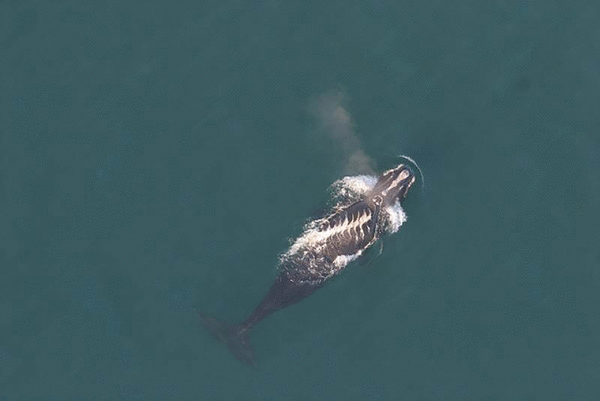
BOSTON — The Trump administration is looking into rolling back an East Coast boat speed rule that whale advocates say would lead to more deadly ship strikes.
The National Oceanic and Atmospheric Administration has proposed amendments to the North Atlantic right whale speed rule from 2008. NOAA is proposing a shift away from mandatory speed reductions in favor of technology-based measures.
Whale advocates are fired up over the proposal, as ship strikes are the leading cause of death for critically endangered North Atlantic right whales — accounting for 58% of documented deaths over the last nine years.
Research has shown that the 2008 speed rule significantly cuts risks to whales, according to the advocates.
“The Vessel Speed Rule saves lives – both humans and critically endangered North Atlantic right whales,” said Oceana Senior Campaign Director Gib Brogan. “A vessel colliding with a whale can injure or kill people, destroy vessels, and is often fatal to the whale. Vessel strikes are a top threat to this species.
“The existing, 18-year rule helps mitigate vessel collisions and gives North Atlantic right whales a better chance at survival,” Brogan added.
There are only about 380 North Atlantic right whales remaining, and fewer than 70 reproductively active females.
After public review in 2008, NOAA issued the Vessel Speed Rule that created two types of management tools to slow large boats and protect the whales from boat strikes.
First, the rule required boats 65 feet or longer to slow down to 10 knots in Seasonal Management Areas, where North Atlantic right whales are expected to be present. Second, the rule established a voluntary speed limit of 10 knots in Dynamic Management Areas, which are triggered by North Atlantic right whale sightings.
Studies suggest boats traveling under 10 knots are less likely to kill North Atlantic right whales should they collide.
“It’s incredibly sadistic to destroy a solution that helps shield endangered whales from being killed by speeding ships,” said Rachel Rilee, oceans policy specialist at the Center for Biological Diversity. “Trump officials are attacking one of the only protections North Atlantic right whales have against extinction.
“This is a brutal blow to right whales, who need and are legally entitled to far more help than they’ve been getting,” Rilee added. “I’m disgusted to see the Trump administration going after these beloved animals.”
NOAA in its announcement about the speed rule proposal said the agency is looking for ways to “reduce unnecessary regulatory and economic burdens while ensuring responsible conservation practices for endangered North Atlantic right whales.”
NOAA added that it’s focusing on developing new technologies, engineering approaches, and other advanced tools to reduce the risk of vessel strikes with whales.
“Technology has the potential to provide transformational tools to prevent species extinction while allowing marine industries, including fisheries, boating, and shipping, to continue to flourish,” NOAA added.
Female right whales, calves and juveniles are at a disproportionate risk of vessel strikes. Since 2017, vessel strikes are confirmed to have killed 15 right whales, seriously injured another three whales and injured or caused poor health in an additional nine whales.
“We are fully on-board to support innovation and the use of technology to help mariners navigate whale habitat safely,” said Greg Reilly, retired Coast Guard officer and commercial mariner. “But relying on unproven concepts as a substitute for established protections is a high-stakes gamble we simply cannot afford.
“With so few North Atlantic right whales remaining, there is no margin for error,” added Reilly, who’s with the International Fund for Animal Welfare. “Slower vessel speeds remain the only measure proven to reduce deadly vessel strikes and weakening that safeguard now would put this critically endangered species at even greater risk.”
NOAA Fisheries has opened a 90-day comment period on the advance notice of proposed rulemaking.
------------
©2026 MediaNews Group, Inc. Visit at bostonherald.com. Distributed by Tribune Content Agency, LLC.






Comments