NASA primed for March launch of Artemis II after successful test
Published in Science & Technology News
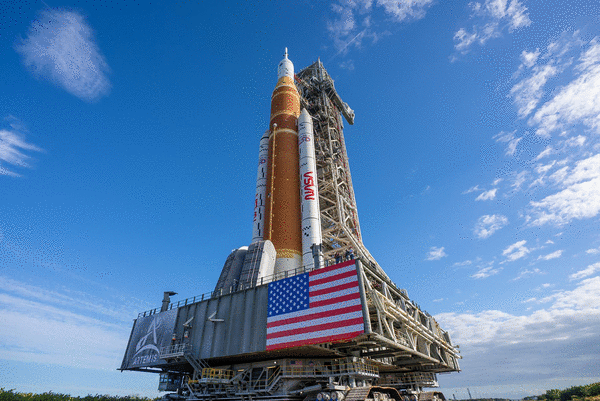
The four astronauts set to venture farther than any human has ever traveled from Earth are set to enter quarantine Friday with the chance to launch on the Artemis II moonshot mission early next month.
NASA officials announced the new target after completing a redo of a simulated countdown Thursday night at Kennedy Space Center’s Launch Pad 39-B that solved a recurring headache of propellant leaks on the Space Launch System rocket.
“Following that successful wet dress yesterday, we’re now targeting March 6 as our earliest launch attempt,” said Lori Glaze, acting associate administrator for NASA’s Exploration Systems Development Mission Directorate. “I am going to caveat that. I want to be open, transparent with all of you that there is still pending work.”
There are several opportunities that run through March 11 before NASA would have to stand down until opportunities between April 1-6.
NASA astronauts Reid Wiseman, Victor Glover and Christina Koch as well as Canadian Space Agency astronaut Jeremy Hansen will wait for the official date in Houston only flying back to KSC about five days before launch. Artemis II will feature the first crewed flight of the Orion spacecraft, which has a 10-day mission plan to send the quartet of astronauts on a lunar fly-by as part of a 600,000-mile round trip.
They would venture farther from Earth than any of the Apollo crews did between 1968-1972. Their trip would also be the first time since Apollo 17 that humans have ventured outside low-Earth orbit.
The wet dress rehearsal was a redo of an initial test run held Feb. 2 that suffered from liquid hydrogen (LH2) leaks in the propellant line running into the core stage of the Space Launch System rocket.
The cryogenic propellant saw leak rates which managers suspected were coming through one of two seals that cut the full test countdown short. It’s similar to issues seen during the 2022 test runs and launch attempts of the uncrewed Artemis I mission.
Those resurgent issues removed any chance to launch in February.
NASA replaced the seals as well as a filter that was suspected of slowing the flow of LH2 during a followup confidence test held last week.
“Both of those interfaces were rock solid,” said Artemis launch director Charlie Blackwell-Thompson. “Really no leakage to speak of. So it was really performed well. So the work that the team did paid off.”
With no significant leak, teams were able to fill the SLS core and upper stages with more than 700,000 gallons of cryogenic LH2 and liquid oxygen (LOX) just as the rocket would be on launch day.
That allowed teams to complete all of the tasks that were cut short two weeks earlier including two runs through what is called terminal count allowing for a hold and reset of the countdown clock.
“When we did the test three weeks ago, the hardware was talking to us, so we listened,” said John Honeycutt, chair of the Artemis II Mission Management Team. “The remediation activities that we took turned out really well.”
While the crew were not at the pad for the test, NASA did send out the support closeout team, who would seal them into the Orion spacecraft atop the rocket on launch day, to run through their workflow again.
Work that still needs to be done before NASA targets a launch date includes reviewing the test data, servicing and retesting the rocket’s flight termination system and bringing the closeout crew for one more practice run. Also on tap is a multiday flight readiness review next week.
“Those things are all in front of us. We need to successfully navigate all of those, but assuming that happens, it puts us in a very good position,” Glaze said.
The goal of Artemis II is to prove the safety of Orion and set up future Artemis missions including Artemis III, which aims to return humans to the lunar surface for the first time since Apollo 17 more than half a century ago.
The launch comes more than three years after the uncrewed Artemis I mission, which was the first flight of the SLS rocket.
It remains the most powerful rocket to ever launch to orbit, and with 8.8 million pounds of thrust, will be giving the crew of Artemis II a ride to space that surpasses Apollo.
“This is really getting real, and it’s time to get serious and start getting excited,” Glaze said.
----------
©2026 Orlando Sentinel. Visit at orlandosentinel.com. Distributed by Tribune Content Agency, LLC.






Comments