San Diego County approves $8.75 million to combat Tijuana River pollution crisis
Published in Science & Technology News
SAN DIEGO — The San Diego County Board of Supervisors unanimously approved $8.75 million Wednesday to address the ongoing Tijuana River pollution crisis through health studies, infrastructure improvements and an expanded air purifier program.
The funding package includes $4.75 million for epidemiological studies and a temporary infrastructure fix at Saturn Boulevard, plus $4 million to expand an air purifier program serving South Bay residents.
“This crisis disproportionately hits our low-income and vulnerable neighborhoods,” Supervisor Paloma Aguirre said during the meeting. “And by funding these projects, we’re telling the people of South Bay that your health is a priority and that we can’t wait for years for solutions to come from the federal government or from across the border.”
The board also established a County Pollution Crisis Chief position to centralize coordination of the county’s sewage crisis response. The executive-level role will serve as a single point of accountability for public health monitoring, infrastructure mitigation, emergency response, environmental protection and intergovernmental advocacy.
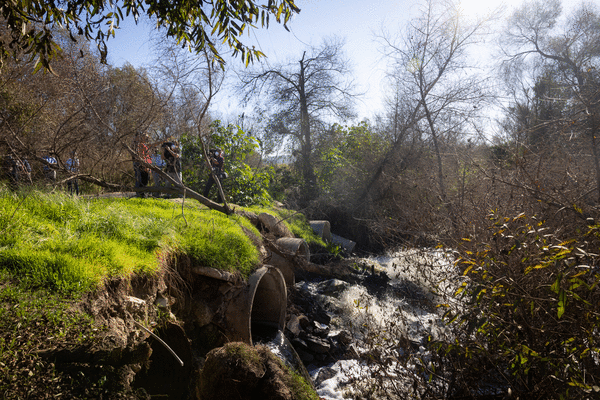
The Saturn Boulevard hot spot, where polluted water churns through concrete culverts, has been identified as the epicenter of the Tijuana River Valley air pollution crisis in the South Bay. Research shows the area releases millions of particles, aerosols and molecules carrying dangerous pollutants into the air.
The board approved $2.5 million for a temporary pipe extension project designed to reduce turbulence by extending existing culvert pipes below the water surface. Currently, sewage and industrial waste drops from culvert pipes onto rocks below, creating splashing that releases airborne pollutants including hydrogen sulfide.
Richard Whipple, deputy director of the county’s Department of Public Works, said the temporary pipe extension could be implemented within two years and was selected for its relatively simple approach and reduced difficulty in obtaining environmental permits.
Implementation will require agreements with the city of San Diego, which owns the land at Saturn Boulevard, and the U.S. Navy, which owns adjacent land.
If alternative funding sources are identified for the Saturn Boulevard project, the county’s $2.5 million allocation will be redirected to other immediate needs in the Tijuana River Valley, according to the board letter.
The board also approved funding for epidemiological studies. A retrospective health study for $250,000 will analyze existing health data to evaluate potential associations with historical pollution exposure. A long-term health study totaling $6 million will follow 1,000 to 2,000 individuals over multiple years, with the county contributing $2 million contingent on $4 million being raised from other sources.
Aguirre defended the need for additional studies, citing survey data showing nearly 70% of residents reporting illness and 90% saying the crisis affects their daily life.
“It’s akin to you being a pilot, getting into a plane, flying the plane and saying, I know the weather, I don’t need the data,” Aguirre said. “We’re talking about important information that we need to collect so we know exactly how we can make health interventions in the right way.”
Board Chair Terra Lawson-Remer called the situation “the regional crisis of our time” and emphasized the need for both immediate interventions and long-term infrastructure solutions.
“Standing here, we do not need any more reports to know what’s at stake,” she said. “We can see it, we can smell it. If your home or your work is nearby, you live it every single day.”
In a separate but related vote, the board unanimously approved $4 million to expand the Air Improvement Relief Effort program, which provides free air purifiers to affected households.
The San Diego Air Pollution Control District launched the program in 2024, distributing over 10,000 purifiers to local residents. A December survey of current participants found 88% were satisfied with the purifiers, 80% reported reduced sewage-related odors in their homes, and 86% found the application process easy.
The program currently provides one air purifier and two replacement filters per household, but the California Department of Public Health recommends multiple purifiers per household. The new funding will expand the program from one to three air purifiers per household for approximately 35,000 households in the affected area.
“Clean air is not a luxury. It’s a fundamental human right,” Aguirre said. “Providing free air purifiers to impacted schools and households represents an effective swift and tangible way to reduce exposure while long-term infrastructure solutions continue to move forward.”
Supervisor Jim Desmond supported the air purifier funding but emphasized the need to maintain pressure on Mexico to fix failing infrastructure.
“This is a bandaid. It’s another bandaid on a gushing, literally gushing wound,” Desmond said. “We can’t let up on the pressure of Mexico to fix their failing infrastructure that’s causing this entire mess.”
Desmond proposed an amendment, accepted by the board, directing the chief administrative officer to send a letter to the EPA and International Boundary and Water Commission expressing county support for Minute Orders 330 and 333, international agreements under which Mexico committed $46 million in 2026 and $47 million in 2027 for treatment plant and pump station upgrades.
The board’s action comes as advocacy for solutions intensifies across the region. Last week, 15 students from Coronado High School and Chula Vista Community Charter School traveled to Sacramento to lobby state legislators in support of Assembly Bill 35 and Senate Bill 58, which aim to provide funding and update air pollution standards related to the sewage crisis.
AB 35, authored by Assembly member David Alvarez and sponsored by the County of San Diego, passed the Assembly this month with bipartisan support and would accelerate the release of $46 million in Proposition 4 funds for cross-border river pollution projects.
The $8.75 million in funding will be drawn from prior year unrestricted general fund balance made available as unlocked reserves.
_____
©2026 The San Diego Union-Tribune. Visit sandiegouniontribune.com. Distributed by Tribune Content Agency, LLC.





Comments