Trump is winning the fight against offshore wind despite court losses
Published in Science & Technology News
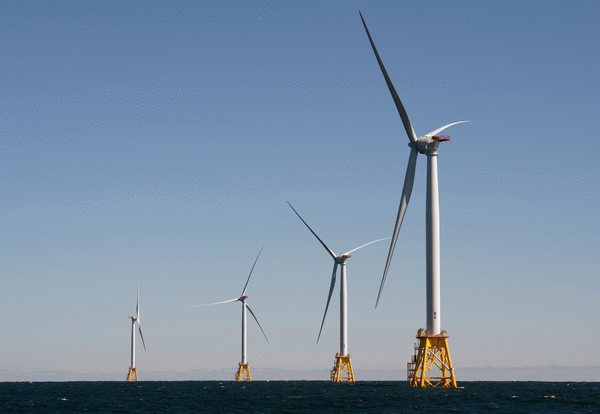
President Donald Trump’s campaign against offshore wind power in the U.S. sustained major setbacks last week when three different judges blocked enforcement of a government ban and allowed projects in New York, Rhode Island and Virginia to resume construction. And two others may win similar decisions soon.
But Trump may already have won his battle to gut the industry, even if the turbines now under construction begin supplying electricity as planned in the next year or so. That’s because the dramatic shift in U.S. government policy since Joe Biden was president has escalated the risk of investing in multibillion-dollar projects that already were facing significant financial and technical hurdles.
“The courts can stop the abrupt enforcement of policies, but they can’t really restart a stable pipeline for these projects,” said Atin Jain, an analyst at BloombergNEF. “Under this kind of policy environment, nobody is going to touch U.S. offshore wind for some time.”
And there’s still a possibility Trump prevails in court. So far, rulings allowing construction to resume are temporary, and decisions have yet to be made on the merits of company lawsuits claiming the government’s Dec. 22 stop-work order was illegal. The administration has pledged to keep fighting, saying the projects pose undisclosed national security risks.
“President Trump will continue to aggressively implement his energy dominance agenda to lower energy bills, improve our grid stability and protect our national security,” said White House spokeswoman Taylor Rogers. Since returning to the White House, Trump put forward a flurry of policies designed to undermine the renewable energy industry while boosting production of fossil fuels. On his first day in office, Trump issued an executive order pausing federal approvals of wind projects on federal lands and oceans, throwing the industry into months of uncertainty. In December, a federal judge ruled that decree illegal.
Along with the stop-work orders for projects already underway, the administration also has indicated in court filings that it intends to retract offshore wind projects approved under Biden that have yet to commence construction. The former president had been a champion of the industry, calling for construction of enough turbines spinning off U.S. coasts to produce the same amount of electricity as 30 nuclear reactors.
Trump’s One Big Beautiful Bill also sped up the phaseout of federal tax credits for offshore wind, where projects need to start work by the middle of this year to qualify. Without such subsidies, offshore wind costs about $199 per megawatt-hour, according to estimates by BloombergNEF, making it a lot harder for developers to justify the economics to their investors.
The flurry of roadblocks thrown up by the administration has essentially clipped the wings of the U.S. offshore wind industry. Early last year, BloombergNEF saw the potential for about 46 gigawatts of new offshore wind capacity by 2040. Now, the research firm expects only 6.1 gigawatts, which is almost all of the capacity of the current projects. “The odds of any new starts are very, very low under the current federal position on the wind industry,” Jain said.
The U.S. Department of the Interior, which issued the stop-work orders, has argued they were justified because of national security concerns. It didn’t provide details in court filings, but claimed the Department of Defense provided new classified information about advances in “adversary technologies” that “could raise national security issues with offshore wind projects.”
However, those arguments have been rejected so far by three different judges, all of whom were able to review specific details of the national security claims. One was appointed by Trump, another by former President Ronald Reagan and the third by Biden. The developers who prevailed in court last week said the work halt had cost them millions of dollars a day. They’re now trying to finish installations while they still have specialized vessels under contract. Orsted A/S, which is the joint developer of Revolution Wind off the New England coast, had its nearly completed project halted twice by Trump. Both times a federal judge lifted the bans. The developer said it had lost about $105 million from the first pause, with the second one in December costing about $1.44 million a day. Orsted Chief Executive Officer Rasmus Errboe said the focus is now on completing the Revolution Wind project, with first power generation to Rhode Island and Connecticut just weeks away.
Dominion Energy Inc. won a reprieve from a judge on Friday allowing the company to resume construction of an $11 billion wind project off the coast of Virginia. Dominion said it will “now focus on safely restarting work” on the project’s 176 wind turbines, some of which will start delivering electricity in a matter of weeks. “While our legal challenge proceeds, we will continue seeking a durable resolution of this matter through cooperation with the federal government,” the company said in an emailed statement. Orsted and Equinor also pledged to work with the administration to resolve concerns about the projects. Meanwhile, another developer jumped into the legal fight with the government. Vineyard Wind, a joint venture between Iberdrola SA’s subsidiary Avangrid Inc. and Copenhagen Infrastructure Partners, filed its suit last week seeking an injunction so it can finish an offshore wind farm that is operating and 95% complete.
_____
(With assistance from Priscila Azevedo Rocha, Kari Lundgren, Josh Saul and Jennifer A Dlouhy.)
_____
©2026 Bloomberg L.P. Visit bloomberg.com. Distributed by Tribune Content Agency, LLC.






Comments