Orlando confirms avian flu to blame for Lake Eola swan deaths as toll hits 19
Published in Science & Technology News
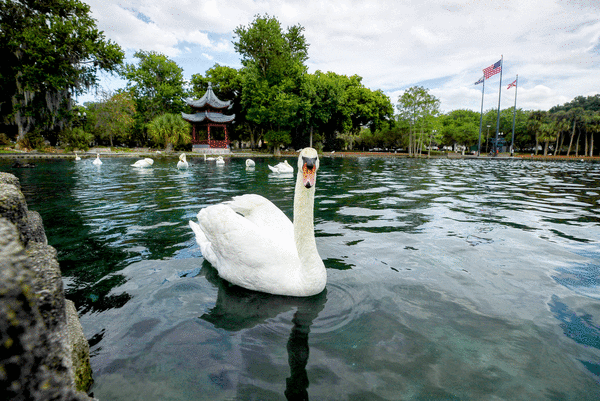
ORLANDO, Fla. — The number of swans that have died in the avian flu outbreak at Orlando’s Lake Eola Park has spiked to 19, city officials said Monday.
Since discovering the first deaths in December, the city has operated under the assumption that avian flu was to blame – though only in recent days did it receive official confirmation through necropsy results.
In all, 21 birds have died, including an anhinga and an ibis.
All 19 deceased swans are Royal Mutes, a spokesperson said. A report published last year by the British Trust for Ornithology found that Mutes were particularly susceptible to the avian flu, testing positive more than any other wild bird species in the United Kingdom in 2021 and ranking second in 2022.
Lake Eola accounts for just a fraction of a reported 128,000 infections across five states, according to the University of Minnesota’s Center for Infectious Disease Research and Policy. It cites data from the U.S. Department of Agriculture’s Animal and Plant Health Inspection Service, with reported outbreaks in Arkansas, Nebraska, Kansas, New York and Iowa, while also citing the suspected outbreak at Lake Eola and another impacting about 200 Canada geese near Des Moines.
The city said its parks staff has consulted with veterinarians and the Florida Fish and Wildlife Conservation Commission for advice on combating the outbreak. Thus far, their advice has been to let the virus run its course and allow the flock to build immunity, a process that could take about a month.
A similar strategy was conducted during the last bird flu outbreak at the park two years ago.
The virus can be transmitted to humans, though it’s extraordinarily rare. Just one case has been reported nationwide since 2002.
Since the initial discovery, crews have sanitized areas where the swans gather on the shoreline and have frequently pressure-washed walkways to remove excrement. Public feeders have also been removed from the park and notices have been posted warning people to avoid contact with excrement and to wash their shoes if they step in it.
Prior to the outbreak, the swan flock was estimated to have between 50 and 60 birds, with five of the world’s six varieties.
While the swans are city-owned – and receive annual health check-ups and vaccines – the public park also draws numerous wild and migratory birds, which could have brought the disease into Orlando’s crown jewel.
Last week, City Commissioner Patty Sheehan told the Orlando Sentinel that nine swans had died in the initial outbreak.
_____
©2026 Orlando Sentinel. Visit orlandosentinel.com. Distributed by Tribune Content Agency, LLC.






Comments