Column: Remembering New Coke and other terrible food ideas
Published in Variety Menu
Seriously? Whose idea was this?
In the 1960s, a popular national brand decided to expand their product portfolio by selling frozen food.
What could go wrong? The brand was known to just about everybody.
Unfortunately, the brand was Colgate. As in the toothpaste people. And nobody, but nobody, wanted to buy frozen food from them.
I was recently wasting far too much time on the internet when I stumbled upon a listicle that was, shockingly, actually interesting. Written by Melanie Hartley for preparedcooks.com, it lists 16 horrible food ideas that surprisingly made it to market.
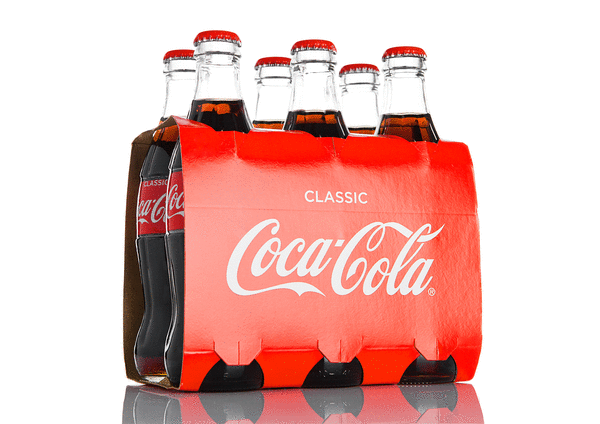
The first one she listed, of course, is New Coke, the textbook example of what food companies should never do.
In 1985, the good people at the Coca-Cola company decided to change the formula for one of the most popular food products in America. They made it sweeter and eliminated the distinctive aftertaste. One wag at the time accurately called it “Pepsi-flavored Coke.”
Seventy-nine days later, the broken and humiliated Coke management announced they were bringing back what they called Coca-Cola Classic. Sales dwindled of New Coke, later branded Coke II, and it was off the market entirely by 2002.
It’s not just Coke that imploded into silliness. Pepsi decided it wanted to get into the terrible-idea act, too, and in 1992 it confidently launched Crystal Pepsi.
It was clear. It looked like water but it tasted like Pepsi, leading to a fatal disconnect between the eyes and the mouth. It lasted just over a year, joining such equally unlikely colorless beverages as Clear Miller beer on the trash heap of food history.
In 1996, Frito-Lay began using an additive called olestra to some of its snack chips, which they called WOW — Tostitos WOW, Doritos WOW, Ruffles WOW and Lay’s WOW. The chips were briefly popular because the olestra replaced most of the fat in the chips, making them seem healthier.
There was only one teeny tiny little problem with olestra. A side-effect hardly worth mentioning.
Olestra can give you diarrhea. It can give you abdominal cramping. And it can keep your body from absorbing important vitamins.
Late-night television hosts, stand-up comedians and sketch comedians had a field day. Almost immediately, people stopped buying products with olestra in it.
The Food and Drug Administration later concluded that the side effects were actually fairly minor. It removed the mandatory warning label from products containing olestra, but the damage was done. No food products with olestra are currently available in the United States.
Olestra is, however, now used in deck stains and as a lubricant for small machines.
In 2000, the otherwise sane marketers at Heinz decided to add a 58th variety: Heinz EZ Squirt ketchup. It was ordinary ketchup, but in in-your-face bright colors.
You could have your choice of Blastin’ Green, Funky Purple, Stellar Blue, Totally Teal, Passion Pink or Awesome Orange. Heinz also sold a mystery bottle, which could be Passion Pink, Awesome Orange or Totally Teal, but you wouldn’t know which until you got home and used it.
The colors were gross, and were especially unappetizing when squirted on top of french fries.
But kids seemed to like it, at least at first. But when the novelty wore off, sales plummeted. It turned out that bright red — made without food coloring — is a perfectly good and appealing color for ketchup.
But perhaps the worst food idea ever was in 1974 when a national brand decided to sell single-serving glass jars of beef burgundy and Mediterranean vegetables and a dessert called blueberry delight.
The company that made them, though, was Gerber. They called them Gerber Singles, and the idea was that adults — or at least college students and the like — would want to eat something that didn’t require cooking. And because it was Gerber, the food was puréed.
It was not a success. College students did not relish the idea of eating baby food. No one, it seemed, wanted to eat puréed sweet and sour pork.
They were only sold for three months before being pulled, unmourned, from grocery store shelves.
©2026 STLtoday.com. Distributed by Tribune Content Agency, LLC.






Comments