The Disappearing Middle of Fashion
Published in Fashion Daily News
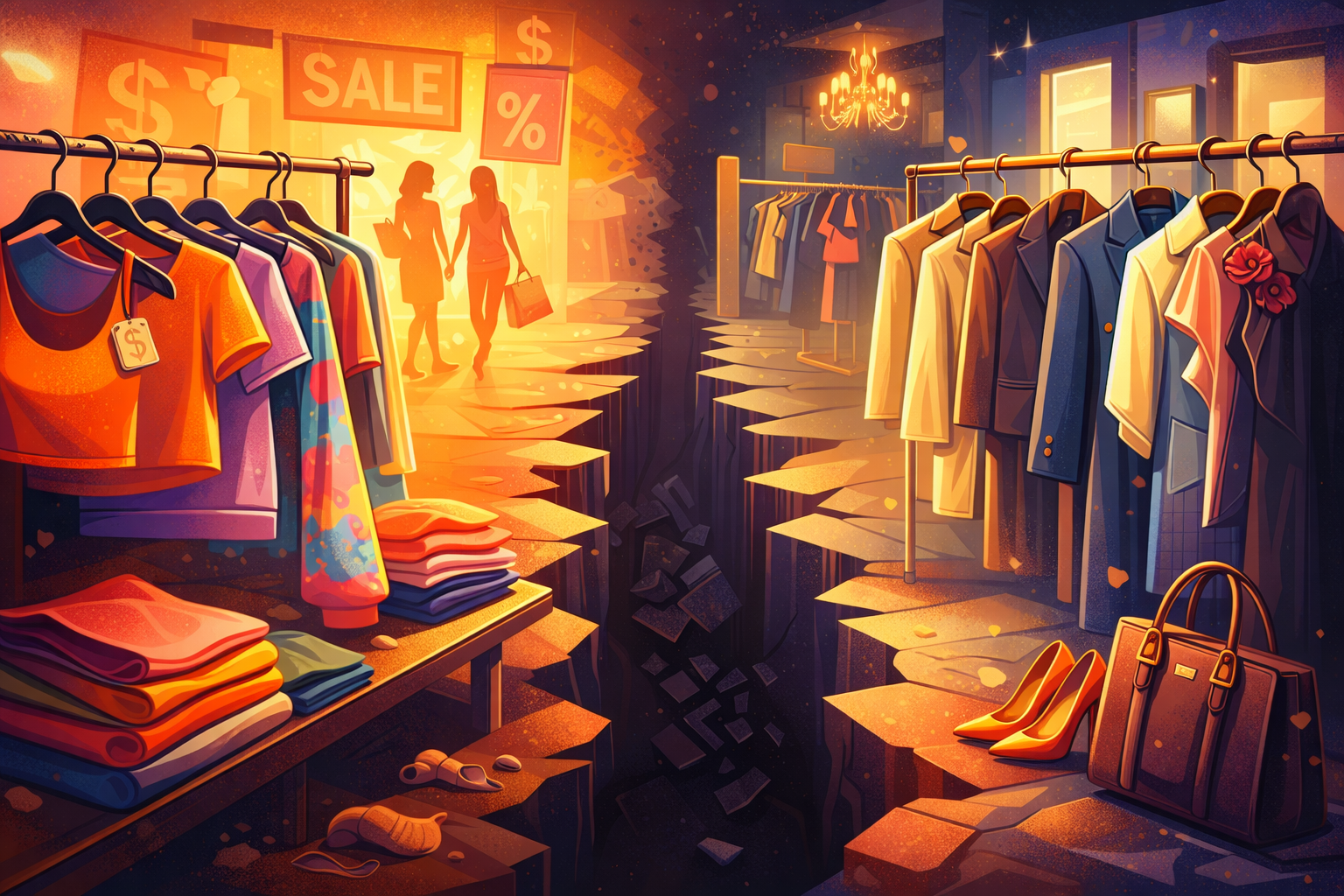
Walk into a clothing store today and the divide is unmistakable. On one end, racks of ultra-cheap garments trend-hopping at breakneck speed, stitched loosely for a season—or less. On the other, luxury pieces priced far beyond the reach of most consumers, marketed as heirlooms, investments, or cultural statements. What’s missing is the once-dominant middle: clothing that was well-made, reasonably priced, stylish without being showy, and designed to last.
The disappearance of fashion’s middle isn’t just a matter of taste. It reflects deeper economic pressures, cultural shifts, and changes in how people relate to clothing itself. The loss matters not only to consumers, but to designers, retailers, and the idea of fashion as a shared cultural language.
When the Middle Was the Market
For decades, the center of fashion was defined by dependable quality and accessible aspiration. Department stores thrived on brands that offered good fabrics, thoughtful cuts, and durability at prices that felt like a considered purchase rather than a gamble or a luxury splurge.
These clothes were not cheap, but they weren’t precious. A jacket might cost a week’s discretionary income, but it was expected to last years. Designers balanced trend awareness with restraint, assuming garments would live in real wardrobes, not social media feeds.
That middle supported entire ecosystems: skilled factory workers, pattern makers, regional textile mills, and retailers who invested in long-term customer relationships rather than viral moments.
Fast Fashion and the Collapse of Price Expectations
The first major pressure on the middle came from fast fashion. Brands built on rapid turnover normalized the idea that clothing should be inexpensive, plentiful, and disposable. Prices fell dramatically—but so did expectations.
When a shirt costs less than a meal, consumers stop asking how it was made, how long it will last, or whether it fits into a coherent personal style. Clothing becomes content: worn briefly, photographed once, then replaced.
Mid-priced brands found themselves trapped. Their costs—ethical labor, quality materials, slower production cycles—could not compete with fast fashion pricing. Yet they also lacked the brand prestige and margins to justify moving upscale.
The result was a squeeze that many never survived.
Luxury’s Upward Drift
At the other extreme, luxury fashion has steadily drifted further away from everyday wear. Once defined by craftsmanship and scarcity, it now increasingly trades on branding, spectacle, and exclusivity.
Price inflation in luxury has outpaced improvements in quality. Logos have grown larger, collections more theatrical, and seasonal cycles more relentless. Luxury no longer positions itself as “the best version of normal clothing,” but as a distinct category altogether—often disconnected from daily life.
This upward drift leaves a widening gap between clothes people can afford and clothes they are encouraged to desire.
The Vanishing Department Store
The decline of department stores accelerated the collapse of the middle. These stores once acted as curators, presenting a spectrum of options that taught consumers how to dress across budgets and occasions.
As department stores shuttered or hollowed out, mid-tier brands lost their primary stage. Online marketplaces, while expansive, flatten distinction. Without physical context, quality becomes harder to communicate, and price becomes the dominant comparison point.
The middle of fashion relied on being seen, touched, and tried on. Its absence from physical retail made it easier to forget—and harder to replace.
Casualization and the Shrinking Wardrobe
Another factor is the widespread casualization of dress. Workplaces relaxed dress codes. Social norms shifted. Comfort became paramount.
While this change brought welcome freedom, it also reduced demand for the kinds of garments that once anchored the middle: tailored trousers, structured jackets, polished shoes. When fewer people need such clothes, fewer brands can sustain making them at scale.
Casual wear itself bifurcated—into inexpensive basics and luxury athleisure—leaving little room for thoughtful, well-made everyday clothing that sits between.
The Cultural Cost of Extremes
Fashion’s middle once functioned as a shared visual language. It allowed people from different backgrounds to meet in a space of mutual legibility—recognizing quality, appropriateness, and effort without spectacle.
As the middle disappears, style becomes polarized. On one side, trend-chasing churn. On the other, luxury signaling. Both prioritize visibility over longevity.
The result is a quieter loss: fewer clothes that simply do their job well, fewer designers rewarded for subtlety, fewer consumers developing long-term relationships with what they wear.
Who Is Trying to Bring It Back?
In recent years, small labels and direct-to-consumer brands have attempted to rebuild the middle by emphasizing transparency, durability, and timeless design. They speak of “investment pieces” and “cost per wear,” reframing value rather than price.
Some succeed, especially among older consumers and those fatigued by fast fashion. But scaling remains difficult. Without the infrastructure that once supported the middle—department stores, local manufacturing, patient capital—these efforts often remain niche.
The middle, it turns out, requires systems, not just intentions.
Why the Middle Still Matters
Clothing is one of the most intimate interfaces between individuals and the world. When choices narrow to disposable or aspirational extremes, something essential is lost.
The middle of fashion mattered because it respected both maker and wearer. It assumed people wanted clothes that reflected care, not status; continuity, not novelty.
Rebuilding that middle would mean recalibrating expectations—about price, quality, and patience. It would require consumers to value restraint and makers to be rewarded for durability rather than speed.
Whether that recalibration is possible remains an open question. But the hunger for it is real, visible in growing frustration with both fast fashion waste and luxury fatigue.
The disappearance of fashion’s middle is not inevitable. It is the result of choices—economic, cultural, and collective. And like all such choices, it can be reconsidered.
========
is a New England–based writer covering fashion, labor, and consumer culture. Her work examines how clothing reflects economic systems and everyday ethics. This article was written, in part, utilizing AI tools.






Comments