Let's talk about heat pumps: This Pittsburgh utility is helping to train contractors on the science and art of HVAC
Published in Home and Consumer News
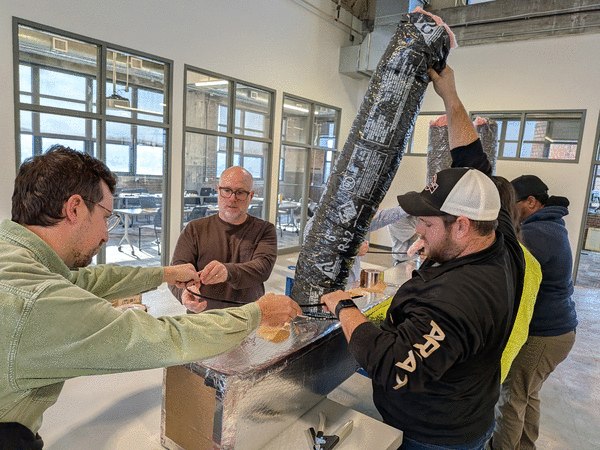
PITTSBURGH — Frank Gillis laid out four sheets of fiberglass inside the Penn College Building Performance Lab in Pittsburgh's Homewood neighborhood.
With a knife, he demonstrated how to cut through the insulation layer, stopping short of the aluminum cover — "like filleting a fish" — and how to fold the sheet into a rectangular duct, attach it to other ducts, and seal it with staples, zip ties and pressure-activated tape.
His students, most of them experienced contractors, fanned out into groups and followed his lead, trading tips and needling each other on who could get the better seal.
The assignment was a welcome break from the spreadsheet that Mr. Gillis, a senior program manager for residential buildings at Penn College, was searing into their eyes on Nov. 19.
The physics and math of duct design were in the spreadsheet. The smoke show was on the training room floor.
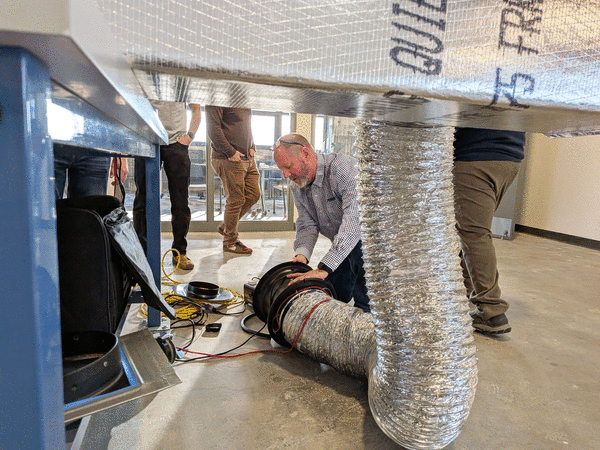
Once the students joined their duct segments into one big system, Mr. Gillis brought out the fan and the smoke machine.
"Let's find out where those leaks are," he said, turning the red knob.
Soon, some of the seams began to exhale smoke, which made escaping air visible. It also brought on more needling, although the system passed the pressure test and would do well in any new home, Mr. Gillis said.
Ductwork design was day three of the four-day heat pump training course sponsored by Duquesne Light Co., a Pittsburgh-based electric utility that serves more than 600,000 customers in parts of Pennsylvania's Allegheny and Beaver counties.
A heat pump is an electric appliance that transfers heat between indoor and outdoor air, pumping warmth out of the house in the summer and cool air out in the winter. It doesn't generate energy — it just moves it — which makes it more efficient than a regular furnace, although as Mr. Gillis and other building professionals have found, many heat pumps often need a supplemental source of heat when temperatures outside drop below 40 degrees.
About 10% of Duquesne Light's customers have heat pumps, the utility estimates. But awareness of the technology, both among residential consumers and HVAC contractors, varies widely.
The right way to talk about heat pumps
The utility has an interest in raising that awareness.
Training HVAC contractors on the mechanics and economics of heat pumps is part of Duquesne Light's beneficial electrification program, which is funded through the rates of all consumers. It was born, or at least introduced, in 2022 in a policy paper where Duquesne Light made the case for heat pumps — and electrifying everything that can be electrified — as a decarbonization strategy.
A lot has changed since then.
For example, decarbonization is no longer a federal goal under the current administration, and the incentives for things like energy efficiency improvements and heat pumps passed under President Joe Biden are ending this year. Concerns about phasing out natural gas appliances because of indoor air quality concerns and emissions of methane, a potent greenhouse gas, have been put on the backburner or dismissed by federal agencies that regulate emissions.
The conversation has shifted toward affordability, said Emily Phan-Gruber, manager of strategy and outreach with Duquesne Light's Electrification Solutions business.
"I think the economics of this region — with the price of natural gas (being low), the reality is for a lot of customers maybe a full heat pump isn't going to make financial sense," she said. "But a dual-fuel option might.
"We support that as well because we recognize that financially it's not going to be possible for everyone, but a heat pump can still provide the majority of the heating and cooling needs of a home. And if you need that, you know, gas supplement over the coldest days of the winter, then that's there for you."
Earlier this year, Duquesne Light partnered with Michigan-based consultant Pearl Edison to offer what they call an "energy efficiency concierge" service, where Pearl will evaluate and design a heat pump installation project for the customer, provide a budget and information on rebates and tax credits, and hire a local contractor to perform the work.
Contractors who go through the training at the Building Performance Lab, whose location in Pittsburgh's Homewood neighborhood is run by the nonprofit Pittsburgh Gateways Corp., would be qualified to bid on these projects.
The right time to talk about heat pumps
Mr. Gillis lives in a newer neighborhood development in Lycoming County, in north-central Pennsylvania.
When a new house is built, the owner typically hosts an open house where people can appreciate the gleaming granite countertops and fancy fixtures. Mr. Gillis heads straight for the HVAC system and finds "it's usually crap."
"It hurts my heart to see how much money people are willing to spend on things they know. And things they don't (suffer) because the contractor didn't explain it them."
Part of the Building Performance Lab training is to help contractors understand how and when to educate clients on the options. Typically, when a customer calls an HVAC company, it's an emergency. It's not a time for explaining the physics of air and heat transfer or for designing the best system of HVAC and ductwork to make things more comfortable and efficient.
"It's always Saturday night at midnight," said Trent Lagunas, an HVAC installer with Bethel Park, Pennsylvania-based HVAC Hernandez who attended the training.
Most homeowners don't want to give up a furnace that still works — they want to run it into the ground.
Often, that's the right move, contractors say.
Ideally, however, there will be a plan in place when things get terminal.
"As an HVAC contractor, we have to paint that picture," Mr. Lagunas said.
©2025 PG Publishing Co. Visit at post-gazette.com. Distributed by Tribune Content Agency, LLC.







Comments