Automakers enter energy storage business as data centers face backlash
Published in Automotive News

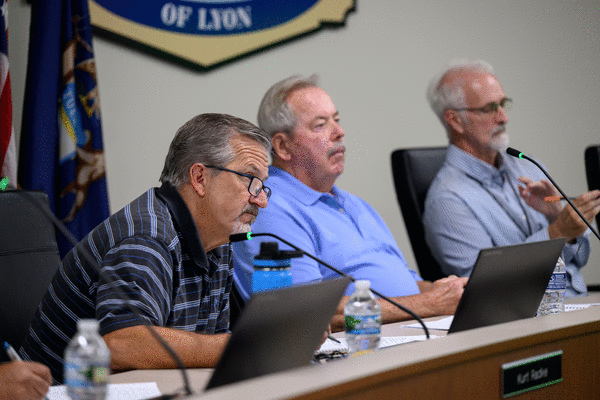
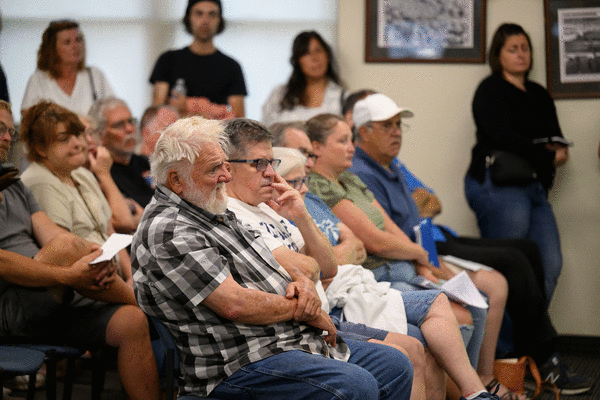



U.S. consumers are increasingly expressing opposition to data center developments across the country, raising questions about whether that pushback could extend to automakers in the stationary battery energy storage business that supplies data centers.
From Saline Township to Washington Township in Michigan and across the country, some residents are protesting massive data center projects popping up in their communities as demand for artificial intelligence tools grows. Concerns related to the environment, energy costs and the impact of AI's expansion fuel the pushback and have become hot topics in this year's elections.
Meanwhile, data centers also have made stationary energy storage an attractive, high-margin business for automakers, especially as lower-than-expected electric vehicle demand creates overcapacity in EV battery plants.
"I think that’s cordoned off for now," Daniel Ives, analyst at investment firm Wedbush Securities Inc., said in response to a question on the impact of data center controversy on automakers' stationary energy storage businesses. "If that becomes a bigger piece, it throws them into the political argument. It’s a tightrope they need to navigate."
Although data centers have existed for decades, a building boom has come about from a heightened demand for data processing and power for generative AI. The sites often require massive plots of land, energy to power the servers and water to keep equipment cool. Once up and running, they often don't need many people to operate, limiting job creation.
Automakers' turn to stationary energy storage is an agile way to respond to the changing dynamics of EV demand following the elimination of a federal tax credit for plug-in vehicles and deregulation of greenhouse gas and fuel economy regulations. But it also affords them capacity should they need to reverse course again and use these plants for EV battery supply.
"If they needed to change over to the automotive capacity, they could," said Stephanie Brinley, S&P Global Mobility associate director of AutoIntelligence. "It would be expensive, but they still have battery supply."
EV maker Tesla Inc.'s utility-scale Megapacks, long used in the battery storage business, now are driving the division with supply going to centers supporting the likes of SpaceX, Facebook's Meta and others. By itself, Tesla CEO Elon Musk's Space Exploration Technologies Corp., an aerospace and defense technology conglomerate, purchased $295 million worth of Megapacks in the second quarter.
Musk recognized the controversy around data centers in a conversation with JPMorgan CEO Jamie Dimon during a road show presentation ahead of SpaceX’s record initial public offering in June: “There are very few people who want a power plant in their backyard. If we wanted to, say, double the electricity usage of the United States, we would have to build twice as many power plants. Most communities are not super excited about that.”
Ford Motor Co.'s new subsidiary, Ford Energy, is retooling one of its battery plants in Glendale, Kentucky, to produce stationary battery storage systems starting next year. Executives are betting on the business to help turn the automaker's money-losing Model e EV division around by 2029 and have said utility companies, industrial manufacturers and data centers are potential customers.
"It's early days, but at the strategy level, there is no doubt that the growth for battery storage, for both data center build-out and grid stability, (in) places like California, and Texas, and Florida is exploding, both for consumers and business users like data centers," Ford CEO Jim Farley said earlier this month on an investor call. "We have been deeply engaged with customers as we develop this business plan, and we continue to engage them in specific contracts for our 20-gigawatt-hour capacity in '27 and beyond."
General Motors Co.'s battery joint venture with LG Energy Solution, Ultium Cells LLC, has launched production for stationary battery storage. GM also plans to enter the stationary battery storage industry itself, though its focus is on residential applications initially.
The first three months of 2026 produced the largest single-quarter concentration of blocked or delayed data center projects on record, according to the most recent report from Data Center Watch, a research project backed by AI security company 10a Labs. At least 75 projects worth about $130 billion faced disruption from local opposition.
"Some of the opposition is grounded in concerns of increased electricity bills, water shortages, noise, and land use changes affecting local character," Emily Hoch, a senior fellow at Data Center Watch, said in an email. "However, we are also hearing about the role of technology, job displacement, and other parallel concerns relating to the technology supported by this construction."
In Michigan, local petitioners in Augusta Township forced a public rezoning vote in which the electorate rejected a data center proposal. Developers withdrew projects in Lansing and Washington Township. The University of Michigan's leadership paused a supercomputer data center in Ypsilanti Township in response to community concerns. Several municipalities have passed moratoriums on data center developments.
Many voters also cited opposition to data centers in the midterm primary elections. In the Democratic contest for U.S. Senate in Michigan, Abdul El-Sayed, whose plan calls for increasing regulations on data centers, beat out Haley Stevens, who took an AI optimist approach.
"I don't like data centers," Dom Binguit, 25, of Canton Township said earlier this month about casting her vote for El-Sayed. "They're not good for the environment."
Meanwhile, Ultium Cells began producing lithium iron phosphate battery cells for energy storage systems last month at its plant in Spring Hill, Tennessee, following a $70 million investment. The plant's cells supply LG Energy Solution Vertech, the U.S. energy storage division of LG Energy Solution. LGES spokesperson Phil Lienert said in a statement that these energy storage systems are used in a variety of applications, but he deferred to end-user consumers to comment on the specifics of the deployment of the products.
The launch in Tennessee came a month after the Detroit automaker said it would build sodium ion battery cells for energy storage systems starting in 2028 in partnership with startup Peak Energy. In a news release, Peak Energy emphasized how its system's passive cooling reduces energy waste.
"GM is focused on residential energy solutions today and is gearing up to support the reliability needs of the electricity grid tomorrow through vehicle-to-grid technology and battery chemistries suited for energy storage," GM spokesperson Stuart Fowle said in a statement. "We play no role in the planning and placement of data centers.”
GM also has a partnership with Redwood Materials that seeks to repurpose EV batteries for second-life applications like energy storage and to recycle the batteries' materials.
Ford plans to start producing stationary battery storage products next year. It's fully taken over the Kentucky site from the joint venture it dissolved with SK On Ltd. after nixing plans last year for future EVs that it didn't see becoming profitable. Ford Energy hasn't announced a deal with data centers at the moment. It does have a five-year framework agreement with EDF power solutions North America, a subsidiary of France's EDF Group and a developer of energy facilities. EDF is deploying grid-scale energy storage projects across the United States.
Ford declined to comment on general data center backlash and its potential impact given its energy storage system business.
Dealers like Jim Seavitt, president of Village Ford in Dearborn, however, aren't worried: "I don’t think that will influence people in buying Fords. I don’t think they will tie them together. They want to know, 'what is the new product and what it's going to cost me.' "
It's too early to determine whether consumers will make that leap, S&P Global's Brinley said. She added: "Consumers are notorious for being upset about something and proceeding to make a buying decision that doesn’t align with what they are angry about."
Some issues, however, do sway buyers. Tesla's global sales declined 13% in early 2025 as Musk aligned himself with President Donald Trump. But that plus Musk's position at the center of the AI revolution with his other businesses may make him less vulnerable to fallout, Ives said.
"GM and Ford and Stellantis, if they head down the path, are just dipping their toe in the water," Ives said. "They could get thrust into the political spotlight. Musk is already in that."
Still, automakers supplying energy storage systems helps address some of the points of opposition to data centers, said Glenn Stevens, executive director of MICHauto, the automotive arm of the Detroit Regional Chamber that's a member of the Michigan for Responsible Data Centers coalition. If these centers will be built regardless, energy storage can help alleviate strain on the electrical grid at times of peak demand and encourage more renewable energy supplies that can be stored and deployed at times when the wind doesn't blow, or the sun doesn't shine.
"As we proceed, the demand for them is not going to go away," Stevens said of data centers. "For Michigan, we are citizen- and community-first, but we also have to understand we have to move the way the world is going, the way technology is going and prepare people for the jobs of that future. Otherwise, we could get left behind, and that’s not an option."
©2026 www.detroitnews.com. Visit at detroitnews.com. Distributed by Tribune Content Agency, LLC.






Comments