Driverless cars have touched down in Tampa. Here's what to know
Published in Automotive News
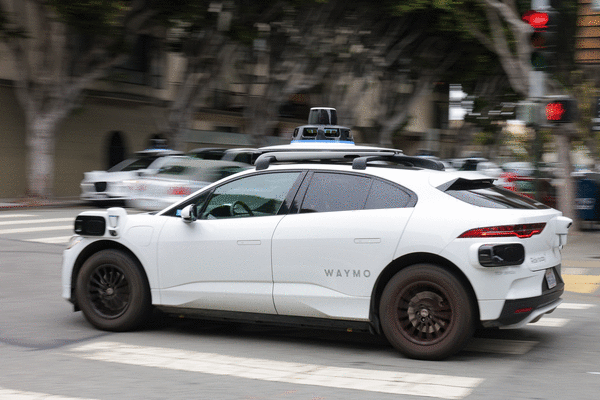
TAMPA, Fla. – Fleets of autonomous, unmanned cars have descended upon Tampa.
Elon Musk’s robotaxis hit the streets last week, and curious passengers are already hitching rides in the self-driving vehicles. But Tesla – which touted the technology as the next best thing to its investors – isn’t the only company launching driverless cars in the city.
Waymo, owned by Google parent company Alphabet, dispatched vehicles to scour and map the streets of Tampa late last year and is expected to open a competing service soon.
Tampa is one of the latest cities to welcome autonomous cars. Waymo operates in 11 places with plans to start taking rides in 21 more around the country and the world, while Tesla’s autonomous rides are online in six.
It’s a new age, said Jeff Farrah, CEO of the Autonomous Vehicle Industry Association, which advocates for companies like Tesla and Waymo.
“We’re very much in the commercialization era of autonomous vehicles,” Farrah said. “This took a couple of decades of American ingenuity and innovation and capital investment to get us where we are.”
Here’s what you need to know about trying the service in Tampa Bay.
How do driverless cars, well, drive?
Waymo and Tesla use different technologies to steer the wheel.
Waymo cars are equipped with cameras, radars and audio sensors. In addition they use “LiDAR,” which uses laser light to measure distances. All of these combine to give the car a 360-degree perspective and even a bird’s eye view above traffic.
These sensors help an autonomous car see multiple football fields ahead, Farrah said. The information gathered by the sensors and radars is fed into software, which uses artificial intelligence to make judgment decisions.
Say, for example, a ball rolled onto the street and a kid went to pick it up. The car would know to stop because of the “marriage” between software and hardware, Farrah said.
Unlike its peers in the industry, Tesla has rejected the use of sensors. Robotaxis instead rely on a vision-only approach with cameras that feed AI-based software. Officials with Tesla did not respond to questions from the Tampa Bay Times.
“LiDAR is lame,” Musk said back in 2019. “In cars, it’s friggin’ stupid. It’s expensive and unnecessary.”
Are driverless cars safe?
This is perhaps the biggest question.
Companies tout safety as one of their guiding principles, arguing autonomous cars could cut down on accidents caused by human error.
But recent footage from major cities show confused driverless cars heading in the opposite direction of traffic, into construction zones or flooded roadways and even blocking an ambulance after a mass shooting.
In a recent Tesla earnings report, Musk said avoiding accidents is a priority as robotaxis expand. “If we injure even one person, it will be worldwide headline news and regulators will immediately clamp down on our activities,” he said.
Tesla’s camera-only approach is a cause of concern, said Donald Slavik, an attorney who who sued the company in the first jury trial dealing with its autopilot program.
The system could face problems in extreme weather events, he said including rainstorms and fog.
“If there’s a hurricane coming, what do you do?” Slavik said. “How does the vehicle react? You don’t have a human making judgments on things, and you can’t teach a computer everything compared to how you can teach a human to make judgments.”
Waymo has encountered its own kinks. Cars in San Francisco had to be towed away after their batteries died while sitting in traffic. One vehicle killed a tabby bodega cat named KitKat that had gone under the car.
“The Waymo Driver is always alert, follows speed limits, promotes seat belt use, and operates some of the safest vehicles on the road,” the company says on its website.
Farrah said an autonomous car would never be impaired or distracted like a human driver.
Waymo vehicles, for example, were involved in 68% fewer crashes reported to police compared to human drivers in the cities they operate in, according to a study from the Insurance Institute for Highway Safety.
Farrah said every minute spent on the road and every block driven gives the vehicles more experience to navigate situations. The cars operate in a sort of hive mind, meaning what one car learns is transmitted to a wider network.
“Humans don’t tend to get much better as drivers over time. If anything, people tend to get worse as they get complacent, as they get older,” Farrah said. “But that’s the opposite when it comes to autonomous vehicles.”
Local officials respond
City officials are cautiously optimistic as autonomous cars arrive in Tampa.
Mobility department director Brandon Campbell said he was not aware of any meetings between local leaders and Tesla. Waymo, however, has led more outreach, presenting city officials with timelines and planned service areas. The company hosted a first responder training to teach Tampa police officers and firefighters how to interact with unmanned vehicles in an emergency.
The city cannot regulate the private companies dispatching driverless vehicles, but Campbell said officials want to be as intentional as possible.
“That might look a little different from one autonomous vehicle company to another, depending on how willing they are to engage with us and to talk with us,” Campbell said. “Our doors are definitely open to discuss with them and what their plans are.”
The city will monitor reported crashes on a day-to-day basis as usual, Campbell said.
In statement, Mayor Jane Castor said Tampa is a destination for innovation. “We’re excited to welcome new technology that can make transportation safer, more convenient, and more accessible,” she said.
Where and when can I catch a ride?
Robotaxis are already booking rides through an app within a specific grid that includes areas of West Tampa, Tampa Heights and Egypt Lake. Tesla has not had any discussions with Tampa International Airport to gain access to its roadways, Joshua Gillin, an airport spokesperson said.
Waymo cars will be available to Tampa residents later this year, the company said. Driverless rides are only available to Alphabet employees for now, the final stage before fully opening rides to the public.
Waymo is still in negotiations with Tampa International Airport, Gillin said.
Who can ride in a driverless car?
Kids under 8 years old are prohibited from riding in a Tesla Robotaxi. Minors above the age of 8 are allowed if they are with an adult.
Those under 8 years old can ride in a Waymo, but they would need a car or booster seat and cannot sit at the front. Up to three people can ride in a Robotaxi and four in a Waymo. Passengers are prohibited from sitting in the driver’s seat.
How much does it cost?
When robotaxis first launched in 2025, rides had a flat fare of $4.20, but the company abandoned that pricing model. The base fare for a ride is $3.25, and every mile traveled costs $1.
The price of Waymo rides are determined by the most direct route, the company said. Like other rideshare services, the price tag may be higher during busier periods.
©2026 Tampa Bay Times. Visit at tampabay.com. Distributed by Tribune Content Agency, LLC.






Comments