Toyota threatens GM's sales crown as US hybrid demand surges
Published in Automotive News
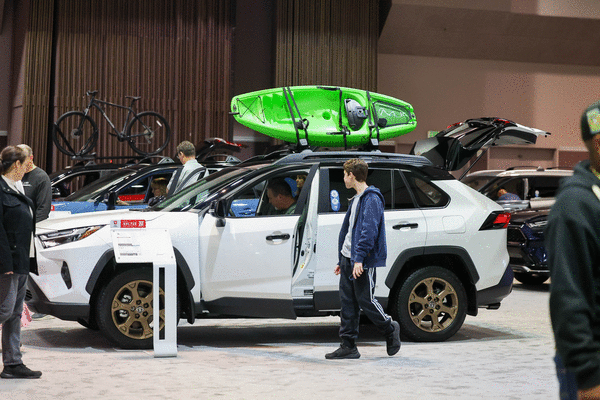
General Motors Co. is facing an uncomfortable reality: Toyota Motor Corp. has a shot at taking the U.S. sales crown once again thanks to growing demand for its gasoline-electric hybrids.
The Japanese automaker is expected to increase its market share to 15.8% in the first half of this year, while GM’s share may tumble by almost 1 percentage point to 16.8%, according to a forecast from researcher Cox Automotive. If consumers continue to flock toward fuel sippers, Toyota has a shot becoming the No. 1 auto seller in the U.S. this year.
“Toyota has a chance,” said Charlie Chesbrough, senior economist for Cox. “We’re not predicting it yet, but it’s possible. Consumers are interested in hybrids and GM can’t compete.”
Chesbrough expects GM to put up a fight. “They would use incentives to try to keep it,” he said.
Toyota overtaking GM in the Detroit automaker’s home market would mark a historic shift. GM has held the top spot since passing Ford Motor Co. in 1931, losing to Toyota only once — in 2021 — amid a global semiconductor shortage. A shake-up also would underscore the ill effects of GM Chief Executive Officer Mary Barra’s risky bet on EVs over hybrids, as most American buyers have been reluctant to go all-electric.
GM spokesman Jim Cain disputed that the automaker would increase incentives to maintain its sales lead over Toyota. The company has worked to avoid rebates as part of a push to maximize profit and cash flow, holding incentives below the industry average for the last three years.
“Our track record speaks for itself about discipline on production, pricing and incentives,” Cain said.
A spokesman for Toyota had no immediate comment on whether the carmaker is on track to take the top sales spot in the U.S.
Hybrid momentum
Through May, Toyota’s sales of electrified vehicles, which include battery-powered cars but are predominantly hybrids, rose 5.6% in a market that is expected to fall this year.
By contrast, industrywide sales of full-size trucks and SUVs, where GM and Ford are strongest, are both down as the war with Iran has pushed the average price of gasoline to almost $4 a gallon.
Toyota earlier this week began producing the latest version of its best-selling RAV4, which is now only sold as a hybrid, at its plant near Lexington, Kentucky.
To alleviate shortages of the popular compact SUV, the Japanese carmaker aims to boost U.S. output to 100,000 vehicles at the plant this year, supplementing imports from Canada and Japan, said Kerry Creech, president of Toyota Motor Manufacturing Kentucky.
“Our ramp up will be pretty fast,” Creech said in an interview. “We’ll be fully ramped up in 30 days” after implementing lessons learned from the earlier RAV4 production start at Toyota’s Canadian operations.
Toyota offers hybrids on more than 20 models in its U.S. lineup. GM has only the electrified Corvette and Ford offers a hybrid on only the Maverick small pickup, F-150 and Lincoln Nautilus SUV.
“Toyota stuck with the idea that you have to have a big portfolio,” Chesbrough said. “They have midsize cars, compact cars. The Detroit three are focused on more specific vehicles.”
GM made its big bet on EVs at a time when Tesla Inc.’s sales and stock were surging and regulators across the globe were tightening emissions rules. For GM, hybrids were an expensive interim solution, so Barra decided to go bigger on all-electric models.
“For EVs, it was pleasing Wall Street,” said Stephanie Valdez Streaty, director of industry insights at Cox. “We want to get that valuation like Tesla.”
Ford also has risk of losing its No. 3 spot to Korea’s Hyundai Motor Co., which offers several hybrids. Cox predicts Ford’s market share will drop a point to 12.6% through the first six months of 2026, while Hyundai should climb to an estimated 11.7%.
(With assistance from Chester Dawson.)
©2026 Bloomberg L.P. Visit bloomberg.com. Distributed by Tribune Content Agency, LLC.







Comments