‘A nightmare to think about.’ Driving behavior may be early warning sign of dementia
Published in Senior Living Features
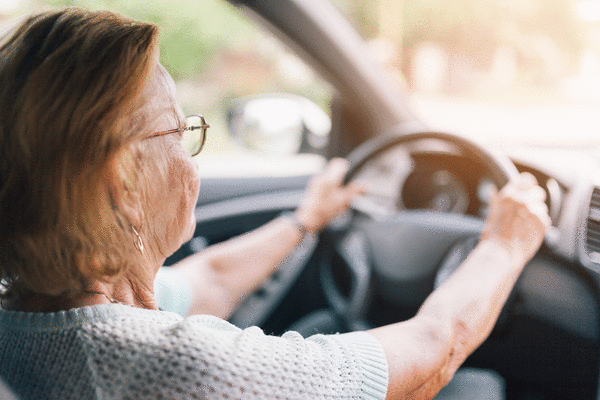
FORT LAUDERDALE, Fla. -- When the red light turned green, Christine Burger found herself unsure what to do next.
Burger, 73, had driven the streets of Delray Beach for many years, and had traveled often through the intersection where she was now stopped. Yet she was unsure which direction to take.
It wasn’t the first time.
“There are times when I’m with my husband, and I’m driving, and I’ll stop in an intersection, and I think, well, which way am I supposed to go?” Burger admitted. “I think to myself, well, I know either way I’m going to get where I have to go, but why don’t I know where I’m going when I have gone that same route the whole time I lived in South Florida … and it’s very frustrating.”
The personal and family struggle over when to stop driving is increasingly common in Florida amid the highest number of senior drivers ever recorded in the United States. A decision to take away car keys or give them up often comes after an accident or driving scare — typically when Alzheimer’s disease is further advanced. Yet more subtle changes in how people drive may be early warning signs not to be ignored.
New evidence in a study by researchers at Florida Atlantic University and the University of Central Florida found that changes in driving behavior can act as biomarkers indicating a decline in mental clarity that pre-dates major signs of dementia.
The three-year FAU/UCF study of 450 seniors in South and Central Florida found that drivers with mild cognitive decline exhibited less control of the gas pedal, took shorter or more fragmented trips, engaged in frequent hard braking, and drove lower average speeds. Overall, drivers with mild cognitive decline were less confident and less responsive on the road than those without it.
“Everyday driving habits — captured passively through in-car sensors — may offer a powerful new way to detect subtle cognitive changes long before they become obvious,” said Ruth Tappen, senior author and professor in FAU’s Christine E. Lynn College of Nursing and a member of FAU’s Stiles-Nicholson Brain Institute.
Tappen and her team of researchers studied driver behavior in real-life traffic conditions using the in-vehicle sensors: one for telematics data and one for video. Participants also underwent regular tests of thinking and memory skills.
Researchers found that it was the combination of behaviors — not any single action — that most effectively distinguished those with impairment from those without. In the past, studies have mostly used driving simulations and questionnaires.
“This is a suggestion that you be more aware of what’s happening to you cognitively, and if you become more aware of changes, get tested,” Tappen said. “We’re not doing this to get people off the road. We’re in the business of letting people know what may be happening with them.”
Tappan said seniors with some early mental decline may self-regulate, possibly unconsciously. They may exercise greater caution while driving — remaining in the slower lanes and staying in familiar neighborhoods.
“These attempts to compensate for accumulating deficits eventually become insufficient to allow the individual to continue to drive safely,” Tappen’s research found. Studies have shown that individuals with Alzheimer’s are at an increased risk of at-fault crashes, according to the Alzheimer’s Foundation.
Study participants weigh in
Lorraine Marchand, 80, of Sunrise, participated in the FAU study.
“Everybody my age is interested in cognitive decline. We all watch ourselves to see what we’re doing. Are we forgetting things? It’s just very common to be concerned,” she told the South Florida Sun Sentinel. “I think that driving is complex and people with really serious problems know it, but people who don’t have a really serious decline, they don’t really know how it affects their driving.”
Marchand said she has noticed behavior changes in friends who seem unaware. “They don’t get lost and anything obvious like that, but they’re more cautious in their driving,” she said. “They stick to the right-hand lane all the time and go really slow.”
She understands, though, that losing access to a vehicle in car-dependent Florida poses huge challenges.
“It’s like a nightmare to think about not being able to drive here in Florida,” Marchand said. “How do you get around? What do you do? How do you function? I can’t walk to Publix, and I can’t certainly can’t carry my groceries back.”
Family members often share how challenging it is to tell their loved ones to stop driving. Some seniors become angry and refuse.
Priscilla Jean-Louis of Tallahassee says her mother, Vera Johnson, drove until she was 70, even though she should have given up her keys a year or two earlier. By the time Jean-Louis disconnected her mother’s car battery to derail her, she was driving in the wrong direction, stopping at green lights and running red lights. “My daughters were scared to ride with Granny,” she said. “It prompted me to pay attention.”
Taking away a family member’s keys is emotional, said Jennifer Braisted, the Alzheimer’s Association of America’s territory advocacy director for the Southeast Region.
“If you notice something is different when driving with mom and dad or a spouse, have those conversations and get a plan in place,” she said. “I have seen many instances where the family wished they had done something sooner.”
Giving up driving is not a given
While over time, dementia affects the skills needed for safe driving, not everyone with a diagnosis needs to give up driving. One in three people diagnosed with dementia still drives, particularly with new medications and treatments that are preventing the disease from advancing.
About 1 in 9 people age 65 and older, or about 11%, are diagnosed with Alzheimer’s dementia. About 35.8% of people over 85 have Alzheimer’s.
Burger said she has a diagnosis and takes medication. So for now, she continues to drive.
“I am fortunate,” she said. “I’m still aware of stop signs and red lights. I’m still aware of a lot, and that’s only because I went to a neurologist. I was tested, and I am on medication, and I’m starting cognitive therapy to keep this at bay so that I can drive as long as possible.”
She plans to monitor her own driving habits.
“The minute the neurosurgeon surgeon or any doctor involved in my treatment says ‘you can no longer drive,’ I will not drive,” she said. “And we are planning because that might happen.”
Tappen said the study is ongoing and the video data still needs to be analyzed. However, she said research indicates that seniors should use their cars, equipped with many sensors, to monitor their driving.
“Our cars talk to us these days, so pay attention,” she said. “The car can provide you with some feedback and let you know that you might want to be more aware and have an evaluation done.”







Comments