Baltimore abuse survivors, archdiocese hundreds of millions apart in bankruptcy plan
Published in Religious News
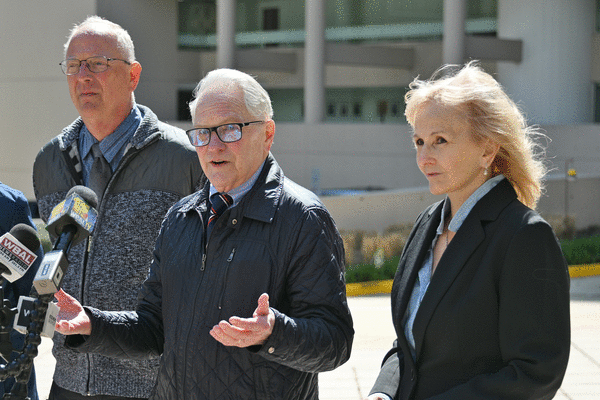
BALTIMORE — Several survivors of sexual abuse within the Archdiocese of Baltimore and their advocates expressed dismay Monday that the church’s proposed bankruptcy plan doesn’t do enough to compensate for decades of emotional damage.
“I think they have a long way to go yet,” said survivor and attorney Teresa Lancaster. Although she was encouraged to see the church “starting to put numbers on paper,” Lancaster said she felt their proposed amounts were “painfully low.”
Recent filings in federal bankruptcy court show that the Archdiocese of Baltimore and its survivors are still hundreds of millions of dollars apart on a settlement.
The church on Friday submitted a reorganization plan, a blueprint to keep its business alive while it satisfies its debts to creditors. In this case, the plan would allow the diocese to continue its charitable and religious mission while also compensating hundreds of survivors, whose rush of lawsuits in 2023 spurred the bankruptcy claim before litigation could even begin.
Legal scuffles since then between a survivors committee, the church, its parishes and its insurers have taken up the better part of three years.
After last week’s filing, starting points between the two main parties were more than $600 million apart
On Friday, the church offered to pay nearly $44 million to a survivors’ trust, plus an additional $125 million of approved settlement money from at least two insurance companies, totaling approximately $169 million. In their own reorganization plan, filed early last month, the survivors committee proposed the archdiocese put in about $115 million by itself, as well as to-be-determined amounts from real estate, parishes, schools and insurers. The total posited by survivors topped $770 million.
Ed Caldie, an attorney representing the survivors committee, told The Baltimore Sun on Monday that the archdiocese’s proposal was “profoundly disappointing,” an unprecedented attempt to force a settlement on survivors.
“It’s clear to the Committee that the Church has substantially more assets than they are offering to contribute to compensate survivors,” Caldie said. “The Archbishop appears intent on forcing a resolution on Survivors … and the proposal thus represents a significant step backwards from our point of view.”
In a statement Friday describing its filing, the archdiocese said its reorganization plan is a step toward its dual objectives in the bankruptcy proceeding: providing equitable compensation to survivors while sustaining the church’s mission and ministries.
“The Archdiocese will continue to listen, to learn, and to seek a resolution that honors the dignity of survivors and strengthens the mission of the Church for generations to come,” the statement read.
The most recent bankruptcy hearings have focused on defining where settlement money can come from.
In court, the church contends that its parishes and schools are separate entities from the archdiocese, which reportedly acts as an administrative body assisting them. Lawyers for the survivors, however, say there are enough civil and financial connections between the church and the parish corporations for the latter’s proceeds to apply to the bankruptcy case, including property sales from the archdiocese’s “Seek the City to Come” consolidation campaign.
Last month, Vicar General Adam Parker, one of the highest-ranked leaders in the city diocese, was called to testify and define the church-parish relationship.
Parker said that although Archbishop William E. Lori serves as each parish corporation’s president, and he is their vice president, profits from property sales are returned almost entirely to each corporation. Money derived from “Seek the City,” which has helped merge 61 parishes into 30 worship and ministry sites, was intended to address declining attendance and aging buildings, not to pay survivor claims, he said.
U.S. Bankruptcy Judge Michelle Harner, in an April 29 preliminary ruling, described Lori’s involvement with the local parishes and schools as “distinct” from his role atop the archdiocese and allowed the church to continue providing real estate services to the “nondebtor” corporations.
With that ruling, the implementation of which will be evaluated in a July 6 status conference, the church filed a reorganization plan that left the parish, or nondebtor, contribution blank.
Christian Kendzierski, a church spokesperson, said in order to be determined, nondebtor contributions require further guidance from the court on what survivor claims are valid, what parts of the plan can move forward and what assets are available to the creditors, among other factors.
Regardless, under the plan submitted Friday, whether parishes, schools and other Catholic entities contribute settlement money would be voluntary, Kendzierski said.
Some survivors on Monday said that without parish contributions, the financial gap between the reorganization plans would maintain a “severe degree of separation” from what survivors first expected.
When Maryland lawmakers passed the Child Victims Act in 2023, it allowed survivors of sexual abuse to sue the public or private institutions in which they were abused, regardless of when the abuse occurred. Before it was amended last year, the landmark bill allowed church survivors to seek upward of $1.15 million in compensation.
The law also opened the door for individuals to pursue decades-old claims involving state-run juvenile facilities, public schools, foster care systems and other government agencies. Potential costs to taxpayers are estimated as high as $60 billion, according to some lawmakers. Moody’s Ratings downgraded Maryland’s credit for the first time in nearly 30 years in May 2025, following an outlook warning first reported by FOX45 News the previous year.
Frank Schindler, a survivor and advocate, said in a phone interview that although the church’s reorganization plan includes a hefty amount of money, in context, it’s a steep drop-off from what was made possible by the Child Victims Act. The creditors committee represents more than 900 survivors. Should the church’s proposed dollar figure be approved, the reorganization plan would provide a maximum settlement figure below $190,000 per claimant.
A handful of survivors are currently asking the bankruptcy court to allow them to pursue their cases in the state’s civil court, which would open the church up to the more expensive victims act. A hearing on that issue will take place early next month.
Schindler said he believes that possibility, as well as Harner’s repeated frustrations with how long the bankruptcy case has taken, may have encouraged the church to make its filing last week.
“They only do what they’re pressured to do and they only do the bare minimum. And that’s what I think this is: the minimum.”
________
©2026 The Baltimore Sun. Visit at baltimoresun.com. Distributed by Tribune Content Agency, LLC.







Comments