At City Hall, stalemate and controversy deepen Chicago's budget crisis
Published in News & Features
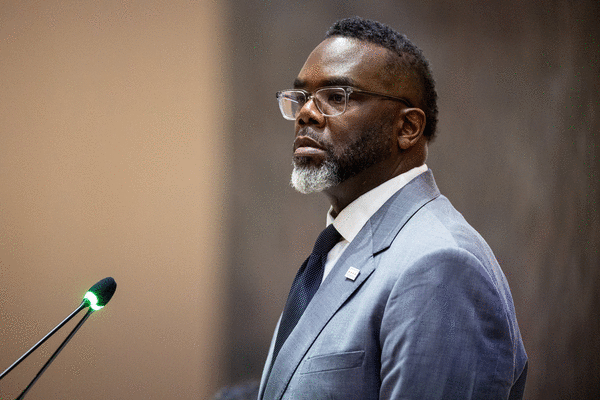
CHICAGO — Walking into City Council chambers, Ald. Andre Vasquez took out his phone, crouched down and pointed the camera toward the ground.
He filmed a dead cockroach, an ominous reflection, he said moments later, of the decisively more complicated budget negotiations aldermen faced when they entered the room Monday after a weekend spent processing the abrupt departure of Mayor Brandon Johnson’s CFO.
“It feels different,” he told colleagues lingering by the dais after a routine meeting.
It was.
The controversy had wrought a new zenith in division and mistrust between Johnson and opposing aldermen, and the already Sisyphean task of filling a roughly $400 million budget gap by a critical year-end deadline had somehow grown even more difficult.
The question at City Hall now: Can the mayor and an adversarial council majority find a way to compromise on a budget before Chicago suffers credit downgrades or even a government shutdown?
The whirlwind week for Chicago’s tangled budget process began the previous Friday, when city Chief Financial Officer Ashlee Gabrysch suddenly resigned. The Johnson appointee three months into her role shocked aldermen by warning in a letter first reported by the Tribune that she faced pressure to share misleading budget analysis and “compromise my integrity.”
What has followed is yet another escalation of the bitter divides amid the waning mayoral control defining Chicago government.
Johnson’s aldermanic opponents ramped up calls for him to back off key budget proposals, foremost his corporate head tax, citing a further smothering of long-faded trust.
Then on Wednesday, the council voted 45-5 to approve an investigation into Johnson’s handling of city finances. Another public blow quickly followed when ratings agency S&P warning Chicago could soon face a credit downgrade amid “political infighting within a condensed budget timeline.”
For months, the mayor had sought to define the budget negotiations by asking if the city should tax the rich and big corporations more to fund additional services. His council opposition seized the recent chaos to instead turn focus toward financial responsibility and transparency.
But Johnson has so far remained dug in on his initial proposal, and City Hall has continued trundling toward a final window for compromise in a dangerous deadlock.
The first signs of a potential compromise from the mayor flashed Thursday afternoon when his staff canceled Friday budget briefings with aldermen and instead promised to circulate “an amendments package” that day, an email obtained by the Tribune showed. Johnson’s administration did not share such a package by the end of the day Friday, but had scheduled more briefings for Tuesday, a signal the mayor could soon share new concessionary proposals.
“My administration continues to recognize the urgency of coming to the table, listening to the concerns of our residents, and finding a path forward that delivers the investments Chicagoans are calling for while continuing to put our city on stronger financial footing,” Johnson said in a statement Friday afternoon that touted his new expenditures. “We have an opportunity to come together, find common ground, and get this done for the people of Chicago.”
If the mayor yields to the pressure and removes his corporate head tax, he will have limited revenue-raising options at his disposal and a hard time winning over council critics.
But with no such proposal yet on the table, both he and his opponents have appeared too unwilling to move toward the middle to Vasquez, a swing vote in recent budgets.
“I think it’s unfortunate and human that people may want to play a game of chicken and then see who blinks first,” Vasquez, 40th, said.
But the roughly 28-member City Council majority that repeatedly objected to Johnson’s initial budget pitch — the same group that forged and passed a plan to close Chicago’s final budget gap last year against the mayor’s will — is carefully holding its stare.
So far, the leaders of the self-dubbed “budget accountability coalition,” derided by Johnson as the “corporate caucus,” have sworn they will not carry the burden of coming up with alternative plans. Even after assembling their amended budget last year, they argue the mayor must do the heavy lifting this time.
“Because we don’t have 1,000 people at our disposal, that exhausted us. We don’t have the resources to do that over and over and over again,” Ald. Anthony Beale, 9th, told the Tribune a day before Gabrysch’s departure. “Who wants to do all that heavy lifting when we don’t have the manpower to help get it done?”
Other opposition leaders accuse Johnson of intentionally failing to enact key parts of the budget they passed last year, including an unprecedented plan to profit from augmented reality advertising and another to raise $90 million by selling collection rights to $1 billion in debt owed to the city.
Finance Committee Chair Ald. Pat Dowell, 3rd, said aldermen worked hard on the last budget only for Johnson’s team to “slow-walk it, not implement, not discuss it.”
But while Johnson’s administration argues several revenue-raisers aldermen passed were simply unfeasible, it recently made an under-the-radar concession by beginning to license video gambling terminals late last month, ending what Beale had ridiculed as bureaucratic stonewalling. If widely implemented, the gambling machines could generate $67 million in annual revenue, not accounting for possible tax revenue declines at the city’s lone casino, according to the City Council Office of Financial Analysis.
Despite his Thursday email hinting he may test compromise soon, Johnson has stood by his head tax since Gabrysch’s departure.
On Tuesday, he began a news conference by touting the tax — $25-per-month for each staffer at businesses with over 125 employees, with exemptions for workers based in poorer parts of the city — as a way for aldermen to appease voters by taxing the rich. Then he credited “a number of City Council members” for sharing alternative ideas, with a caveat.
“We have not gotten to a point where we can replace all of the revenue proposals that I put forward,” he said. “And nor should we, in my opinion.”
While Johnson has boasted regular calls and briefings with aldermen, opposition bloc leaders say his administration has failed to seriously negotiate with them, citing in particular Johnson ignoring their demand he forgo a head tax, first stated in a September letter signed by 29 aldermen.
Texts and call logs obtained by the Tribune show Johnson intergovernmental affairs staffers attempting to contact one opposition bloc leader, Ald. Samantha Nugent, 39th, to discuss the budget. She did not respond, according to the limited records viewed by the Tribune.
The outreach featured texts and phone messages requesting quick “chats” and “any questions of concerns,” but Johnson’s staff did not discuss budget compromises. It was not “meaningful engagement,” Nugent said.
“There’s a difference between meaningful engagement or a new budget proposal and staff just ticking a box,” Nugent said last week. “I find it disappointing that we are now going to the box-checking of staff touches.”
Meanwhile, each side has accused the other of putting the February election first.
Beale argued Johnson’s proposal to spend $7 million to add 390 community violence intervention workers is an effort to build “a political army.” He said he got a similar sense about the mayor’s efforts to reopen shuttered mental health clinics when he asked for data backing up the plan.
“His response to me was, ‘I made a campaign promise,’” Beale said. “That’s not responsible.”
For his part, Johnson has argued his adamant push for taxes on big corporations is in fact a political risk that the aldermen aligned against him won’t take because they “are more in line with corporate interests.”
“If it was my own political survival, I would just acquiesce,” he said Tuesday. “At what point do Democrats actually stand up and fight for working people?”
Despite the incessant criticism and scattered individual concerns about certain line items, Johnson’s opponents have not uniformly presented specific proposals on what should be cut from his initial budget. The opposition bloc broadly criticized Johnson’s new spending as “unfathomable” in a Nov. 10 letter, but said nothing at the time about what new spending must be squashed.
Johnson proposed around $132 million in new spending, much of it for libraries, streets and sanitation, and homelessness services.
That lack of specific spending objections is particularly notable on the item underlying Gabrysch’s departure: a plan to borrow $480 million in debt to pay for police misconduct settlements. The former CFO accused Johnson’s team of pressuring her to cast the debt as a structural budget solution, even though she believed it to be a one-time fix.
Johnson’s opponents have called for more information about the debt package that would lead to around $190 million in interest payments, but have stopped far short of rejecting the plan after approving a similar debt package last year.
The debt package is the best way to drive down the city’s long-term costs as it deals with unavoidable decades-old police misconduct scandals, argued Michael Belsky, Johnson’s comptroller and acting CFO.
“We don’t really have a choice,” Belsky told the Tribune on Thursday.
The acting CFO faced a quick hit earlier in the week from aldermen who were frustrated after he suggested the investigation they approved is unnecessary. Citing Belsky’s recent defense of Johnson against the transparency critique, Vasquez alleged on the City Council floor Wednesday that Belsky last year “was telling us he’s not even allowed to talk to us, and he’s worried about losing his job.”
Belsky downplayed the allegation Thursday, saying Vasquez’s comment had been sparked by missteps Belsky took last year in talking with aldermen while new to his comptroller job without following the proper protocol. He said he is allowed to speak with aldermen, but passes budget-related questions to the mayor’s budget team. He added that the administration welcomes scrutiny from aldermen and has “made it clear that we’re an open book.”
Asked before the mayor’s latest proposal if it is Johnson’s duty to come up with new budget ideas, Belsky responded, “I would say yes,” a major concession and another signal that Johnson may soon propose a compromise. But he added that aldermen share the “mutual responsibility.”
“The budget is an iterative process,” Belsky said. “We’ve asked the council to provide alternatives they want us to evaluate. We’re happy to do that, we’ve done that in the past.”
Belsky said the city is in communication with ratings agencies and has a “deep bench” of finance experts after Gabrysch’s exit. Still, he shared fears that a council financial investigation could slow budget negotiations.
“My only concern is that we have a few weeks here, and we have to roll up our sleeves, and we have to get a budget,” he said.
Whether Johnson proposes a compromise and strikes a more conciliatory tone could prove critical to the tenor of talks moving forward. In recent weeks, the mayor has clung to good-versus-evil budget rhetoric.
At a budget town hall in the Grand Crossing neighborhood earlier this month, Johnson proclaimed his side had “the people” behind its efforts to tax corporations. Then he recalled the Rev. Jesse Jackson telling him how many people falsely claimed they crossed the Edmund Pettus Bridge after the civil rights movement’s Bloody Sunday after choosing to not join.
“Everybody and their mama swore they were on that bridge,” he said in an effort to inspire listeners to lobby their aldermen to support his budget. “But the truth of the matter is there wasn’t very many people who had the courage to stand up and fight for their people.”
The pressure from Johnson’s progressive allies continued Thursday evening when protesters marched on the office of Ald. Monique Scott, 24th, in support of the head tax. A nonbinding November ballot referendum gauging support for a tax on large corporations saw almost 90% of voters in a handful of precincts mainly in Scott’s ward back the idea.
“How do we fix the deficit?” they chanted. “Tax, tax, tax the rich.”
As Johnson kept up his part of the City Hall staring contest toward the end of his Tuesday news conference, he complained his opponents won public credit for passing an alternative budget last year. He dared them to present their own ideas again.
“Do they have the ability to pass their own budget or not?”
©2026 Chicago Tribune. Visit chicagotribune.com. Distributed by Tribune Content Agency, LLC.



Comments