UK and EU tighten relationship as global order shifts
Published in News & Features
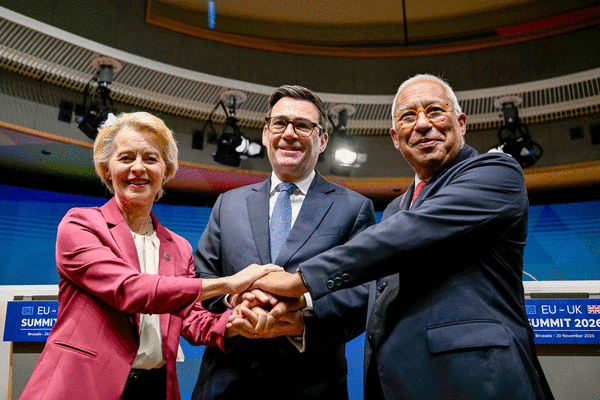
The U.K. and European Union have reached a set of deals to deepen their post-Brexit relationship as China, the U.S. and Russia upend the global order.
The agreements, formally approved at a meeting in Brussels, will help ease food trade, link carbon markets and enable young people to live, work and study in each other’s countries, according to a joint statement. The two also pledged to keep working on future economic alignment, with further talks expected on U.K. access to the E.U.’s “Made in Europe” trade and procurement policy.
Settling on a post-Brexit accord was the key goal of a Friday summit between U.K. Prime Minister Andy Burnham and E.U. officials. Both partners say tighter bonds are needed as the U.S. questions long-standing security commitments to Europe, Russia wages war in Ukraine and China tightens exports of key resources. Tellingly, the summit was held only hours after European allies met in Berlin to discuss Russia’s war, anxiously awaiting the results of U.S. President Donald Trump’s closed-door meeting with Vladimir Putin in China.
“I think we are working together in a world that is changing around us to come back closer,” Burnham said at the summit. “And in doing so, make ourselves stronger.”
The British prime minister said the deals could add as much as 0.5% to Britain’s economic output, while claiming it will also lower food prices. European Commission President Ursula von der Leyen, the E.U.’s top executive, said the benefits will be shared.
“It is a two-way street,” she said at a press conference. “For our businesses on both sides of the channel, it means easier trade and lower costs.”
For Burnham, the European outreach helps unify a fractured left and caters to the solid majority of Brits who polls show favor closer ties with the continent. Still, the strategy runs the risk of reawakening Britain’s Euroskeptic, populist right. Brexit champion Nigel Farage, who now leads Britain’s Reform party, was in Brussels on Friday offering anti-E.U. counter-programing.
“We don’t need to be in political union of any kind at all to do business and have good relations with our neighbors,” Farage said. “That’s the betrayal that Burnham is committing today.
The core elements agreed to at the summit in Brussels had been widely previewed over months of talks that were delayed after the resignation of Burnham’s predecessor, Keir Starmer:
•The U.K. and E.U. will harmonize their so-called sanitary and phytosanitary standards. The statement says the change will allow “the vast majority of movements of animals, animal products, plants and plant products” to occur without current certification requirements. The updates will be implemented in March 2028.
•Both sides will link their emissions trading systems, which impose pollution caps on companies, while allowing those that reduce emissions faster to sell unneeded credits to others. The agreement will apply starting in 2028.
•They will set up a Youth Experience Scheme to annually give 100,000 young people in each region the freedom to travel, work and study abroad for up to three years. The cap, finalized late on Thursday, is a win for the E.U. after British envoys sought a lower number. The statement says the scheme will be available to young people no later than January 2030.
Still, there are some outstanding disagreements, as the two continue to wrangle over whether E.U. students can pay U.K. rates when studying in Britain. They committed to concluding negotiations on fees within six months of the summit.
Lower tuition fees has long been a key demand of E.U. countries during post-Brexit talks, given E.U. nationals are currently subject to much higher international tuition costs. But the impact of such a move could have a sizeable impact on the British economy. The Russell Group of leading U.K. research universities calculated that home-fee status for E.U. students would cost the university sector about £570 million ($750 million) a year.
U.K. officials said the three agreements would proceed even if the U.K. and E.U. can’t agree on tuition fees in the next six months, insisting the deals are done.
Burnham said the U.K. will immediately begin the process of legislating to implement the deals. The U.K. will introduce a bill next week to give the government power to implement the carbon market, the food standards agreements and other items.
Separately, the joint statement commits the U.K. and E.U. to working together on “Made in Europe” policies, which could give Britain a foot in the door on valuable public contracts in the E.U.
The agreement includes a new “partnership for economic resilience,” which will be “driven by the need to address our economic dependencies” through more diverse supply chains. The two sides will start a dialog on the matter to coordinate economic security policies.
While details of that partnership will emerge as talks progress, even the commitment to starting talks is a significant win for the U.K.
Notably, the agreement does hint at a compromise deal on tariffs on Chinese imports — another source of friction as the U.K. resists calls to align with E.U. tariffs on Chinese electric vehicles. Rather than binding the U.K. to mirror E.U. tariffs, the statement says Britain will “ensure outcomes consistent with the relevant E.U. measures” to protect supply chains “across the E.U. and U.K. markets.”
The two sides also agreed to more talks on deporting immigrants without legal status to third countries — a controversial strategy that has gained traction in both the E.U. and U.K. in recent years.
The U.K. and E.U. have been on a fitful path to reconciliation since the center-left Labour Party returned to power in 2024, taking over from the Conservatives who had pushed for Brexit. While Starmer said he wanted to warm ties with the continent, those attempts haven’t always gone smoothly.
The two sides fell out, for instance, over negotiations for the U.K. to join the E.U.’s flagship €150 billion ($165 billion) defense fund, making it harder for British firms to bid for certain contracts. Later, a planned summit between the two was pushed back after Starmer resigned.
But the U.K. was able to rejoin the E.U.’s Erasmus study abroad program earlier this year, several years after it also rejoined the E.U.’s research program, Horizon Europe.
Burnham has since breathed new life into the effort, catching attention when he floated a possible E.U. return for Britain. Since then, the two sides have sought agreements they could peg to Friday’s summit — the one initially planned for earlier this year.
Now, the U.K. leader will have to convince the British public that his strategy has tangible benefits, especially if he wants to eventually pitch a full E.U. reconciliation. Burnham has said he may do that after the next election, which will take place by 2029.
Burnham expressed confidence that his plan reflects the public will.
“People,” he said, “can see the status quo isn’t working.”
—With assistance from Max Ramsay.
©2026 Bloomberg L.P. Visit bloomberg.com. Distributed by Tribune Content Agency, LLC.





Comments