'Be brave enough to rectify your errors': Doral faces pressure to end ICE pact
Published in News & Features
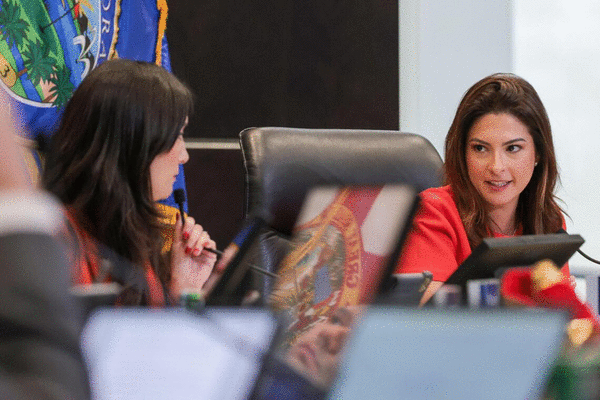
DORAL, Fla. — Dozens of immigration activists called Doral City Council members cowards, accused them of abandoning immigrant families and urged them to show courage Wednesday as they demanded the city end its 287(g) agreement with U.S. Immigration and Customs Enforcement instead of waiting for an opinion from the state’s attorney general.
At a City Council meeting Wednesday morning, Yareliz Mendez-Zamora, policy coordinator for the American Friends Service Committee, a Quaker organization, said she shares the fears of many mixed-status families with undocumented relatives who work throughout South Florida, including in Doral.
She challenged Doral’s elected officials to stand up for residents and end the city’s partnership with ICE.
“You’re brave enough to ask for the votes of this community, but you’re not brave enough to protect them,” she said.
Another activist called the decision to wait for the attorney general’s opinion “an extreme act of fecklessness,” urged elected officials to “call his bluff” and accused them of cowardice as families live in fear, businesses lose customers and residents are afraid to call police.
The confrontation came a week after Councilwoman Maureen Porras attempted to place the city’s 287(g) agreement with ICE on the council agenda for discussion. Her request was not included following a legal interpretation by City Attorney Lorenzo Cobiella, who warned that discussing a termination of the agreement could expose the city and individual council members to legal consequences under Florida law.
Porras tried again Wednesday to bring the agreement before her colleagues.
“I wanted to take the opportunity to have this discussion in a public forum with my colleagues, the attorney, the city manager and our police department,” she said. “I think it’s important for the welfare and well-being of our community to have this discussion.”
Instead, Vice Mayor Rafael Pineyro proposed postponing the discussion until Florida Attorney General James Uthmeier issues a legal opinion in response to a letter Mayor Christi Fraga sent weeks ago asking whether Doral can withdraw from its agreement with ICE. Fraga is scheduled to meet with Uthmeier in early December.
The council approved Pineyro’s motion 4-1, with Porras the lone dissenting vote. Porras told the Miami Herald she voted against it because Pineyro’s motion would prevent the council from discussing her proposal until further notice.
“We should discuss it now,” Porras said.
The 287(g) program allows local police officers to receive training to carry out certain immigration enforcement duties, including questioning and detaining people suspected of violating immigration laws. Doral says that although the city joined the program, none of its officers have been trained so far.
Pineyro told the Herald that city leaders should press for broader immigration reforms, because even if Doral’s 287(g) agreement with ICE is rescinded, that would not prevent federal agents from doing immigration raids.
“If we are concerned about our Latino community, we must start working on an immigration reform,” Pineyro said. “We’re talking about federal laws, but they affect my community, and I’m going to do whatever is necessary.”
The vice mayor said he was the only council member willing to support rescinding, revoking, pausing or eliminating the 287(g) agreement — after receiving a legal opinion from the Florida attorney general — “if that gives residents a sense of relief and confidence in the police department.”
But he cautioned against creating the perception or expectation that ending the agreement would mean federal immigration agents would no longer operate in Doral.
Pineyro pointed out that, despite the agreement, the Doral Police Department is not enforcing immigration laws or making immigration arrests.
“We were advised last year to approve the agreement, and we did, but our officers have not been trained for that purpose,” he said.
The vote to delay the discussion reflected the political majority led by Fraga, which includes Pineyro, Councilwoman Nicole Reinoso and newly elected Councilman Pedro “Peter” Espinosa. Pineyro and Reinoso have consistently supported Fraga’s positions on key city issues, while Espinosa, who joined the council after winning election earlier this month, was backed by Fraga in his campaign.
The delay angered immigration advocates, who said families cannot afford to wait for answers from government lawyers while people live in fear of detention, avoid everyday activities and lose income.
“People are terrified to call the police because they don’t know if that call can take them to an ICE detention center,” said Adelys Ferro, executive director of the Venezuelan American Caucus. “No more excuses.”
‘Call his bluff’
Mendez Zamora, whose parents are Nicaraguan immigrants, said she fears for her undocumented cousins who work throughout South Florida.
“Every time I don’t hear from them, I wonder, is this the day that I’m going to find out that they are in Miramar, or if they’re in Krome or if they’re in BTC?” she said, referring to immigration detention facilities.
She invoked the history of Jim Crow, redlining and slavery, arguing that laws alone do not determine whether government decisions are morally right.
“Call his bluff, because if you’re brave enough to get conflicting legal advice, then be brave enough to rectify your errors,” she said of Uthmeier.
Legal warnings at the center of the dispute
Cobiella, the city attorney, defended his handling of Porras’ earlier request, saying he had not prohibited her from bringing the matter forward. He said his response was based on state and federal law and pointed to opinions the attorney general has issued since 2025 involving local governments and immigration enforcement agreements.
Alana Greer, an attorney and director of the Community Justice Project, a nonprofit legal organization that has opposed local immigration enforcement partnerships, said the city should not allow pressure from state officials to dictate its decisions.
“Cities have power under your charter, under our state Constitution, to act,” Greer said. “There is nothing in state law that prohibits the city from having an active discussion about the priorities of your residents when it comes to ICE collaboration and from making a plan that follows state law that allows you to exit this agreement.”
Greer, who said she has spent nearly a decade litigating and working to end local immigration enforcement partnerships, argued opinions from the attorney general are advisory, not law.
She challenged warnings that Doral could face penalties for withdrawing an agreement with ICE. Greer said even if state officials take the city to court, a judge would be left to decide.
Thomas Kennedy, a spokesperson with the Florida Immigrant Coalition, also challenged the legal advice the city received before signing the agreement, arguing that Doral was not required to participate in the federal immigration enforcement program.
“I want to reiterate that the city attorney gave you a bad opinion when telling you that the city was obligated to enter into this agreement,” Kennedy said. “The city was not obligated to enter into this agreement.”
A recent Herald analysis found that despite pressure from the state, most South Florida cities with their own police departments have not partnered with ICE in the 287(g) program.
About one-third of municipalities in Miami-Dade and Broward with independent police departments have joined, including Coral Gables, Davie, Hialeah, Hollywood and Sweetwater.
Of the 17 cities with agreements, eight responded to Herald requests for data. Those cities reported training 22 officers total. Doral and North Bay Village said they had not trained any officers, despite signing agreements.
Residents’ fears and businesses’ losses
Maria Claudia Schubert-Fontes, who grew up in Doral after her family moved from Venezuela in the early 2000s, said she was proud to see the city grow, but she said the immigration agreement has changed how some residents live.
She said residents are afraid to drive, to go grocery shopping, visit salons, go to work and even call police.
“Our neighbors can’t afford to wait for the attorney general’s response,” Schubert-Fontes said. “This has been impacting our community for months.”
Cesar Camacho accused the council of cowardice for postponing a discussion.
“It is a huge act of cowardice for the City Council to kick the can down the road,” Camacho said.
He said Doral had swung toward Democrats in the recent election, which he attributed to opposition to federal immigration policies, and urged council members to recognize what he described as a mandate from voters.
“This is not just a political partisan issue,” Camacho said. “People are voting because they want you to act on their behalf.”
He called waiting for the attorney general’s opinion an “extreme act of fecklessness.”
Seeking help daily
Daniel Gomez, who works with the Florida Immigrant Coalition, said the organization’s free and confidential hotline receives calls daily from immigrant families seeking help. Doral, he said, is the community from which it receives the most calls in Miami-Dade.
Gomez, the son of Dominican immigrants, said families have increasingly sought help since the end of Temporary Protected Status for Venezuelans. Parents and relatives fear detention, separation from their children, and deportation to countries plagued by poverty, corruption and insecurity.
Ending Doral’s agreement would not stop ICE or Border Patrol from operating, Gomez said, but would end the city’s own participation in the federal partnership.
“It will end your own city’s complicity in the terror that is sweeping your community every single day,” he said. “It will remove the voluntary, unnecessary, unpopular and harmful agreement that only increases the fear and distrust of law enforcement in your community.”
©2026 Miami Herald. Visit at miamiherald.com. Distributed by Tribune Content Agency, LLC.





Comments