Democrats express 'points of anxiety' over Trump's summit with Putin and Xi
Published in News & Features
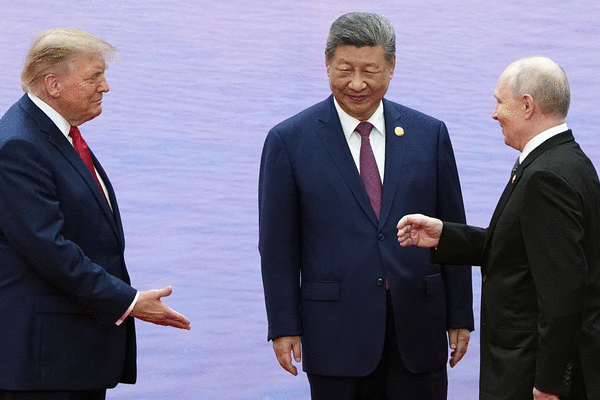
WASHINGTON — Some Senate Democrats have heartburn about President Donald Trump’s planned Thursday meeting with Vladimir Putin and Xi Jinping, but Republicans counter by saying he could get the Russian and Chinese leaders to budge on a list of issues even as he appears politically weakened at home.
Trump arrived Wednesday in China’s Shenzhen economic zone on the banks of the Pearl River ahead of a high-level summit that was ostensibly slated to focus on paring each countries’ nuclear arsenal. But before he left, Trump signaled the three-way talks also likely would include the artificial intelligence race, Moscow’s bloody war with Ukraine, global trade and his standoff with Iran.
The U.S. commander in chief’s tendency to sound deferential to Putin and habit of referring to Xi as a personal “friend” concerns many congressional Democrats. But Trump’s GOP allies on Capitol Hill, despite this month’s midterm election losses, still describe him as a dealmaker who has a chance to use his final years to bend Putin and Xi toward U.S. interests.
Rick Scott, a Florida Republican who sits on the Senate Armed Services and Foreign Relations committees, said Tuesday he was hopeful that Trump could make some progress on at least one issue with the Russian and Chinese leaders.
“As we all know, China and Russia want to destroy our way of life,” he said. “But it would be great to reduce … nuclear stockpiles and make sure we're not going to ever get attacked.
Still, Scott sounded skeptical about two world leaders Trump has tried to keep close during his two terms. “But do I trust Xi or Putin? No, they're a bunch of liars.” Asked if he worries Trump might trust them too much, Scott replied: “I don't think he trusts him any more than I do. … I'm glad the president's trying. Hope springs eternal. But do I actually really believe something good's going to come out of it? I don't.”
Outgoing House Armed Services Vice Chair Rob Wittman, R-Va., said part of Trump’s talks on Thursday “should be to make sure the world is a safer place, to make sure we don't have aggressive behavior like Russia in an unprovoked attack against Ukraine.
“They ought to be talking about how they don't do those sorts of things, how they don't threaten their neighbors, how they don't try to intimidate through the assertion of force that they ought to be able to work together to make sure we assure a safe globe,” said Wittman, who lost his reelection race earlier this month.
That comment came one day after Trump told reporters as he left the White House for Asia that he sees Putin “backing down a little bit” in his conduct of the war with Ukraine.
“I think he could be tougher. I think he could be a lot tougher, frankly,” Trump said Monday. “I think he's backing down.”
Those kinds of deferential remarks about the Russian leader are a big reason why some Democrats have heartburn about Thursday’s meeting.
Senate Armed Services member Mazie K. Hirono, D-Hawaii, said Tuesday that she’s concerned about the Shenzhen summit because “I’m not sure what’s going to pop out of (Trump’s) mouth next — especially for a meeting with two guys he clearly likes.”
Sen. Tim Kaine, D-Va., also a member of the Armed Services and Foreign Relations committees, said he has “high hopes” for the trilateral meeting — but “maybe not high expectations.”
“I have some points of anxiety. I'm nervous about any discussion about Ukraine that doesn't involve the Ukrainians. And, so, some of the advance to this is like, ‘We're going to talk about ending the Ukraine war.’ You can't do that without Ukraine at the table,” Kaine said. “So the desire to bring about more peace and stability, that's a good thing to talk about. But no conditions about Ukraine and ending that war without them at the table? Not so sure about that.”
During remarks Tuesday on the Senate floor, Minority Leader Charles E. Schumer criticized what he described as Trump’s misplaced priorities.
“Enforcement of the new rules restricting China’s access to our most sensitive AI chips should start today,” the New York Democrat said, adding that Trump should focus more of his Asia swing on securing commitments from U.S. allies to block China from gaining an upper hand in the AI technology race.
Trump touted just that on Tuesday during remarks in Manila at a U.S.-Association of Southeast Asian Nations (ASEAN) summit in the Philippines.
“Since I returned to office, we've made major trade deals with Malaysia, Cambodia, Indonesia, as well as Japan, South Korea, and almost everybody, frankly, at the table,” he said. “And we've made many other vital agreements across the region spanning energy, critical minerals and technology.”
But on Wednesday, Trump appeared to have pivoted to the trip’s main event.
He stood beside Xi at an Asia-Pacific Economic Cooperation (APEC) summit in Shenzhen and smiled as Putin approached. Trump extended his hand and shook Putin’s as the Chinese leader looked on.
Scott, a Trump ally in the Senate, said Tuesday he sees the president “trying to build relationships to try to make sure we don't end up at war (because) he doesn't like war.”
Trump signaled Monday that he might press Xi for details on an alleged Chinese spy who had an affair with Nvidia founder Jensen Huang, costing the AI mogul his job as the company’s president and CEO. He also said he could bring up Nvidia’s sales of sophisticated microchips that many lawmakers — Republican and Democrat — want to ensure remain in the U.S. for domestic AI development.
The administration’s response to the turmoil at Nvidia, with Trump even suggesting he'd support Huang returning as CEO, is a rare area where Republicans have expressed concern publicly. House Energy and Commerce Committee Chair Brett Guthrie, R-Kent., wrote to Commerce Secretary Howard Lutnick on Wednesday seeking information about “the implementation of federal laws governing technology exports, in particular the application of export controls relating to semiconductor chips, the effect of which has a broad impact on America’s race with China to artificial intelligence (AI) dominance and the ability of U.S. companies to set global technology standards.”
Heather Williams, director of the Project on Nuclear Issues at the Center for Strategic and International Studies, wrote this week that for the three leaders, the “path is fraught with challenges.”
“Putin could diplomatically outmaneuver the Trump administration and make any progress on nuclear issues dependent on undermining Western support to Ukraine,” she wrote in an analysis for the Washington, D.C.-based think tank. “Even the optics of Trump and Putin negotiating while the war continues and as Russia ramps up missile strikes on Ukrainian civilian targets could be interpreted as undermining U.S. values.”
_____
©2026 CQ-Roll Call, Inc. Visit at rollcall.com. Distributed by Tribune Content Agency, LLC.






Comments