Fed up with gang violence, thousands flood Haiti's streets to thank Bukele
Published in News & Features
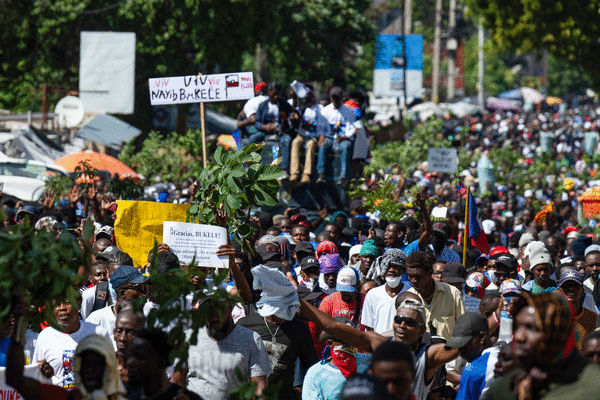
PORT-AU-PRINCE, Haiti — Thousands of Haitians, many of them from gang-controlled neighborhoods, poured onto the streets of Port-au-Prince Tuesday to show their support for the presence of Salvadoran troops in the country and to urge President Nayib Bukele of El Salvador to continue the military campaign against their country’s armed gangs.
Bukele’s public messaging and unprecedented military buildup in Haiti has fueled an extraordinary show of support among Haitians at home and abroad. On Saturday, Haitian soccer fans attending a sold-out Concacaf Nations League quarterfinal match against the United States at Inter-Miami’s Nu Stadium held up signs with the Salvadoran leader’s name and chanted “Bukele, Bukele” throughout the game.
“If the bandits are destroying the homes of poor people then Bukele needs to destroy their homes too,” said Michael Lombard, one of the organizers of Tuesday’s demonstrations.
“Today, the bandits are assassinating us. They rape us, they kidnap us,” he added. “We are going throughout Port-au-Prince to the prime minister’s office and in front of the U.S. embassy to tell them, ‘We are fed up.’”
Some marchers said it was the first time in years they had dared to take to the streets of dense Port-au-Prince, where members of the powerful Viv Ansanm gang coalition have tightened their grip on neighborhoods, driving residents from their homes, shutting down schools and health facilities and deepening a humanitarian crisis.
With nearly 1.5 million Haitians internally displaced, many have sought refuge in soiled encampments after being forced to abandon their neighborhoods. The United Nations warned Tuesday that on top of the more than 4,500 killings they’ve documented since January, armed violence, displacement and persistent hunger are driving high levels of acute malnutrition, which are expected to worsen in the coming months.
“It’s the first time we’ve been able to take to the streets,” said Patrick Célestin, a resident of Carrefour-Feuilles, a neighborhood of the capital that has endured repeated gang attacks.
He pleaded with Bukele, the Salvadoran strongman, not to withdraw his troops, warning that residents could face reprisal from armed gangs that have recently come under increased pressure from security forces in the country.
“If he stops, these guys will kill all of us,” Célestin said as demonstrators shouted “Bukele” in the background. “This is why we are asking President Bukele to stand with us — Carrefour-Feuilles, Croix-des-Bouquet, Martissant.”
Bukele in a post on X, responded in Haitian-Creole with a video of protesters. “I never expected anything like this.”
“I hear you loud and clear. I love you too,” he posted. “We will triumph. God will give us victory.”
Haiti’s justice minister was in El Salvador this week representing Prime Minister Alix Didier Fils-Aimé at the II Conferencia Internacional sobre Estado y Democracia, CIED 2026. The news agency EFE quoted El Salvador’s vice president, Félix Ulloa, defending the military operation in Haiti as “legitimate.” The Salvadoran troops will withdraw once they have rescued the four soldiers who went missing in the Caribbean nation, Ulloa said, according to the news agency.
Last week, Haiti’s national police announced that after months of operations against gangs entrenched in downtown Port-au-Prince, they had retaken control of Sylvio Cator stadium and turned over responsibility for its security to the Salvadorans.
Despite the police announcement, many Haitians credited Bukele with the operation after he posted images on social media showing his troops guarding the stadium and robotic dogs armed with automatic rifles.
Célestin said he wanted Bukele to now deploy his soldiers to Carrefour, the sprawling suburb south of Port-au-Prince that has been under complete gang control for years.
“It’s time for him to arrive in Carrefour,” he said, also thanking President Donald Trump for his support.
Bukele contacted Trump about the deployment after he began dispatching his soldiers to Haiti following an ambush of four Salvadoran aviation technicians by heavily armed gangs. The men are attached to the United Nations Gang Suppression Force and were returning to base from a supermarket east of Port-au-Prince when their Toyota SUV was surrounded and riddled with bullets. They have not been heard from since.
The Salvadoran force, now numbering roughly 2,500 soldiers, includes special forces, infantry and attack helicopters. While it has added another contingent to Haiti’s security landscape, it has also raised concerns and questions about coordination and how long Bukele can sustain the buildup.
The vast majority of the soldiers are operating outside the Gang Suppression Force, the separate international mission that’s backed by Washington and approved by the United Nations Security Council to help Haiti regain control of territory from armed gangs.
On the upside, observers have credited the deployment with intensifying the fight against gangs both on the part of the Gang Suppression Mission and the Haitian national police. A Haitian police task force that operates out of the prime minister’s office and uses explosive drones recently dropped several drones targeting gangs’ strongholds. A prominent gang leader is among those who died after the attack. In another operation, another powerful gang leader had his home bombed.
In both cases, many Haitians credited Bukele and his Salvadoran troops.
Foreign military interventions in Haiti are costly, one reason the Trump administration pushed last year for the creation of the Gang Suppression Force to replace a Kenyan-led multinational mission that struggled to secure international financing.
The new force is not a U.N. peacekeeping mission. But the U.N. Support Office in Haiti, established to provide logistics and other support, is being financed through assessed contributions from U.N. member states. There is also a separate U.N. Trust Fund to support the intervention.
Observers say Bukele’s appeal among Haitians reflects several factors.
Haitians are exhausted by the years of gang violence and desperately want relief — and a reason to hope after years of living under the constant threat of killings, kidnapping and sexual violence.
Bukele is also capitalizing on a longstanding weakness of Haitian governance: the refusal to communicate. He’s speaking directly to Haitians in Creole while also issuing warnings to gang leaders. While one has spurred hope, the other has led gang leaders to abandon their strongholds — and even plea for a dialogue amid the mounting pressure.
©2026 Miami Herald. Visit at miamiherald.com. Distributed by Tribune Content Agency, LLC.




Comments