Sierra LaMar retrial: Defense raises specter of mishandled and overlooked evidence
Published in News & Features
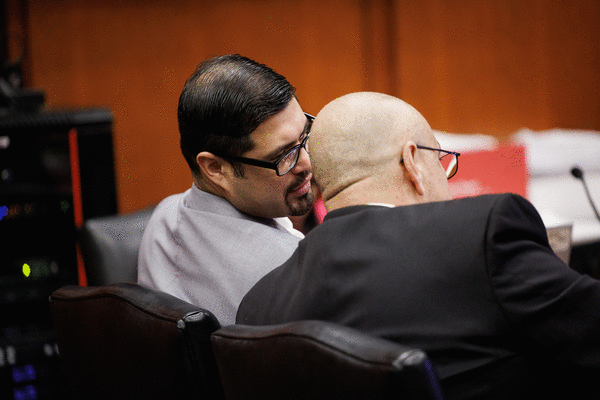
SAN JOSE, Calif. — As the third week of testimony commenced in the murder retrial of Antolin Garcia Torres, a defense attorney zeroed in on conflicting memories and implied procedural lapses in how authorities examined a bag carrying the clothes and belongings of Sierra LaMar recovered two days after her 2012 disappearance.
On Monday, attorneys continued their questioning of Sgt. Brian Randall, the deputy who processed Sierra’s signature Juicy-brand duffel bag that contained, among other items, the borrowed San Jose Sharks sweatshirt she was last seen wearing via a selfie photo she took minutes before she vanished while heading to school in rural Morgan Hill on March 16, 2012.
The other key finding in the bag was Sierra’s blue jeans, from which investigators and forensic technicians would extract DNA they asserted linked Garcia Torres to the 15-year-old’s disappearance and presumed death, evidence that was credited for securing his 2017 murder conviction, which was overturned by an appellate court earlier this year. The jeans, according to Randall’s retelling and past trial testimony, also reeked of urine, which prosecutors contend indicated Sierra was strangled or in fear for her life; her body has never been recovered.
Deputy Alternate Defender Al Lopez, who also represented Garcia Torres in the first trial, repeatedly asked Randall about him using the backside of a dry erase board as a surface on which he laid out and photographed Sierra’s belongings. Lopez’s questioning appeared aimed at emphasizing to jurors the lack of cleanliness of the improvised evidence examination, inside a police trailer serving as a command post parked outside Sierra’s home.
Randall testified he was doing the best he could with what was available at the time, describing the urgency of detecting any clue that might lead to finding Sierra during the key 48-hour window after her parents reported her missing. He frequently referred to his previous reports when speaking in court to Lopez and Deputy District Attorney O’Bryan Kenney, and freely acknowledged that his memory of those days 14 years ago was hazy, highlighting a broader challenge for witnesses during the second trial.
Lopez appeared to be seeding a theory that the Santa Clara County Sheriff’s Office mishandled evidence and exposed it to possible contamination. While Randall was firm in testifying that he continually changed rubber gloves while handling and photographing the duffel bag’s contents, he also described wiping it down with disinfectant wipes throughout.
“I figured it was the best surface I could use under the circumstances,” Randall told Lopez.
The defense attorney later pointed to a report written by Randall in which he errantly documented using the white side of the dry erase board, which he previously testified he did not do because it was too dirty.
Lopez asked, “Was your report false when it came to the type of surfaced you used?”
Randall answered, “It was a mistake that I made … I don’t know why I wrote I used the white smooth surface when that wasn’t the case.”
Earlier in his testimony, Kenney looked to get ahead of Lopez’s questions about the ad hoc evidence examination inside the trailer.
“Did you do your best to keep those items clean and in the same conditions as you found them,” Kenney asked, to which Randall replied, “I tried my best to keep them in their natural state.”
“Did you use your common sense to make the best of the situation you had?” Kenney followed.
“Yes,” Randall said.
Lopez also interrogated Randall about the discovery of women’s clothes on the roadside not far from Sierra’s house off Palm Avenue in unincorporated Morgan Hill. Randall testified that he showed the weathered and tattered clothing to Sierra’s parents, and they confirmed the clothing — including a bra and a pink top — did not belong to the teen, and noted that they were sized extra-large, which did not match the diminutive Sierra.
But Lopez asked if the items were preserved for testing, and Randall confirmed that the clothing was later thrown away, after having been deemed to have no value in the search for Sierra. That was part of a steady line of questioning from Lopez that sought to bolster a defense theory, foreshadowed in opening statements earlier this month, that authorities overlooked potential crime scenes including the metal shed off Laguna Avenue near where Sierra’s bag was found nestled inside a cactus.
Witness testimony to this point has established that the shed area was not processed or examined for any forensic evidence. But Randall, like other investigators and search team members who have already testified, emphasized that in the days after Sierra disappeared, they were conducting a missing persons investigation and had no knowledge early on that a kidnapping or homicide might have occurred.
“Did you consider sealing the area off so you could preserve the area?” Lopez asked.
“At the time we were looking for missing person … (or) any other clues for her whereabouts,” Randall said.
Earlier testimony presented a potential conflict between the accounts of a civilian search-and-rescue team member, Albert Wackermann, and Randall. Wackermann testified that he was instructed by a deputy to remove Sierra’s bag from the cactus where it was found, which he considered unusual. But Randall also recalled removing the bag from its discovery site.
Garcia Torres was convicted of murdering and abducting Sierra and was serving a life-without-parole prison sentence until this past February, when the 6th District Court of Appeal threw out the murder verdict, ruling it was tainted because the trial court consolidated the murder charge with three unrelated attempted kidnapping allegations reported three years before Sierra disappeared.
Testimony is scheduled to continue Wednesday. The trial is expected to last through December and potentially into the new year.
_____
©2026 MediaNews Group, Inc. Visit at mercurynews.com. Distributed by Tribune Content Agency, LLC.






Comments