Plastic waste in the Great Lakes could be coming from as far as 120 miles away, study shows
Published in News & Features
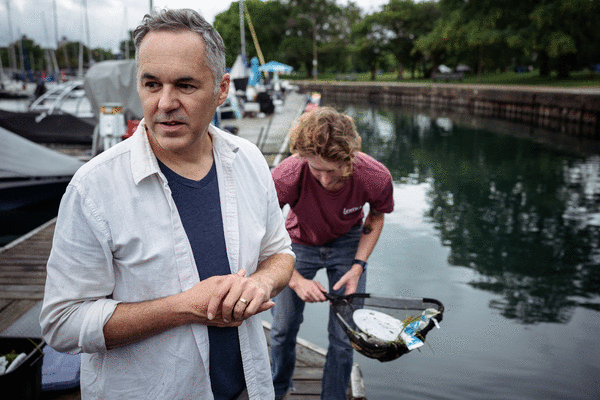


CHICAGO — For scientists working to keep plastic litter out of the environment, the idea might seem counterintuitive.
Looking to follow the movement of water bottles and other floating throwaways, they tossed dozens of plastic smoothie shakers into rivers across the United States and Canada, including stretches of the Chicago River.
The researchers equipped each of the shakers with a small GPS device to track where they ended up.
Computer modeling of the results suggests half of the plastic bottles washing into the Great Lakes and oceans every year come from at least 10 miles and up to 120 miles away, the scientists reported.
In other words, far away from shoreline trash traps and volunteer beach cleanups that tend to be the focus of efforts to combat plastic pollution.
The study shows cities and towns upstream also have a role to play. “It shows a community’s actions can have a distant impact, even in places like the Midwest where we often consider ourselves landlocked,” said Tim Hoellein, a Loyola University biologist and one of the study’s authors.
Hoellein’s contribution included deploying smoothie shakers at several points in northern reaches of the Chicago River system, including the Middle Fork Savanna in Lake Forest, Glenview Woods and the Skokie River.
Some didn’t make it very far, becoming snagged in fallen tree limbs and other debris. But one floated nearly 18 miles downstream to Goose Island in Chicago.
Though stickers affixed to the shakers declare “THIS IS RESEARCH, NOT GARBAGE,” one appeared to have been scooped out of the river by a Metropolitan Water Reclamation District trash-skimming boat, Hoellein said.
Another pinged to the home of one of Hoellein’s neighbors. (He walked over to retrieve it and return it to the water.)
Bottles also were tracked in and around Boston, Los Angeles, Miami, San Francisco, Toronto and Washington, D.C.
The new study, published Friday in the peer-reviewed journal ACS ES&T Water, is part of a broader effort to raise public awareness about plastic pollution and persuade policymakers to do something about it.
At least 22 million pounds of plastic waste flow into the Great Lakes every year, half of it into Lake Michigan, the Chicago Tribune previously reported in “Great Waste in the Great Lakes,” a series about threats to 40 million Americans and Canadians who depend on the world’s largest source of fresh surface water.
Development of the GPS-equipped smoothie shakers began in the laboratory of Chelsea Rochman, a University of Toronto biologist who has petitioned overseers of a Great Lakes treaty between the U.S. and Canada to begin routinely monitoring plastic pollution.
One of the shakers Rochman’s team released into the Don River, a major Lake Ontario tributary, meandered nearly 230 miles across the lake from Toronto and ended up near Rochester, New York.
Bottles and other recently tossed goods are known as macroplastics, which over time break down into micro- and nanoplastics, tiny bits found in nearly every organ of the human body and increasingly linked to disease.
Another study published this week, led by Rochman, showed how microplastics quickly sink to the bottom of a lake or blow or wash ashore.
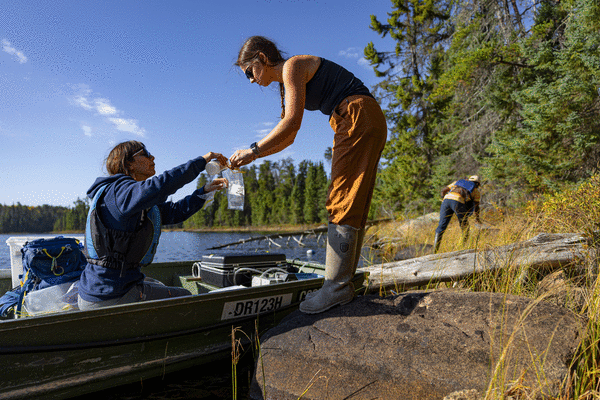
The findings are part of ongoing research at the Experimental Lakes Area, a series of self-contained lakes in the boreal forest of western Ontario set aside to study water pollution.
In this case, Rochman and her team added a gallon of bright, color-coded microplastics into Lake 378 during each of the past three years — an amount intended to mimic bits of pollution in urban storm runoff.
What they found suggests microplastics will remain constantly suspended in water — and continue making their way into humans and fish — as long as society keeps polluting.
“This is a multifaceted problem that has a multifaceted answer,” said Sherri “Sam” Mason, a chemist at Gannon University in Erie, Pennsylvania, who studies plastic pollution in freshwater.
“Some of that is policy,” said Mason, who wasn’t involved in either of the new studies. “A big part of it is turning off the tap (of new plastics), but at this point we have unleashed the genie out of the bottle.”
Britta Baechler, lead author of the bottle-tracking study, said rivers essentially act as storage areas for plastic waste. A soda bottle might remain stuck along a riverbank for some time until storms flush it downstream.
More intense storms and flash flooding fueled by climate change make it more likely plastic bottles are pushed farther away from where they entered a river.
Over time bottles break down into micro and nanoplastics, Baechler noted, and potentially leach toxic chemicals known to cause harm into the water.
“The simplest fix is making sure a bottle never becomes litter,” said Baechler, director of ocean plastics science at the nonprofit Ocean Conservancy. “Individuals can carry a reusable bottle, pick up litter they see.”
“From a policy perspective, bottle deposit programs work well because they give a bottle value,” Baechler said. “When a bottle’s worth money, even a dime, it’s far less likely to end up in a river.”
____
©2026 Chicago Tribune. Visit at chicagotribune.com. Distributed by Tribune Content Agency, LLC.






Comments