They brought the Epstein files to 15 states. Florida was the final stop
Published in News & Features


FORT LAUDERDALE, Fla. — As Democrats took control of Congress on Tuesday night, a group of survivors of Jeffrey Epstein’s abuse gathered in a Fort Lauderdale food hall with friends and family, watching the results and singing karaoke.
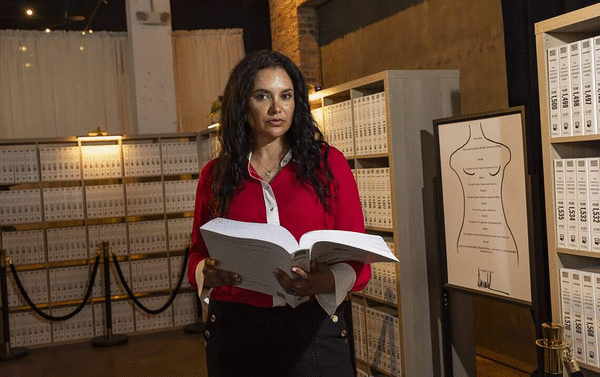
Surrounding them – bound into 3,437 volumes weighing 17,000 pounds – were 3.5 million pages of the Department of Justice’s files on the deceased sex trafficker, and a timeline of his two-decade long friendship with Donald Trump.
“This is way more than just the obscene files,” said Sharlene Rochard, a model and legislative advocate who said she was abused by Epstein after she met him at age 17. “This is America healing itself from the ground up.”
The bound volumes traveled to 15 states in an exhibit called the “Donald J. Trump and Jeffrey Epstein Memorial Reading Room.” Rochard, who lives in Canada with her four children, was one of the survivors accompanying the exhibit, speaking with politicians and other victims of sexual abuse.
Florida – home to much of Epstein’s abuse and his widely criticized plea deal – was the last stop.
The election results have been largely characterized as a repudiation of the first two years of President Trump’s second term – much of which was defined by public fixation on these files, accumulated during two decades of investigations into Epstein’s crimes across four presidential administrations, and a fight over their release.
Now – with control of the House and Senate – the Democrats are preparing for further scrutiny into the case and Trump’s own ties to Epstein. The Epstein files tour hosted 51 candidates, and all but seven won their races on Tuesday, organizers said, including Rep. James Talarico in Texas, Rep. Abdul El-Sayed in Michigan, Rep. Annie Andrews in South Carolina, Rep. Amy Acton in Ohio, Rep. Bob Brooks in Pennsylvania and Pia Dandiya, who won Florida’s 22nd congressional district, which spans Broward and Palm Beach across to Collier and Hendry counties.
In September, standing with Rochard and another Epstein survivor at the exhibit, Talarico asked the Texas attorney general to sue the Department of Justice to release any withheld files.
“When did holding sexual abusers accountable become controversial?” he asked.
The president – who resisted publishing the files before relenting to pressure from Congress and the public – was friends with Epstein from the 1980s into at least the early 2000s. In late October, Democrats on the House Judiciary Committee published a 53-page-report implicating Trump in Epstein’s crimes. The report details allegations of five women who told committee members that Trump raped or sexually assaulted them while in the company of Epstein.
The White House denounced the report and Trump has denied any wrongdoing.
“This ‘report’ is nothing more than a desperate attempt by crazed Democrats to distract Americans from the surging Republican momentum driven by President Trump’s historic achievements,” White House spokeswoman Lauren Bis told the Miami Herald.
Trump “has been fully exonerated of anything related to Epstein,” she added.
But the organizers of the mobile ‘Reading Room’ emphasize that’s not the case.
David Garrett, a Michigan-native who spent much of his career in the wine industry and tech, is the founder of the exhibit, which is part of a non-profit he started called the Institute for Primary Facts.
Before this undertaking, he did not know any Epstein survivors. He describes himself as a “business guy.” He studied political science at Michigan State University and had a brief internship on Capitol Hill, but said he had mostly been a “political tourist.”
But he felt the files, as with many other sensitive issues in the news, were too big of an issue for the public to absorb through a phone screen. It had to be tangible. A father to two daughters, he wanted a way to showcase the scope of Epstein’s crimes to the public, and scrutinize both Trump’s handling of the files and his ties with Epstein.
“There hasn’t been any real accountability to the other co-conspirators or enablers, and there’s no justice for the survivors,” said Garrett, 57. “I think it’s because, you know, there’s a person of interest, at the very least a person of interest in this case, who’s in charge of the case.”
“That’s a corruption of our system of justice,” he said.
‘May the truth come out’
The show debuted in May as a pop-up at a gallery at 101 Reade Street in New York City, just a few blocks from the jail cell in lower Manhattan where Epstein died in 2019. Within the first hour, a woman approached Garrett. She said that she survived Epstein’s abuse herself, and thought what he was doing was “amazing.” She asked to share his phone number with other survivors.
He spent that week on call after call with other women, explaining what he was trying to accomplish. He would walk across the street to talk to them, and watch as lines to see the exhibit stretched down the block.
Then there were the visitors who he suspected may have also survived abuse. One woman came alone for about six days in a row, holding different bouquets of fresh flowers each day. She would stare at the spines of the books and cry. Men came who shared their stories, too. One day, someone left about 100 flowers in front of the gallery.
“It’s important for us to know that no matter how rich and powerful you are, if you abuse or traffic little girls, there’s going to be accountability,” Garrett said. “That’s the story that we want to tell.”
He invited over a dozen survivors to the “Epstein files filibuster,” where they read the files out loud for 24 hours straight. That night changed his life, he said. They ordered pizza and stayed up talking until 3 a.m.
The survivors asked Garrett to bring the show to Washington, where they were meeting with congressional representatives. They earmarked copies of the books, highlighting possible investigative leads, and handed them to the Senate Judiciary Committee. Again, he had lines out the door. Over 1,000 people came the last day alone, he said.
“People come here, and they look at this, and they think, these books tell a story that happened in the past. But that’s not true,” Garrett said. “They’re telling a story that is still happening. And without accountability will continue to happen and get worse.”
Together, they decided to take the tour around the country to talk to voters.
The Department of Justice estimates there are more than 1,000 victims of Epstein’s abuse. The exhibits included a memorial room of 1,400 candles for Epstein victims; artwork from Maria Farmer, who first reported Epstein to the FBI in 1996; and a wall completely covered in messages from visitors. At their last count, they’d received over 13,000 notes.
“I am truly sorry for what you ladies went through. I weep for your pain. I hope to be a comfort to those I cross paths with that share in your pain,” reads one flashcard. “May you find peace and love to bring you comfort. May the truth come out.”
A ‘healing tour’
The project’s first challenge had been simply printing the books. The files are heavily redacted, with a standard redaction level so dense that when printed, the layers would have ripped holes in the pages. The team had to go line by line on PDFs to fix it.
The second was looking for venues. Finding people willing to host a mobile collection of the Epstein files across 15 states was not easy, but nowhere was it more difficult than in Florida. Garrett estimates over 100 places in the state turned him down.
“We started in New York, which is where Trump and Epstein met, and where Epstein died,” he said. “We wanted to end the tour here, which is where, I think, they were friends for decades.”
Rochard only started speaking publicly about her abuse in November 2025, inspired by other women who had come forward.
“I think that the ‘Reading Room’ and bookmobile has had a huge impact on the elections, because we were meeting with all the representatives and the candidates,” she said Wednesday at the Fort Lauderdale exhibit.
She asked representatives for more education for young people to protect them against sex trafficking. She proposed to Bob Brooks – a former firefighter who won his race for Pennsylvania’s 7th Congressional District – that there be classes to educate firefighters on warning signs, and to recognize victims.
She spoke with Amy Acton, the Democratic physician who defeated Republican Vivek Ramaswamy in the Ohio gubernatorial election, and has also shared her own story of childhood sexual abuse. Acton talked with her about how trauma manifests in one’s body, and how survivors tend to be constantly stuck in a state of hypervigilance – a fight, flight, freeze or fawn reaction, even long after the danger is gone. Annie Andrews, a pediatrician and Democrat who won the U.S. Senate seat in South Carolina, spoke about treating children victims of abuse.
But the focus was never solely on the politicians.
Talking with the public was “healing,” said Rochard, who traveled with the exhibit. For a long time she did not have therapy or an outlet to process her trauma, she said. She wants the tour to continue, and said it should be considered a “healing tour” for the country.
Sharlene Rochard holds a photo of her younger self during a news conference on the Epstein Files Transparency Act outside the U.S. Capitol on Nov. 18, 2025 in Washington, DC. Heather Diehl Getty Images
On Wednesday, the exhibit’s final day, one of the visitors approached her. Jeanne Doody, 69, told Rochard she had survived sexual abuse within her own home as a child, at the hands of her stepfather. She had wanted to talk about it, even write a book, but struggled for a long time to do so. She cried, and her hands shook as she spoke.
“I’ve lived with it. I’ve had years of therapy, but the trauma stays in your body. Stays in your heart,” she told the Herald. “I can’t even tell you how much I love these beautiful women. They’re giving a safe place for people like myself.”
“I have so much respect for them for stepping forward,” she said. “That president has no business leading our country.”
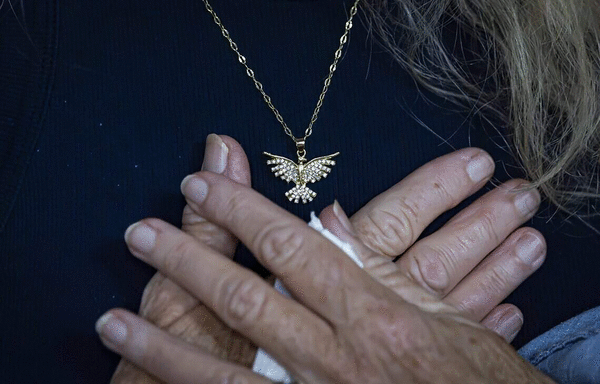
Some of the Epstein survivors started wearing matching gold necklaces of a phoenix, a symbol of rising from the ashes. It was a metaphor that Doody’s own therapist had shared with her.
After they spoke, Rochard took her own necklace off and gave it to Doody.
©2026 Miami Herald. Visit at miamiherald.com. Distributed by Tribune Content Agency, LLC.






Comments