American Airlines returns to Haiti, launches daily service from MIA
Published in News & Features


Six years after suspending service to Cap-Haïtien, American Airlines returned to the northern Haitian city on Sunday, restoring daily flights and marking a milestone in the carrier’s decades-long relationship with the Caribbean nation.
The flight from Miami International Airlines marked American’s 100th destination in Latin American and Caribbean, following its recent resumption of service to Venezuela. But for Haiti, American’s return carried even greater significance.
The country has been without regular service by a major international airline since late 2024, when gang gunfire in the skies of the capital prompted the Federal Aviation Administration to prohibit U.S. commercial carriers from landing at Toussaint Louverture International Airport. Since then, the country has become increasingly isolated even as the smaller Hugo Chavez International Airport in Cap-Haïtien emerged as the new international gateway amid the escalating gang violence in Port-au-Prince and neighboring cities.
Although Cap-Haïtien wasn’t covered by the ban, Fort Lauderdale-based Spirit Airlines suspended service and never was able to resume before shutting down.
American Airlines’ return makes the airline the first major U.S. carrier to resume daily since the suspensions to the capital, giving visitors to the country more options in terms of air travel.
“This is a very big step,” American’s Senior Vice President of MIA Operations Juan Carlos Liscano told the Miami Herald. “Telling the world that we are resuming and continuing service to Cap-Haïtien tells everybody that conditions and things are looking very good.”
Liscano said while there are markets that the carrier flies to and “we’re very proud of that,” there are some destinations that “are very special, near and dear to us.”
Haiti is one of them, both because of the airline’s long history with the country – it’s first flight to Haiti was in 1971 – and the vibrancy of the Haitian community in South Florida, particularly Miami. This wasn’t lost on speakers at a ceremony the carrier had prior to takeoff.
That connection was a recurring theme on Sunday during a ceremony at Miami International Airport before departure.
“Thanks to American, more of our residents and visitors can travel between Miami and Haiti again,” said Cassandra Arnold, deputy chief of staff to Miami Dade County Mayor Daniella Levine Cava. Arnold, who was born in Port-au-Prince, said seeing the resumption of flights was personally meaningful to her. Its significance, she said, goes beyond providing residents with travel options to Cap-Haïtien and the northern coast of Haiti,
“Today, this launch also represents opportunity, connection and hope for our beautiful Haitian people,” Arnold said.
Miami-Dade Tax Collector Dariel Fernandez and Basil A. Binns II, deputy director for Administration, Business Development, and Retention at the Miami-Dade Aviation Department, described the return as a momentous occasion. Binns said Cap-Haïtien, affectionately known as Okap, is the latest example of how American continues to lead the way to the world and Miami-Dade was proud to serve as that gateway.
“We know when you connect people, and you connect commerce, you help grow economies,” Binns said. “We’ve very proud to be part of that connection.”
Miami-Dade’s Haitian community, the largest in the U.S., is a key part of that, said Liscano. He noted that that American intends to also draw visitors to Haiti from around the United States and intentionally scheduled the Cap-Haitian flight to accommodate passengers connecting through Miami.
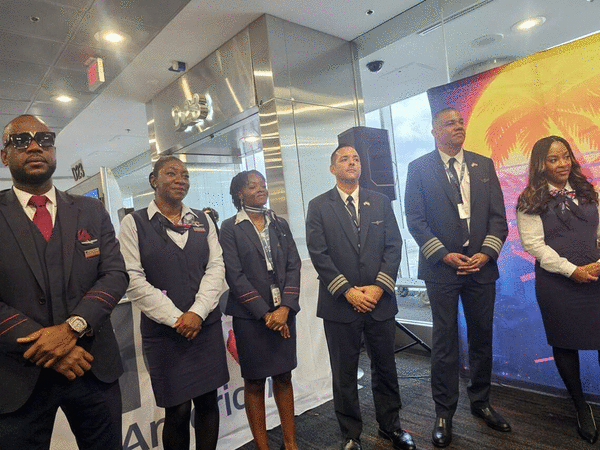
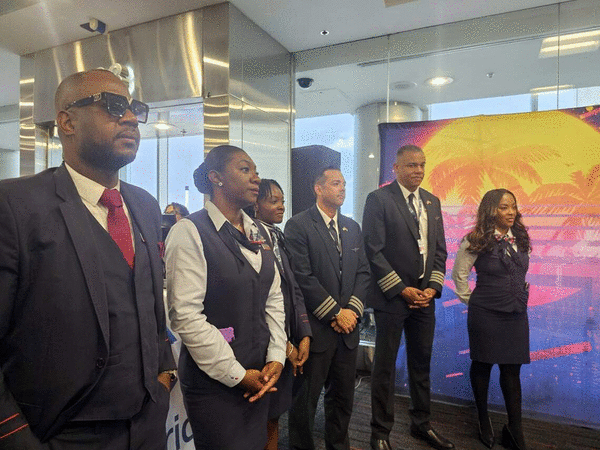
The aircraft that was used to operate Sunday’s flight, for example, flew in from Atlanta. As passengers disembarked and walked out in the gate area, they seemed bewildered at the flurry of activities unfolding. There were red and white balloons, konpa music and a festive atmosphere at guests posed for photos in front of an American Airlines sign. They also posed for photos with the crew, which was about to make history of its own.
The inaugural flight was operated by an all-Haitian, Creole-speaking crew, underscoring the Haitian community’s growth both in the United States, and within American Airlines. The all Haitian and Creole-speaking crew was the idea of pilot Oliver Jean, a Haiti-born pilot, Liscano said.
There was a lot of emotion, said Jean, who has flown countless flights during his 29-year career. Sunday’s flight, however, was like no other.
“It’s the first time I’m going to operate an airplane with an all-Haitian crew,” he said, noting that he will be delivering his announcements “not only in English but also in Creole.”
“This is what’s important for me, to ensure that the passengers feel comfortable inside the aircraft,” Jean added in Creole.
Born in Port-au-Prince, Jean had been scheduled to fly to Port-au-Prince a week after the airline suspended its daily service between Miami International Airport and Toussaint Louverture International Airport in November 2024. The carrier was among three U.S. carriers that were struck by gang gunfire as they all few over Port-au-Prince’s airspace. The incident prompted American, JetBlue Airways and Spirit Airlines to all suspend service. A Federal Aviation Administration ban prohibited landings at the facility, which remains in effect, made that suspension almost indefinite.
For travelers, the loss of commercial service has meant fewer options, higher fares and at times unpredictably as local companies try to fill the void with chartered aircraft that aren’t always available when needed, forcing last minute scheduled changes.
Jimmy Louis, 70, who was flying with his two children, last flew to Haiti two years ago.
As he waited to board, he yelled out, “Don’t ever leave us again.”
“I missed Haiti, I missed my country,” he later told a reporter. He noted the flying home had become an expensive and often unreliable endeavor.
“I missed American,” he said. “When you travel on American … they are not going to leave you wherever you are; if they don’t come, they send you to the hotel. That’s American.”
First-time visitor to Haiti, Kate Dowling, said she was excited to visit the country. Dowling, who works from the Los-Angeles-based nonprofit Lidè Haiti, was headed down with a colleague to interview female executive directors. The organization works with girls and women in Haiti.
Also traveling was Haiti Consul General Yverick Delerme Cyril. He saluted the decision by American Airline to resume the flights and said the government of Haiti was working on its security crisis in order for the main airport in Port-au-Prince could also see a return of international commercial flights.
The return to Cap-Haïtien, Cyril said, was more than a flight. It symbolized the strengthening of ties between Haiti and South Florida. Miami, he said, holds a special place in the heart of Haitians, and sits at the crossroads between the country and its diaspora.
“For thousands of Haitian families this connection is essential,” he said. “It’s bringing families together, facilitating business, opportunities and strengthen the bond between Haiti and its diaspora.”
Liscano, the American Airlines executive, said a lot of variables went into the decision to resume service, including current market conditions.
Aside from the historical significance of the landing of AA flight 2492 in Cap-Haïtien, he said, there is something else. It represents, “the restoring of connection between families and loved ones, between friends and communities, and between businesses and economies; between two places that have incredibly deep ties to each other.”
“Here in South Florida, we understand how important this connection is,” he said.
_____
©2026 Miami Herald. Visit miamiherald.com. Distributed by Tribune Content Agency, LLC.






Comments