Records show ICE detainers rose sharply in Maryland's Harford, Carroll counties before 287(g) ban
Published in News & Features
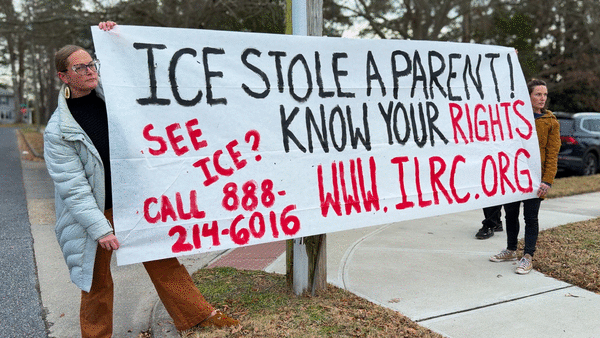
The sheriffs of Harford and Carroll counties, two of Maryland’s most vocal defenders of 287(g), the now-banned program that let local jails work with U.S. Immigration and Customs Enforcement, oversaw immigration enforcement that grew sharply in the years before the state shut it down, according to records obtained by The Baltimore Sun.
Harford County’s 287(g) unit lodged 414 ICE detainers from 2017 through early 2026, with annual detainers rising from 26 in 2017 to 95 in 2025.
“In my honest opinion, we are seeing the consequences of President Biden’s open-border policies. Under the previous administration, there were very limited efforts, if any, to secure our borders or properly screen immigrants entering the United States,” Harford County Sheriff Jeff Gahler said in an email to The Sun.
Gahler said that in an effort to regain control of an escalating situation, ICE issued more detainers as the number of undocumented immigrants with criminal histories who posed a threat to national and public safety increased.
In Carroll County, detainer records obtained by The Sun through a Public Information Act request from the Carroll County Sheriff’s Office show the jail was flagging people for immigration authorities and coordinating with ICE as early as 2019.
“Annapolis politicians work tirelessly to develop and pass ‘pro-criminal’ legislation that sets up Maryland to be an ultra-sanctuary state,” Gahler told The Sun.
A detainer is a request from ICE asking a local jail to hold someone up to 48 hours past their scheduled release so federal agents can take them into custody.
The figures offer a detailed look at how the program operated in the two counties whose sheriffs fought hardest to keep it as both campaign for reelection and challenge the state’s ban in court.
Carroll County Sheriff James T. “Jim” DeWees and Gahler, both Republicans running for reelection, fought to keep their counties’ 287(g) agreements even as Maryland moved to ban them statewide.
In February, Gov. Wes Moore signed two emergency bills into law, banning 287(g) agreements. In May, Gahler and DeWees joined a total of 17 Maryland sheriffs in suing Moore’s administration over the Community Trust Act, which bars local law enforcement from formally cooperating with ICE in most cases. U.S. District Judge Matthew Maddox heard arguments Oct. 21 on the attorney general’s motion to dismiss the case and said he would issue a written ruling.
Gahler testified before the Maryland General Assembly and U.S. Congress in the program’s defense. DeWees, president of the Maryland Sheriffs’ Association, has said every jail in the country should be 287(g) compliant.
Gahler told The Sun on Sept. 21 that Harford’s 287(g) program identified “more than 400 individuals who, when processed into Harford County’s detention center for criminal offenses, were determined to be in the United States illegally,” and that ending the program forces local jails “to release these criminal offenders back into our communities.”
The sheriff’s office records show 414 detainers lodged since the program began. They do not say how many individuals those detainers involved.
Studies of 287(g) have generally not found a measurable effect on crime. A 2018 Cato Institute analysis of North Carolina counties found the program did not affect the crime rate or police clearance rates. A 2021 University of Chicago study pairing 287(g) counties with comparable ones found that after adjusting for potential confounding variables, 287(g) agreements had no effect on violent crime rates. Neither study focused on Maryland’s program.
Gahler first signed a 287(g) agreement with the federal government on Oct. 26, 2016, during the Obama administration, according to the Harford County Sheriff’s Office’s website. The sheriff’s office said screening at the Harford County Detention Center did not begin until May 24, 2017, and the first ICE detainers came that July.
Records obtained by The Sun through a Maryland Public Information Act request show Harford’s 287(g) unit conducted 1,629 interviews from 2018 through early 2026, when the state’s ban ended the program. The sheriff’s office said screening totals from the program’s first two years are archived and unavailable.
Under the version of 287(g) Harford used, known as the jail enforcement model, trained deputies were authorized to interrogate people in custody about their immigration status and issue those detainers themselves, according to the county’s agreement with ICE.
Detainers rose from 26 in the last seven months of 2017 to 38 in 2018 and 43 in 2019, before dipping to 19 in 2020 and 15 in 2021. They then climbed to 43 in 2022, 58 in 2023, 69 in 2024 and 95 in 2025, the highest total in the data. Interviews followed a similar pattern, climbing from 146 in 2021 to 286 in 2025.
U.S. Census Bureau estimates offer a way to measure whether Harford County’s immigrant population actually changed over roughly the same period its 287(g) program was active. The American Community Survey shows the county’s foreign-born population rising from about 14,031 people in the 2014-2018 period to about 15,692 in 2020-2024.
Harford’s foreign-born population grew about 12% over that period, more than twice the county’s 5% overall population growth — though the foreign-born figure only narrowly clears the Census Bureau’s threshold for a statistically meaningful change.
Carroll County used the Warrant Service Officer model, a different version of 287(g) than Harford’s. Under Carroll’s agreement, trained deputies were authorized only to serve arrest and removal warrants ICE has already prepared for people in the county jail.
“The program doesn’t just look at someone that is a migrant in our country illegally, but also examines visas for individuals from other countries that have either violated them for overstaying, such as many of the 9/11 hijackers,” DeWees said. “I don’t care if it’s one person screened and is deported or 100. The program is valuable and should not be banned in Maryland.”
An incarceration and release log kept by the sheriff’s office, obtained by The Sun through a Public Information Act request, lists 90 individuals flagged for immigration authorities between 2019 and September 2026. About half were picked up by ICE, and the rest were transferred to other jurisdictions on unrelated warrants, sent into Maryland’s prison system, released without a noted ICE transfer, or had ICE decline or withdraw the detainer altogether.
In one case, from February 2026, the sheriff’s office noted that ICE declined to pick up a defendant because she was pregnant. Some cases took years to resolve: One person incarcerated in Carroll in May 2020 wasn’t picked up by ICE until September 2022.
Another, booked in January 2022, wasn’t transferred out of county custody until March 2025. The number of people flagged rose from single digits in most years between 2019 and 2021 to 18 in 2024 and 26 in 2025.
About half of the people in the log, 43 of 90, have incarceration dates before 2025, when Carroll signed its 287(g) agreement, and the county’s lighter-touch enforcement model was adopted only that year.
The American Community Survey shows Carroll County’s foreign-born population growing from about 6,349 to about 9,577 over the same period, a 51% increase. The county’s noncitizen population alone grew by about 63%, from roughly 2,490 to 4,069.
________
©2026 The Baltimore Sun. Visit at baltimoresun.com. Distributed by Tribune Content Agency, LLC.






Comments