Why early detection for Alzheimer's is crucial -- and how a proposed state bill might help
Published in News & Features
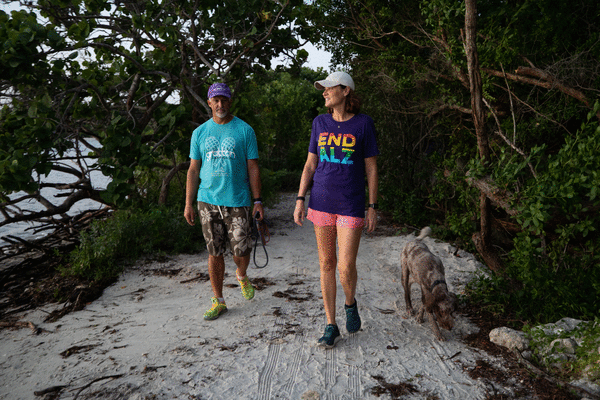
When Victoria Bayle was diagnosed with early onset Alzheimer’s disease at the age of 46, her neurologist gave her a prognosis of 10 years.
She didn’t know anyone in her family with the condition, nor were there medications she could take to slow the disease’s progression.
The resident of Edinboro, in Erie County, went on a road trip with her family a few years after her diagnosis and focused on spending as much time with them as she could — but she wasn’t sure how long she would be coherent for. Two more years, maybe six?
In 2024, Bayle, who is now 51, was approved for the drug lecanemab (brand name, Leqembi).
“I was very fortunate to be able to get Leqembi when I did,” she said, adding that her recent cognitive scores have improved.
She credits the drug — along with prioritizing good sleep, daily exercise and healthy food — as part of the reason she can still grocery shop on her own, drive short distances, and cook for herself and her family.
Lecanemab is in a class of drugs that pinpoints and destroys the amyloid-beta plaques that gum up the brain’s neurons and slow cognition. Because of the pace these drugs work at while the disease progresses, Leqembi is recommended only for patients with mild cognitive impairment — placing a ticking clock on the window of its success.
“The important part of all of this is early detection,” said Joseph Malone, division chief of cognitive neurology at West Virginia University’s Memory Health Clinic, where he oversees Alzheimer’s diagnoses and treatment.
A person who develops Alzheimer’s disease undergoes multiple stages of decline before the most profound type of dementia sets in. Scientists have discovered that the amyloid plaques and tau tangles, hallmarks of the disease, can begin ravaging the brain 20 years before a person shows symptoms.
Once they enter the stage of mild cognitive impairment — where they may have memory loss but not dementia that interferes with daily living — they’re eligible for drugs like Leqembi and are in a sweet spot for ideal outcomes from the medicine.
Let the disease progress, though, and prognosis drops.
“By the time you have mild dementia, tau is widespread,” said Riddhi Patira, a neurology professor at Pitt School of Medicine and a researcher and physician at the school’s Alzheimer’s Disease Research Center.
“So removing amyloid is not going to be enough. If you can stop both, then probably it's going to help,” she said. “You have to intervene early.”
Watching a family member progress into dementia can be agonizing — a reality Pennsylvania Rep. Kyle Mullins, D-Lackawanna, knows well.
His father was diagnosed with Amyotrophic Lateral Sclerosis (ALS) in 2020 and passed away last year from the disease.
Seeing his father deteriorate and grow more and more dependent on the medical system spurred Mullins to advocate for neurodegenerative diseases. He partnered with Republican counterpart Bryan Cutler, R-Lancaster, to devise legislation that could lessen the burden on families. Cutler lost both of his parents to ALS when he was younger.
“To have experienced and watched the decline of someone with Alzheimer’s disease, or ALS, it puts you in a club you never asked to be part of,” Mullins said. “We are doing everything we can to provide hope to those who will someday face a diagnosis.”
The pair were sponsors of legislation, House Bill 1754, which was signed into law in 2024 and requires private insurance companies and Medicaid to cover biomarker testing for Alzheimer’s and other conditions such as ALS and cancers.
But their follow-up bill to get insurance to cover treatment has stalled. House Bill 2734 was introduced late in the legislative session and was not voted on in time. Mullins, who is up for reelection, is the primary sponsor of the bill.
“If I have the honor of being reelected, it is my commitment to this being the first bill I reintroduce in the 2027 session,” Mullins said.
Bayle faced obstacles getting Leqembi covered by her insurance and instead reached out to the manufacturer for financial assistance. HB 2734, she said, could be “a huge step for identifying people who can benefit from treatment.
Victoria Bayle, left, attends a fundraising walk to Alzheimer’s.(Courtesy of Victoria Bayle)
“If we can get more people the medication and a quicker diagnosis, we can save lives,” she said. “We can lengthen lives. We can give people more time to prepare for their future.”
Malone, for one, has observed the benefit of these drugs. They keep patients stable and independent for years more than they would be otherwise, he said. But he and his team frequently get denials from insurance companies when they bill for drugs like Leqembi.
“They’re saying the medications are experimental, despite being out on the market for three years now and having four years of real-world clinical data, which is kind of absurd,” he said.
The headquarters for Biogen, which co-developed Leqembi.
Leqembi holds risks of brain bleeds and seizures, so patients are monitored regularly, and some are screened out because of their risk. Bayle said she receives frequent brain scans and has developed a close relationship with her team at the infusion clinic.
“We see there is a growing number of early onset Alzheimer’s patients out there, and these folks are kind of in a bind, because they’re on insurance that won’t cover for their medications,” said Malone.
Based on the knowledge that damage begins decades before symptoms start, Patira thinks patients should have access to these drugs even earlier.
“We should intervene before even symptoms begin, because there is this prodromal stage of 20 years, and that’s the missed window of opportunity,” she said. “Technology and science have tools to detect those with PET scans, and nowadays a blood test.”
Patients will see the most benefit if future technologies and medicines for Alzheimer’s are released in concert with rules for widespread access, said Patira. Current clinical trials for Alzheimer’s drugs at stage two — before mild cognitive impairment — are occurring, and scientists and regulators can prepare for that future now.
“In order to prepare the field to be ready when the drugs come for stage two, we have to have diagnostics already available,” she said.
©2026 PG Publishing Co. Visit at post-gazette.com. Distributed by Tribune Content Agency, LLC.






Comments