India's Jaishankar outlines key foreign policy objectives
Published in News & Features
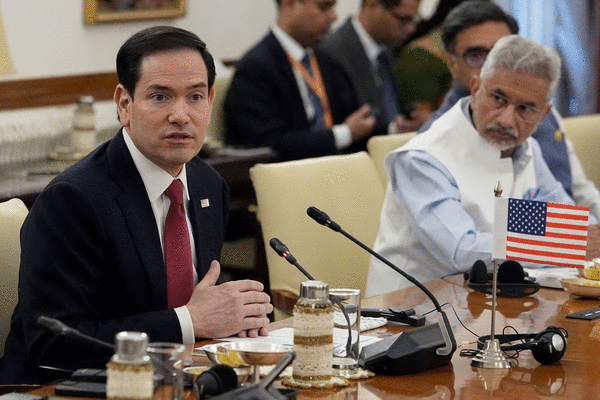
India’s External Affairs Minister Subrahmanyam Jaishankar laid out his country’s approach to some of its most consequential relationships in a wide-ranging interview with Bloomberg Editor in Chief John Micklethwait on Tuesday.
Jaishankar said India and China are exploring ways to make incremental progress on their long-running boundary dispute, while signaling optimism over trade negotiations with the U.S. and deeper ties with Europe. He also defended India’s relationship with Russia and called for guardrails around artificial intelligence.
Here are some key quotes from the conversation.
US Ties
“The reality is, the United States has repositioned itself. It’s changed the manner in which it engages the world, the basis on which it engages the world. So I think every country, in a way, has to recalculate and reset its relationship with the United States.”
“We are a country which has a strong strategic partnership with the U.S. But a strategic partnership is a partnership. It’s not an alliance.”
On the trade deal, Jaishankar said gradual progress is being made.
“I think people — the trade ministers, USTR there, and our commerce and industry minister, they are working on that. They are ironing it out. So my sense is that this is an issue which is heading towards a landing point.
“It’s heading in the right direction. We’re very encouraged by it. Please look at what my trade minister has been saying in public, saying that look, we are kind of almost there. We just need to figure this out.”
China relations
“If you want a normal relationship, if the rest of the relationship is to move, then it makes common sense. It’s a no-brainer that the boundary has to be stable.”
“As the border areas are settling down, and it has settled down to a great extent since 2024, the relationship commensurately is moving towards normalcy.”
“It’s not like we are not insisting that you have to solve the boundary issue in order to do business. What we are saying is, look, the bar is is lower. The bar is: please maintain peace and tranquility.”
However, on the economic relationship, challenges remain, he said.
“We do believe today that we are not getting a level playing field in China, in the manner in which we have given a level playing field to them.”
On the border dispute, Jaishankar mentioned the two sides are working toward an “early harvest” approach — settling some parts of the border first and tackling harder sections later.
“We’ve been tossing these ideas back and forth. How do you do it all at one go? And it’s an active conversation. So we are now looking at those possibilities, and we have to see where we go.”
But he then drew a clear firewall between the boundary talks and economic concessions.
“I wouldn’t link the early harvest to anything other than the boundary question resolution. Anything we do on any policy we have on business, on market access issues, etc., on investment, it will be dealt with separately.”
Russia’s choices
“I do believe it’s in our interest, and I believe in the world’s interest, that Russia has multiple choices, and that Russia has other relationships in Europe, in Asia, of great weight and consequence, and we are a natural, I would say option in that regard.”
Micklethwait explicitly asks whether Russia is becoming too dependent on China, and Jaishankar acknowledges the underlying shift before making the case for India as another option.
“The result of what has happened because of the Ukraine war is that Russia perforce has turned much more to Asia, and in Asia, obviously much of that is towards China.”
“We are reassuring Russia that something which has been built up over the last 75, 80 years remains steady. It’s an option that has worked for both of us.”
Europe trade
“Our hope, in a way, expectation is that we would be able to get this FTA entered into force by, you know, in the coming months, hopefully by the end of the year or early next year.”
“Europe itself is talking strategic autonomy. That’s music to our ears. I mean, they are moving to a position and place which we are very comfortable with.”
AI safety
“AI is, in that sense, mother of all technologies that we know so far.”
“It’s going to be far more pervasive. It’s going to be far more impactful on our everyday life, and it’s something in which everybody will have a stake.”
On regulation of AI, Jaishankar was clear about the need for guardrails.
“I think there’s a pretty good consensus on this, that yes, there should be regulation, there should be guardrails.”
“This must be made in a way much more accessible to people and much more available in their daily lives to their own comfort, not necessarily controlled by forces which on which they have no say.”
_____
©2026 Bloomberg L.P. Visit bloomberg.com. Distributed by Tribune Content Agency, LLC.



Comments